UC Berkeley and Project CETI study shows sperm whales communicate like humans, using vowel-like sounds
UC Berkeley and Project CETI research finds sperm whale clicks carry acoustic patterns resembling human vowel sounds, suggesting language-like structure; the study, led by linguists and aided by advanced AI, challenges prior “coda” comparisons to Morse code.
- A joint study by UC Berkeley and Project CETI finds sperm whale clicks carry acoustic patterns that resemble human vowel sounds, suggesting more language-like structure than previously thought.
- Berkeley Linguistics Professor Gašper Beguš led the work, which used machine learning tools to analyze extensive acoustic datasets.
- Project CETI supplies advanced AI, drones and non-invasive recording techniques; see also Project CETI — The Audacious Project profile.
- Reported machine-learning performance: 99.5% accuracy isolating clicks from noise, 97.5% accuracy in click pattern classification, and 95.3% accuracy in identifying dialects (source).
Why the finding matters
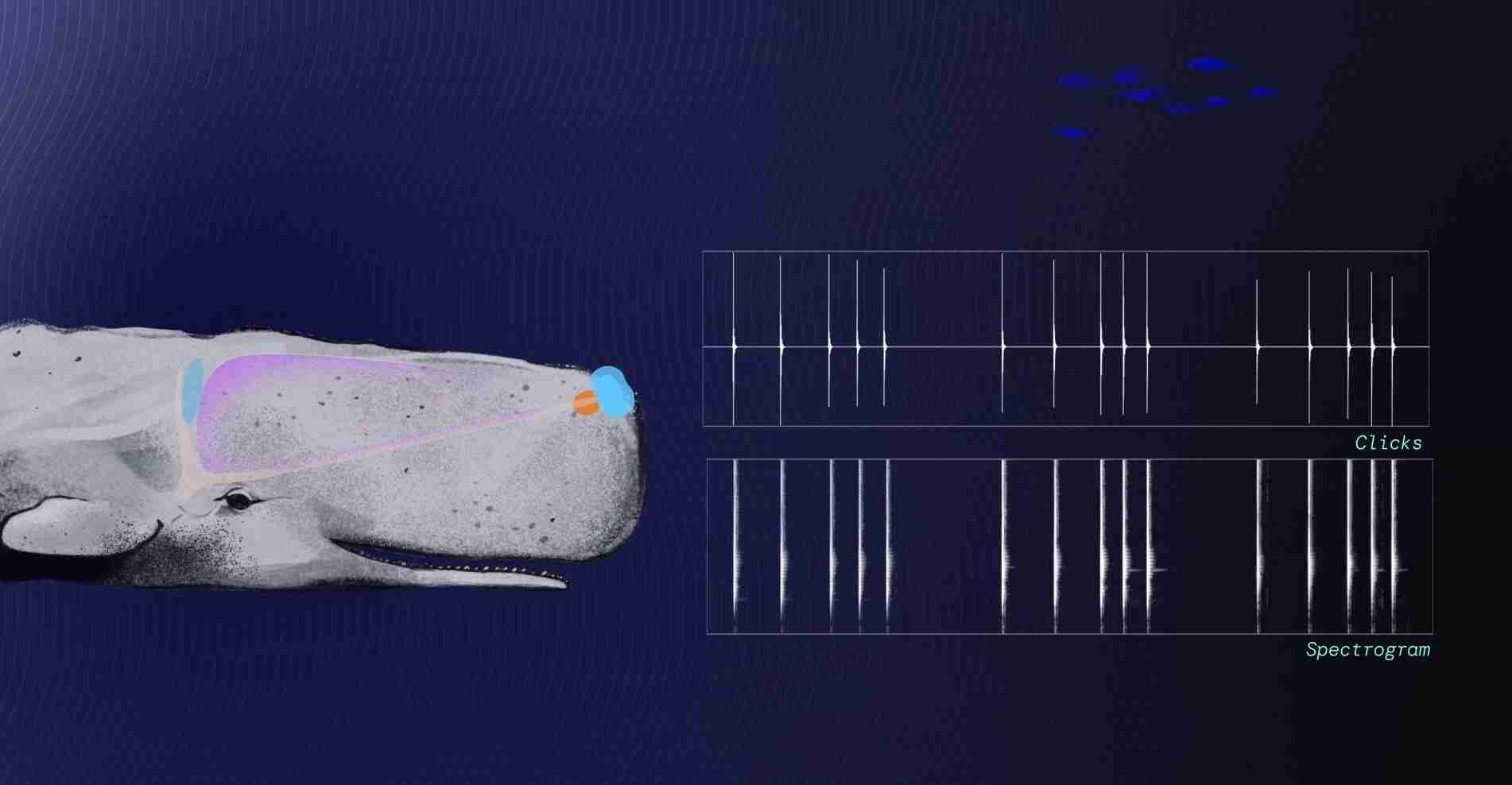
For decades, sperm whale vocalizations were described as strings of clicks called “codas”, often compared to Morse code. This study reframes those clicks as acoustically rich signals with steady spectral patterns. Researchers argue the clicks act like very, very slow vowels rather than short coded beeps, implying deeper parallels between whale communication and human speech systems.
Methods and evidence
The project combined linguistic expertise with unsupervised machine learning. UC Berkeley analyzed acoustic features of recorded sperm whale clicks while Project CETI supported large-scale data collection and computation. Field teams used aerial drones and array microphones to capture high-quality recordings from populations off Dominica and other monitored sites (Project CETI; Audacious Project).
Advanced algorithms sifted clicks from background noise with high precision. Unsupervised models revealed consistent acoustic elements across calls and groups; those elements map to sustained resonant frequencies that, in human speech, function similarly to vowels—helping structure sequences of sounds.
What researchers found about whale “dialects”
The team observed consistent differences in acoustic patterns between social groups—described as dialectal variation. These differences mirror human accents or dialects: similar building blocks arranged in group-specific ways. The presence of such structure strengthens the view that sperm whale vocalizations are organized systems rather than random click sequences (Project CETI; Audacious Project).
Role of artificial intelligence
AI was central. Unsupervised learning allowed detection of patterns without predefined categories, reducing human bias and revealing unexpected structure. Project CETI’s platform also supports supervised classifiers to separate clicks from noise and cluster calls by type and group. Reported accuracy rates—99.5% (click isolation), 97.5% (pattern classification), 95.3% (dialect identification)—lend statistical weight to the linguistic claims (source).
Collecting behavioral context—who is vocalizing, where, and during which actions—helps test whether acoustic patterns align with social signals such as coordination, identity signaling, or environmental information. Project CETI emphasizes non-invasive robotics and drones so sounds can be paired with behavior without disturbing whales (Project CETI).
Conservation and scientific implications
Recognizing complex communication in sperm whales could change conservation approaches. If groups hold culturally transmitted dialects and sophisticated social signaling, disruptions from shipping noise, fishing gear, or habitat loss risk damaging not just population numbers but culturally significant knowledge and social cohesion. Project CETI argues that understanding whale communication can sharpen conservation priorities (Audacious Project; Project CETI).
Policy and research funding perspectives
In California, where marine science and ocean policy are priorities, these findings support investment in marine acoustics, AI research, and protective measures. Federal and state agencies could consider acoustic data when setting shipping lanes, noise standards, and protected areas. Project CETI’s blend of private philanthropy and scientific partnership exemplifies one funding model for interdisciplinary, large-scale projects (Audacious Project; Project CETI).
Skepticism and scientific caution
Researchers caution against overinterpretation. Labeling clicks as “vowel-like” describes acoustic structure, not proof that whales possess human-like grammar or syntax. The study opens the possibility of deeper communicative structure, but demonstrating semantics or shared meaning across individuals will require extensive further work (UC Berkeley release).
Implications for California
- Economic: Improved understanding could boost ecotourism and research grants for Bay Area universities and tech partners, underpinned by Project CETI collaborations and funding profiles like The Audacious Project.
- Political: Lawmakers may face new pressure to adopt underwater noise regulations, vessel routing, and protected corridors based on acoustic evidence of complex social systems.
- Social and cultural: Coastal communities, museums, aquaria and schools could integrate findings into outreach and curriculum, reinforcing California’s science-based environmental values (UC Berkeley; Project CETI).
- Practical: State agencies and ports might pilot quieter ship technologies, adjust speeds in sensitive areas, and fund acoustic monitoring; UC campuses could expand AI–marine biology collaborations.
Sources and further reading
- UC Berkeley press release: “UC Berkeley and Project CETI study shows sperm whales communicate in ways similar to humans”
- Project CETI official site
- Project CETI profile — The Audacious Project
“Projects like this blend linguistics, AI and fieldwork to push the limits of what we know about other minds.”
Exploring whether sperm whales use vowel-like signals and whether those signals map onto structured communication will take time. This study marks an important step toward understanding complex animal communication and the potential for informed conservation and cross-species dialogue.