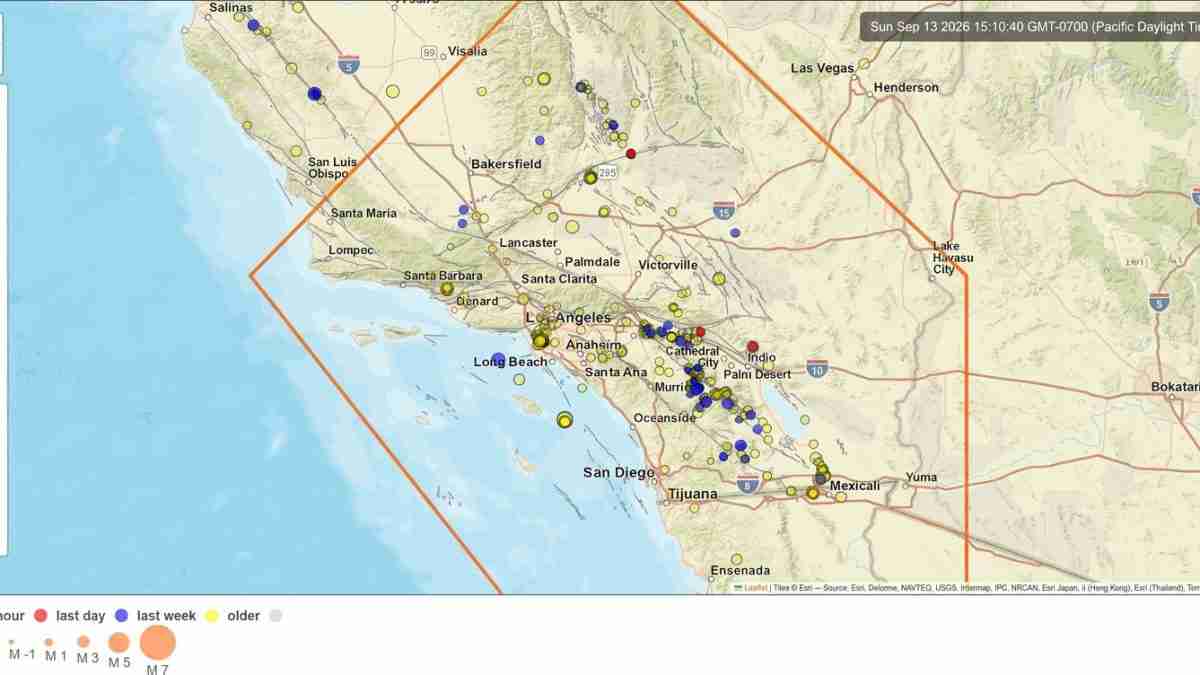
SOUTHERN CALIFORNIA, Sept. 14 (Our California Times) — A cluster of small earthquakes rattled parts of South Los Angeles over slightly more than 18 hours, with activity reported from about 8 p.m. Friday until 2:30 p.m. Saturday.
Reports citing U.S. Geological Survey earthquake records put the activity near Lennox and Westmont, with additional references to Hawthorne and Inglewood. The earthquakes ranged from magnitude 1.0 to 2.7. Some residents in nearby communities reported light shaking.
The exact number of earthquakes depends on which area and time period are counted. Fox Weather described the activity as dozens of earthquakes. Other reports citing USGS records counted about 90 events, while one NewsBreak report listed 93. The supplied reports do not establish whether those totals used the same boundaries, magnitude cutoff or version of the earthquake catalog.
Where did the earthquakes occur?
The reported cluster was near the Newport-Inglewood Fault Zone, a system of faults that crosses the Los Angeles region and extends toward Newport Beach before continuing offshore, according to a Temblor analysis based on USGS data.
But proximity does not establish which fault produced the earthquakes. One report said the specific fault or underground structure responsible for the sequence had not been confirmed. The available information also does not show that every earthquake in the larger counts occurred directly on a mapped segment of the Newport-Inglewood Fault Zone.
Communities where light shaking was reportedly noticed included Crenshaw, Huntington Park, Bell, West Adams, Mid-City and Gardena. Those accounts were not linked in the supplied material to named residents or to an official damage assessment.
What does a swarm mean?
An earthquake swarm is a group of earthquakes occurring in the same general area over a relatively short period. Unlike a typical sequence dominated by one clearly larger mainshock followed by smaller aftershocks, a swarm can include many small events without a single event standing out as the mainshock.
The reported sequence was made up of small earthquakes. Magnitude measures the energy released at the earthquake’s source; each whole-number increase represents a much larger release of energy. A magnitude 2.7 earthquake is still considered small, although earthquakes of that size can sometimes be felt close to the epicenter.
The available records do not establish whether the sequence has fully ended, whether it was caused by movement on a particular fault or whether it changed the region’s overall earthquake hazard. No official forecast, injury report, property-damage assessment or specific hazard statement was included in the supplied material.
What is certain — and what is not?
The strongest finding is that a short-lived cluster of small earthquakes was recorded in the South Los Angeles area. The timing and magnitude range were attributed to USGS records in the reports reviewed.
Less certain are the final event count and the source of the earthquakes. The differing totals may reflect different catalog snapshots or different geographic and time limits. The available material also contains no peer-reviewed study of this particular sequence, no named researcher’s analysis and no published statistical assessment of whether the activity signals a change in earthquake risk.
The sequence’s location near the Newport-Inglewood Fault Zone makes it relevant to Southern California’s seismic setting. It does not, by itself, demonstrate that the fault zone has become more dangerous or that a larger earthquake is imminent.