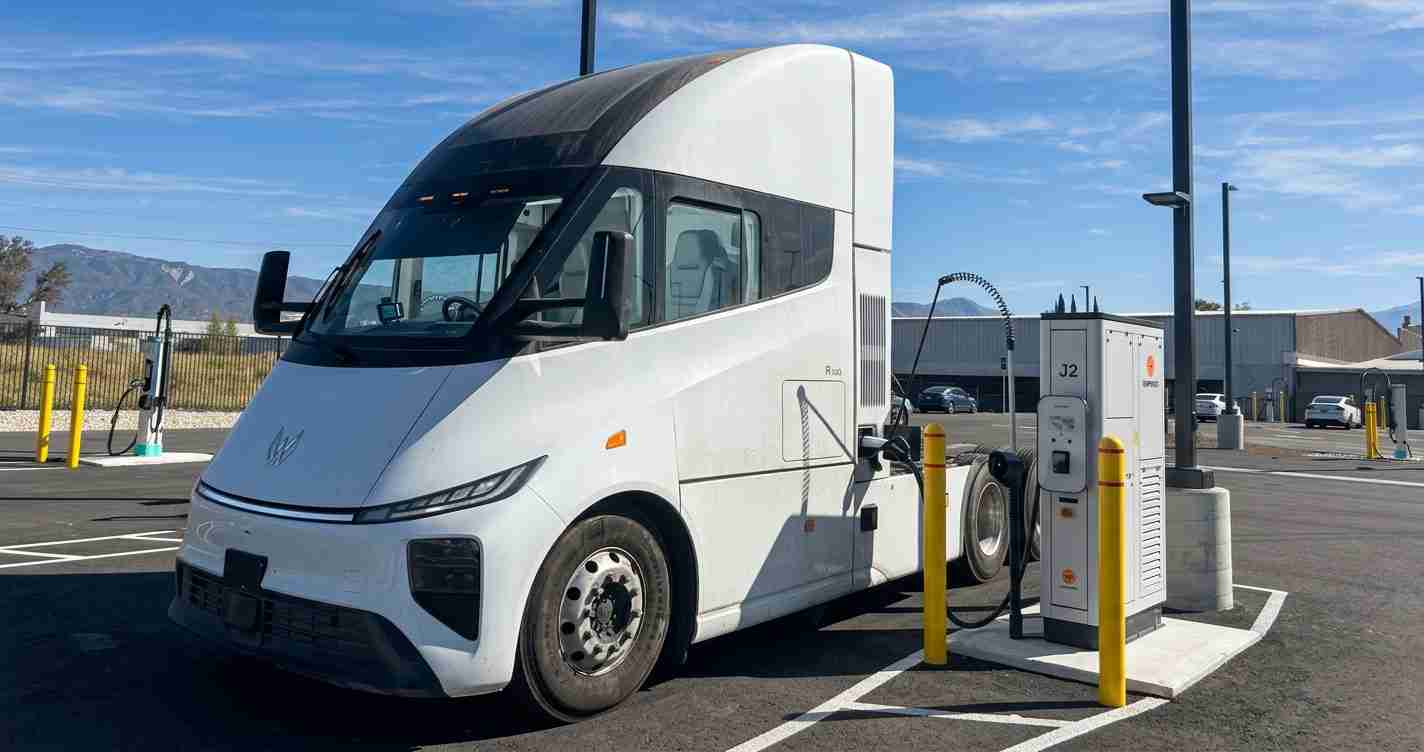
Kempower, Windrose and EV Realty complete North America’s first megawatt truck charge in San Bernardino, a major step for heavy-duty EVs
Lede: Kempower, Windrose and EV Realty completed North America’s first Megawatt Charging System session in San Bernardino, delivering up to 1.2 MW and 1,500 amps with liquid-cooled cables — a key advance for heavy-duty electric truck infrastructure.
Key takeaways
- First North American MCS test: Kempower, Windrose and EV Realty completed the inaugural MCS session at EV Realty’s San Bernardino hub (Electrek, ChargeDevs).
- Technical performance: A 1,200 kW Kempower Power Unit feeding two Mega Satellite MCS dispensers delivered up to 1.2 MW and 1,500 amps continuously using liquid-cooled cables (Electric Drives).
- Operational impact: MCS enables much faster charging, reduced downtime and more efficient fleet operations for long-range heavy-duty trucks (CalStart).
- California momentum: The San Bernardino site — opening April 2026 — complements other regional megawatt projects and utility upgrades supporting large-scale deployments (Electrive, CleanTrucking).
What happened at the San Bernardino test
Kempower’s Mega Satellite Megawatt Charging System session at EV Realty’s San Bernardino hub used a 1,200 kW Kempower Power Unit connected to two Mega Satellite dispensers. The combined setup delivered up to 1.2 MW and 1,500 amps continuously, using liquid-cooled cables to control cable temperature and maintain stable charging at these high power levels. Reporting and technical details were published by Electrek, ChargeDevs and Electric Drives.
Voices on the test
Suncheth Bhat, chief commercial officer at EV Realty: “We are building sites that can serve any heavy-duty truck, including those utilizing MCS. This test confirms that we will be ready for real-world MCS charging when the trucks hit the road later this year.” (Electrek)
Jed Routh, Kempower’s VP of markets and products: The milestone demonstrates interoperability and reliable delivery under regional conditions. (ChargeDevs)
Why the Megawatt Charging System matters
Heavy-duty electric trucks require far more power than passenger EV chargers provide. The MCS standard supports >1 MW — multiple times the output of typical DC fast chargers — enabling long-haul trucks to regain range much faster. Faster charging reduces fleet downtime, helps drivers meet tight delivery schedules and lets operators use fewer chargers per route, improving asset utilization and lowering operating costs (Electric Drives, Electrek, CalStart).
MCS uses robust cooling systems and high-amperage connectors to handle repeated high-power cycles without overheating. The San Bernardino session specifically demonstrated liquid-cooled cables managing heat during sustained high-power draws, a critical reliability feature for time-sensitive fleet operations (Electrek, ChargeDevs).
How this fits into a wider push
Kempower has been testing MCS in Europe with truckmakers and logistics firms for several months; San Bernardino marks the first documented North American real-world use and a step toward broader U.S. deployments (Electric Drives, Electrek).
Truckmakers are planning MCS-capable long-range models; the primary industry question has been where those trucks will recharge. EV Realty’s approach — building hubs capable of serving any heavy-duty truck, including MCS models — addresses that “where” problem and helps fleets plan routes around dependable charging hubs (Electrek).
Other California moves toward megawatt charging
California is seeing multiple heavy-duty charging projects: WattEV upgraded a San Bernardino depot for up to 200 trucks with megawatt charging; bp pulse and TA are advancing a Southern California hub with 750 kW Tesla MCS bays; WattEV’s I-10 expansion lists 11.5 MW of capacity. Programs such as CalStart’s EnergIIZE highlight MCS benefits and utility upgrade needs (Electrive, CleanTrucking, Automotive World, CalStart).
Operational details and what fleets can expect
The Kempower demonstration showed continuous delivery at 1,500 amps — the kind of charging speed required by very large battery packs on long-haul trucks. In real operations, fleets could see turnaround times drop sharply compared with existing slower chargers. That enables fewer reserve vehicles, smaller onsite fleets and reduced labor and idle costs per route, supporting fleet profitability for margin-sensitive operators (Electric Drives, Electrek).
Interoperability and standards: The MCS standard aims to let trucks from different manufacturers use the same chargers. Kempower’s North American session included real-world tests to prove cross-brand compatibility and stable power delivery; alignment on standards will let fleets plan routes with confidence (ChargeDevs).
Implications for California
Economic: Faster, reliable MCS hubs can lower operating costs for freight firms, reduce downtime and create construction and operations jobs when sites are built and staffed (Electrek, Electric Drives, CalStart).
Political: Demonstrations that MCS works in the field support policy decisions and public funding for heavy-duty EV infrastructure, while also highlighting permitting, siting and utility upgrade questions for local leaders (Electrek, CalStart).
Social: Ports, warehouses and logistics corridors in Southern California could see cleaner air and less diesel exposure if heavy-duty trucks electrify — benefits that depend on equitable siting and local hiring practices (Electric Drives, Automotive World).
Practical applications for residents and fleet managers
Fleets planning to buy MCS-capable trucks can point to EV Realty’s San Bernardino hub — scheduled to open in April 2026 — and other regional projects as concrete route-planning options. Utilities and charging operators must coordinate on power capacity and demand management to control costs and avoid grid strain; programs like CalStart’s EnergIIZE are working to align utilities and fleet needs (ChargeDevs, Electrek).
Reporting and sources
This article draws on statements and technical details from Kempower, Windrose and EV Realty and reporting from Electrek, ChargeDevs and Electric Drives. Additional context on regional projects and programs is available from CalStart, Electrive, CleanTrucking and Automotive World.