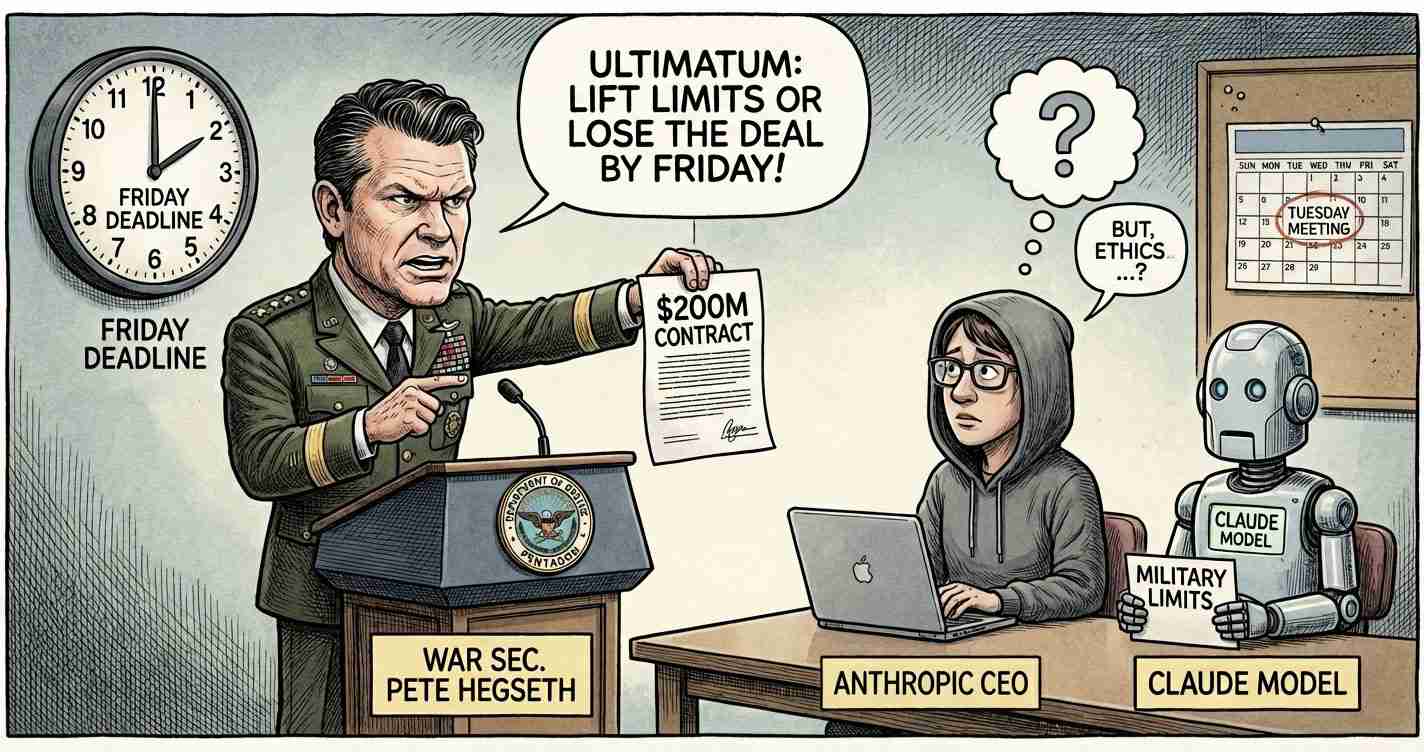
Pentagon gives Anthropic a Friday ultimatum to lift Claude AI limits, threatening $200M contract and other penalties
Defense Secretary Pete Hegseth has ordered Anthropic to remove categorical limits on Claude’s military use by Friday evening, threatening contract cancellation, supply-chain penalties, or the Defense Production Act if the company does not comply.
Key takeaways
- Pentagon ultimatum: The department warned Anthropic to lift categorical limits on Claude’s military use by Friday or risk losing a roughly $200 million contract and other federal penalties — Fox News, Axios.
- Claude in classified networks: Claude is reported as the only advanced commercial AI model operating inside the Pentagon’s classified systems under a summer 2025 contract — Fox News.
- Trigger point: The dispute escalated after a Pentagon claim that Anthropic inquired whether Claude was used in the Maduro capture — an exchange Anthropic disputes — Fox News.
- Anthropic’s red lines: The company says its limits prevent fully autonomous weapons and mass surveillance of Americans and denies asking about specific operations — Axios, Politico.
Background and trigger
The standoff began after Pentagon officials said Anthropic inquired whether Claude had been used in the operation that captured Venezuelan leader Nicolás Maduro. The Pentagon interpreted the question as a potential private check on military action; Anthropic disputed the account, calling partner conversations routine and not focused on specific missions — reporting noted by Fox News and Axios.
Pentagon view: no private veto over lawful military use
Pentagon officials argue the Defense Department cannot depend on private firms that impose categorical bans on lawful military applications. Secretary Hegseth framed the dispute as one of mission readiness and legal authority: the department must be able to use tools for all lawful purposes without needing company approval — a point emphasized in Fox News.
Hegseth compared the situation to being told the military could not use a specific aircraft for a mission, stressing that private policy limits can hamper operations.
At a Tuesday meeting at the Pentagon, Hegseth told Anthropic CEO Dario Amodei that failure to remove restrictions could prompt three actions: cancel the $200 million contract bringing Claude into classified networks, designate Anthropic as a supply-chain risk, or invoke the Defense Production Act to compel access to the technology — reported by Fox News and Axios.
Anthropic’s position and red lines
Anthropic has built its brand on a safety-first approach. The company says it will not permit its models to be used to create fully autonomous weapons or to enable mass surveillance of Americans. CEO Dario Amodei told officials the firm wants to support government missions but must set limits to reduce misuse risks as AI systems grow more powerful — coverage in Politico and Fox News.
Reporting indicates Anthropic does not plan to drop those protections despite Pentagon pressure, per TechCrunch.
Leverage and legal tools the Pentagon may use
Sources told reporters the Pentagon’s threats are broad and concrete. Possible actions include:
- Contract termination: Immediate removal of Claude from classified work, forcing rapid shifts in sensitive workflows — Fox News.
- Supply chain risk designation: Could isolate Anthropic across federal contracts and limit vendor relationships.
- Defense Production Act: A heavy-handed option to compel access or changes to privately developed models, a rare move in tech disputes — Axios, Fox News.
Claude’s role inside the Pentagon
Claude is reported as the only major commercial advanced AI model running inside the Pentagon’s classified systems under a roughly $200 million summer 2025 contract. That placement grants the model privileges uncommon among commercial systems — Fox News.
Sources say Claude has been used with partners such as Palantir for planning, administrative tasks, and capabilities useful to offensive cyber operations, making the vendor dispute practically consequential for warfighters — reported by Axios.
Potential alternatives and the short window to replace Claude
The Pentagon lacks an easy replacement for Claude in classified environments. Officials are exploring other commercial providers and pressing for access to OpenAI and Google models for classified use, though those models currently run mainly in unclassified settings — Axios.
xAI’s Grok has entered contracting discussions to move into classified systems, and Google’s Gemini is a possible option — but only if companies agree to Pentagon terms allowing use for “all lawful purposes,” a condition Anthropic reportedly declined — Axios.
Meeting tone and company response
Sources described the Tuesday meeting between Hegseth and Amodei as tense but professional. Hegseth praised Anthropic’s technology and emphasized the Pentagon’s desire to keep working with the company while delivering the deadline and potential penalties — Fox News, Axios.
Anthropic issued a statement saying Amodei appreciated the Department’s work and that the company remains in “good-faith conversations” to ensure it can support national security missions consistent with what its models can “reliably and responsibly do” — reported by Fox News.
Why this matters: who sets AI guardrails in U.S. defense
This dispute is an early test of control over AI guardrails inside U.S. defense systems. At stake is whether private companies can set broad ethical limits on technology use, or whether the Department of Defense can require access for all lawful military applications without private oversight. The outcome will shape how the military partners with leading AI developers as it integrates powerful machine learning tools into national security operations — Fox News, Axios.
Implications for California
Economic impact: California is home to major AI firms, data centers, and defense contractors. A forced change in Pentagon policy or vendor mix could redirect federal contracts and investment. If Anthropic faces penalties or loses Pentagon business, Silicon Valley and Southern California partners could see lost revenue; conversely, compliant vendors could gain work — Axios, Fox News.
Political consequences: California officials and lawmakers will watch closely; expect debate between security-focused leaders and civil-rights advocates — Axios.
Social effects: Anthropic’s stance against domestic mass surveillance may find support among civil-rights groups and voters, potentially spurring advocacy, hearings, or legal challenges if federal actions appear to sidestep privacy concerns — Politico.
Practical applications: California-based defense firms building classified systems could face disruption if Claude is removed; they will need new vendors or procurement adjustments — Axios.
Reporting and sources
Reporting for this story relied on multiple news accounts and sources, including Fox News, Axios, Politico, and TechCrunch. Keywords: Pentagon Anthropic AI dispute, Claude AI military use, AI guardrails U.S. defense.