Artemis II mission launch sends four astronauts on first crewed deep-space flight since Apollo, testing systems for future lunar landings
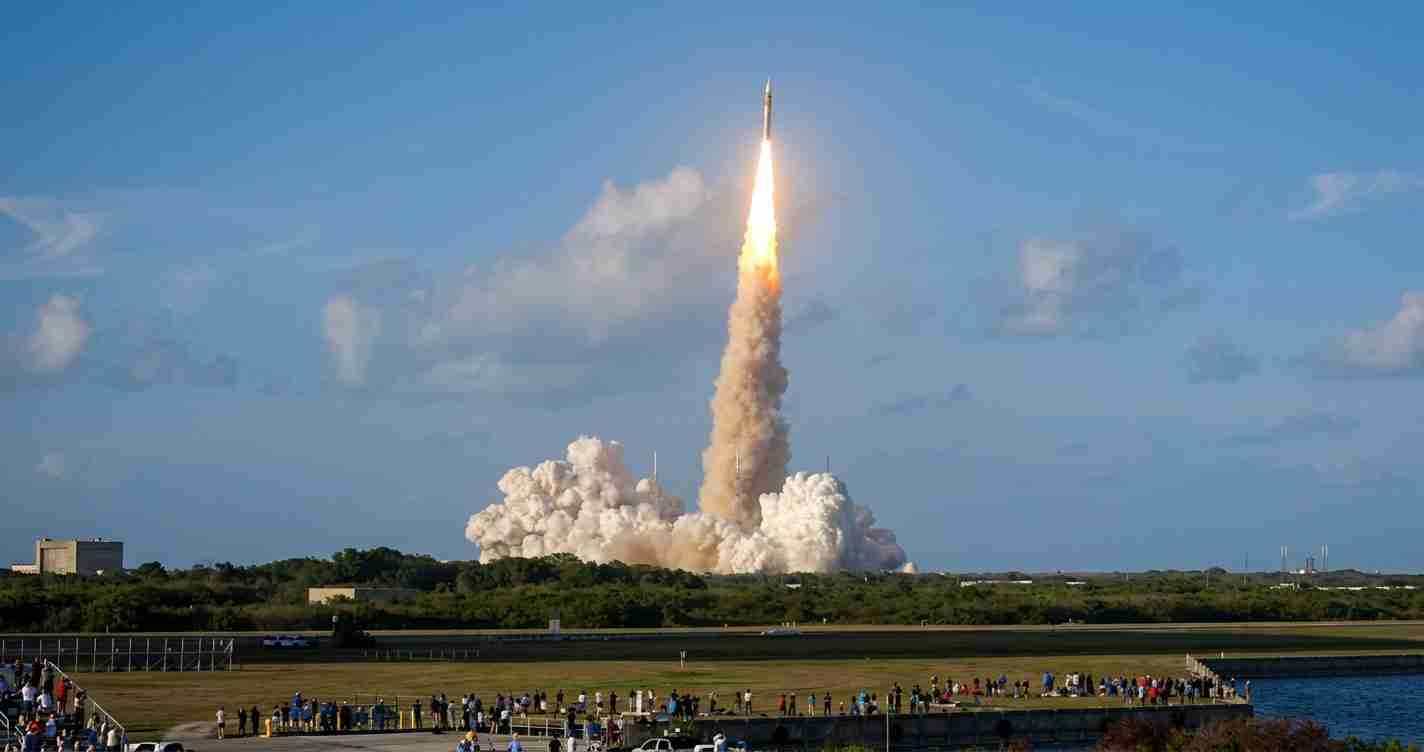
NASA’s Artemis II launched April 1, 2026, from Kennedy Space Center, sending four astronauts on a 10-day free-return lunar flyby — the first crewed deep‑space flight since Apollo — to test Orion systems ahead of future lunar landings.
- Historic return: First crewed deep-space flight since Apollo 17, launching April 1, 2026, from Kennedy Space Center Launch Complex 39B.
- Crew and mission: Commander Reid Wiseman, Pilot Victor Glover, Mission Specialists Christina Koch and Jeremy Hansen undertake a 10-day free-return lunar flyby to validate Orion and SLS.
- Systems validation: Flight will test life support, avionics, communications and radiation shielding ahead of planned Artemis IV and V lunar-landing missions in 2028.
- Public access: Real-time tracking via the Artemis Real-time Orbit Website and the NASA mobile app.
Launch and early flight: what happened
At 6:35:12 p.m. EDT on April 1, 2026, the Space Launch System (SLS) lifted the Artemis II stack from Kennedy Space Center Launch Complex 39B, accelerating the vehicle to supersonic speeds in roughly eight minutes. The core stage separated at mission elapsed time +00:08:14, and the Interim Cryogenic Propulsion Stage (ICPS) will place Orion into a high Earth orbit before a planned translunar departure burn.
Early onboard status: Minutes after liftoff the crew reported nominal conditions.
“We have a beautiful moonrise, we’re headed right at it,”
Commander Reid Wiseman said following liftoff. Orion’s solar arrays deployed successfully, providing power as the crew ran system checks during the first day in high Earth orbit.
If all systems perform as expected, Orion will execute the translunar burn on day two and follow a free-return trajectory that loops the spacecraft around the Moon and returns to Earth after about 10 days. Technical briefings and live updates are available via NASA’s mission channels and coverage resources.
Mission profile and milestones
Artemis II is a test flight rather than a lunar-orbit mission. Key mission milestones include:
- Day 1: High Earth orbit system checks for life support, avionics and communications.
- Day 2: Translunar burn to place Orion on a free‑return trajectory.
- Day 6 (approx.): Closest approach at roughly 8,000 kilometers from the lunar surface and the mission’s farthest distance from Earth — possibly including an eclipse as Orion passes behind the Moon.
- Day ~10: Earth return and reentry procedures.
Purpose: The flight validates systems for longer-duration missions and informs planning for Artemis IV and V, the latter expected to include crewed lunar landings in 2028. See mission details on the NASA Artemis II mission page and analysis from The Planetary Society.
Crew, diversity and expertise
The four-person crew — Commander Reid Wiseman, Pilot Victor Glover, Mission Specialists Christina Koch and Jeremy Hansen (Canadian Space Agency) — launched in the mission’s orange flight suits and posed together on Pad 39B ahead of liftoff. The mission carries notable firsts: Victor Glover is the first person of color and Christina Koch is the first woman to travel beyond low Earth orbit.
Team cohesion: Observers noted the crew’s strong teamwork. Planetary scientists and spectators at the Cape characterized the launch as a historic moment and an emotional return to deep‑space human exploration. As planetary scientist Lindy Elkins‑Tanton said, the crew “seem to have really bonded into a spectacular team.”
Technical background: SLS and Orion testing
Artemis II’s central technical objective is to validate the Space Launch System rocket and Orion spacecraft in a crewed, deep-space environment. The SLS provided the initial ascent energy and performed planned stage separations; Orion’s life support, avionics, communications and radiation‑mitigation systems will be exercised and monitored throughout the mission to demonstrate readiness for longer surface missions.
Monitoring during the mission focuses on:
- Life‑support performance under deep‑space conditions
- Navigation and guidance through translunar operations
- Communications latency and redundancy checks
- Radiation shielding effectiveness for crewed operations beyond low Earth orbit
Preparations and setbacks before liftoff
Artemis II experienced schedule slips earlier in 2026 after engineers detected hydrogen fuel leaks and a helium flow issue in the rocket’s upper stage. Those anomalies moved the target from early February to April 1 and required extensive troubleshooting and retesting by NASA and contractor teams. The rocket was rolled to Launch Pad 39B on March 19 following months of preparation and the 2024 delivery of the core stage.
Launch day procedures: Final terminal counts and checks included a brief T-minus 10-minute hold before liftoff; teams completed planned steps to clear the stack for ascent.
Public access and tracking
NASA provided live tracking so the public could follow the crew in real time. Viewers can monitor vehicle telemetry and flight-path data through the Artemis Real-time Orbit Website and the NASA mobile app. Media outlets and spacewatchers will closely follow Orion’s day‑one system checks and the critical translunar burn on day two.
Implications for California
Economic impact: California’s aerospace and defense sector — including manufacturers, suppliers and research labs — could see increased contract opportunities as Artemis progresses toward operational lunar missions. State firms that supply components for rockets, avionics and ground systems will be watching procurement cycles tied to Artemis IV and V.
Political consequences: The mission’s success is likely to shape federal budget debates and congressional support for NASA. California lawmakers representing districts with aerospace infrastructure may cite Artemis milestones to advocate continued investment in technology and defense programs.
Social and cultural effects: Educators and outreach programs across California can leverage Artemis II to boost STEM recruitment in universities, community colleges and K–12 programs. Museums and planetariums in Los Angeles, San Diego, San Jose and the Bay Area will likely host viewing events and talks. The mission’s diverse crew aligns with the state’s multicultural values, potentially broadening interest in space careers among underrepresented groups.
Practical applications for residents: Californians can follow Artemis II in real time using NASA’s tracking tools and attend local museum events tied to the mission. For those in aerospace supply chains, the mission’s progress may foreshadow contracting and hiring needs in coming months.
Ongoing scrutiny and what to watch next
Key checkpoints that will inform confidence in SLS and Orion hardware include the outcome of Orion’s day‑one checks, the translunar burn on day two, and the lunar close‑approach and farthest‑distance events near day six. Investigators and industry leaders will monitor any emerging technical issues and whether prior design or supply‑chain problems have been resolved.
For now, Artemis II represents a visible step toward returning humans to deep space and validates systems intended for upcoming lunar missions. Follow live updates and technical briefings through NASA’s official channels.