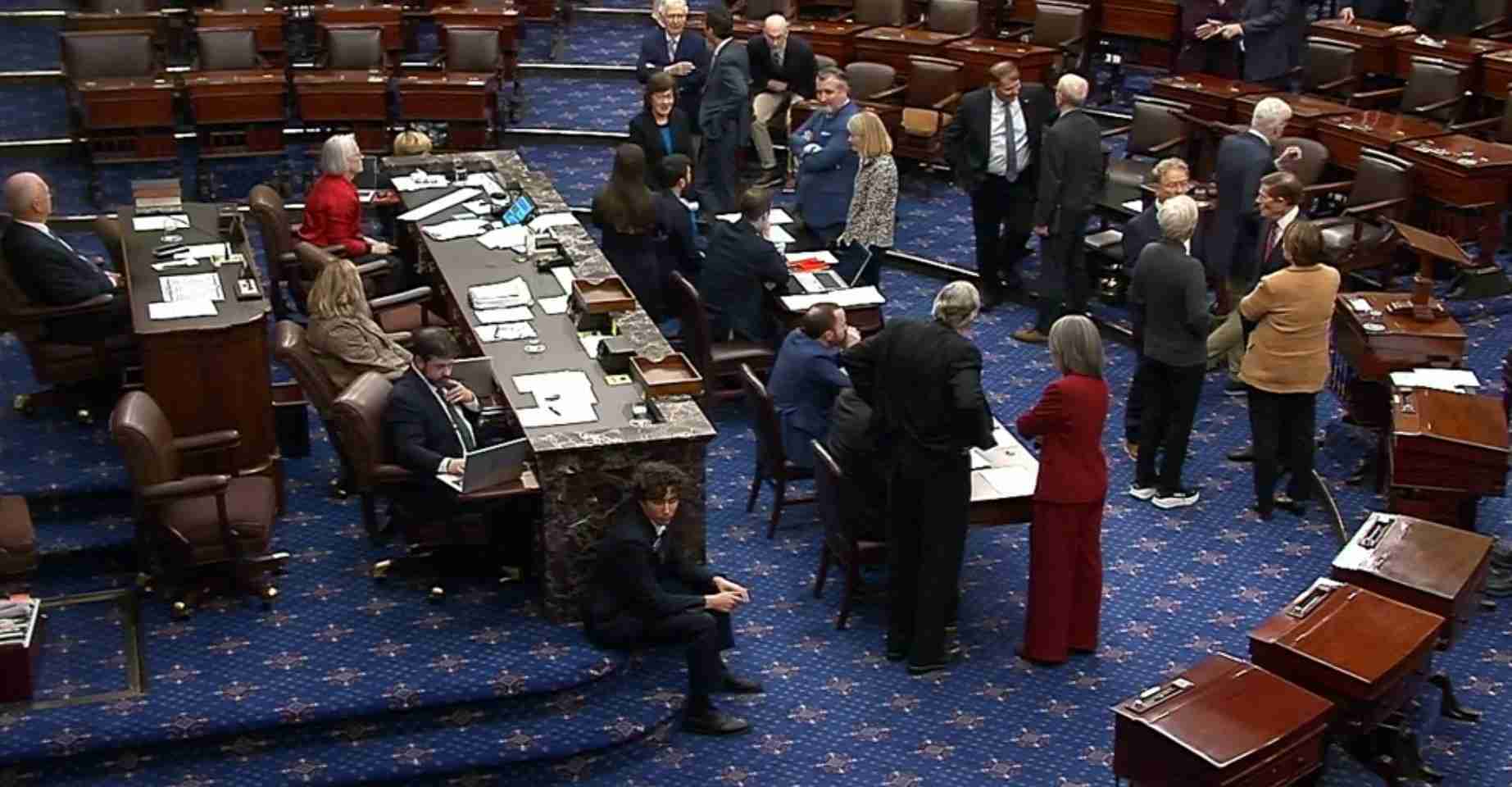
Senate advances short-term funding 60–40 as eight Democrats break ranks
Eight Senate Democrats broke ranks in a 60–40 cloture vote to advance H.R. 5371, moving to end a 40-day government shutdown while deferring a final decision on Affordable Care Act premium subsidies until December.
Key takeaways
- Cloture passed 60–40 to move H.R. 5371 forward, clearing the path toward reopening the government — Senate vote ; Senate vote.
- Eight Democrats crossed to join Republicans — a mix of moderates and those not facing 2026 re-election — enabling the threshold to be met (Crossing the aisle ; Crossing the aisle).
- No immediate extension of ACA premium subsidies — leaders agreed to a promised December vote instead (Obamacare subsidies ; Obamacare subsidies).
- Federal workers are guaranteed re-hiring and back pay if the House approves the bill and the President signs it (Protections for workers ; Protections for workers).
Key information
Senate vote: The Senate voted 60–40 to invoke cloture on the Motion to Proceed on H.R. 5371, the vehicle aimed at funding agencies and ending the shutdown — Senate vote ; Senate vote.
Crossing the aisle: Eight senators who caucus with Democrats joined Republicans: Durbin, Shaheen, Hassan, Kaine, Fetterman, Cortez Masto, Rosen and Angus King — reporting and roll calls noted the lineup (Crossing the aisle ; Crossing the aisle).
Obamacare subsidies: There is no ironclad guarantee in the short-term measure; leaders promised a December vote to decide whether to extend Affordable Care Act premium assistance (Obamacare subsidies ; Obamacare subsidies).
Protections for workers: The agreement guarantees re-hiring and back pay for laid-off federal employees if the House approves the measure and the President signs it (Protections for workers ; Protections for workers).
Next steps: The House must take up the Senate-passed bill; if approved and signed, agencies would reopen, air traffic control and SNAP benefits would resume, and federal employees would be paid (Next steps ; Next steps).
How the vote unfolded
Senate Majority and Minority leaders negotiated late into the weekend over short-term funding language. The cloture vote on the Motion to Proceed on H.R. 5371 reached the 60-vote threshold needed to move forward after eight senators who generally caucus with Democrats joined nearly all Republicans (roll-call reporting).
Those who crossed the aisle largely represent moderate constituencies or are not up for re-election in 2026 — factors cited by analysts as influencing their decision. The vote followed a string of failed attempts (at least 13 prior efforts by one count), which heightened public pressure on lawmakers to act (Mullin press release ; prior vote context).
Why Democrats crossed the aisle
Senators who voted to advance the bill framed the choice as a pragmatic step to restore services and get federal workers back to work. Supporters emphasized that the immediate harm of shuttered services — delayed permits, interrupted travel, unpaid workers — outweighed tying reopening to an immediate subsidy guarantee.
But the compromise does not resolve the subsidy fight. The Senate agreement explicitly defers a final decision on Affordable Care Act premium subsidies, scheduling a separate vote in December rather than including a binding extension in the short-term funding legislation (subsidy deferral ; subsidy deferral).
Political fallout inside the Democratic Party
Party tensions rose. Senate Minority Leader Chuck Schumer publicly denounced the late-night break and urged colleagues to continue fighting for subsidy protections. On the floor he was quoted saying,
“We will not give up this fight!”
— coverage of that exchange is available (Schumer floor coverage).
Other Democrats, including party whip Dick Durbin, prioritized immediate reopening and protections for federal workers over an explicit subsidy extension, calculating the political and practical trade-offs differently (different calculations).
The split raises questions about party discipline and messaging ahead of 2026: moderates may face criticism from progressives, while some voters reward lawmakers who restore basic government functions quickly.
Legislative mechanics and remaining hurdles
Passing cloture is an important step but not the final one. The House must consider and approve the Senate text of H.R. 5371 before it can reach the President. The Senate language funds some agencies through the fiscal year and others only until Jan. 30, 2026 — creating another deadline and a new bargaining platform (funding timetable).
A single senator can still delay Senate proceedings, and House amendments could reopen debate. Lawmakers agreed to return to ACA subsidies in December, keeping the dispute alive and setting up a consequential future fight for millions who rely on marketplace premium assistance (subsidy timeline ; subsidy timeline).
Who crossed party lines
- Dick Durbin (Illinois) — Democrat
- Jeanne Shaheen (New Hampshire) — Democrat
- Maggie Hassan (New Hampshire) — Democrat
- Tim Kaine (Virginia) — Democrat
- John Fetterman (Pennsylvania) — Democrat
- Catherine Cortez Masto (Nevada) — Democrat
- Jacky Rosen (Nevada) — Democrat
- Angus King (Maine) — Independent who caucuses with Democrats
Reopening mechanics and what would resume
If the House passes H.R. 5371 as approved by the Senate and the President signs it, most federal agencies would reopen and furloughed or laid-off federal employees would be paid and rehired. Essential functions disrupted by the shutdown — air traffic control, SNAP benefits, regulatory work — would resume (resumption of services ; resumption of services).
Implications for California
Economic impact: California, home to a large federal workforce, major ports and airports, and many industries tied to federal operations, would see faster return of paychecks and eased strain on supply chains as agencies reopen (economic impact).
Political consequences: The vote creates potential landmines for 2026 campaigns in California. Republicans may demand accountability for the shutdown’s length, while progressives will press for the December subsidy vote to protect marketplace assistance, including Covered California recipients.
Social effects: Reopening would restore SNAP and other benefits, reducing pressure on food banks and county assistance programs and bringing relief to low-income families and industries hit hard by the shutdown (social effects).
Cultural relevance: Californians expect federal support for public health, disaster response and environmental regulation; reopening restores cooperative channels needed during emergencies (cultural relevance).
Practical applications: Passports, permits, small-business loans and regulatory approvals are likely to resume quickly if the House approves the Senate text, reducing backlogs for Californians and businesses (practical applications ; practical applications).
What to watch next
- House action: Timing and any amendments in the House will determine how quickly agencies reopen (House schedule).
- December subsidy vote: Lawmakers must return to the ACA subsidy question in December; the outcome will shape health costs for millions, including many Californians (subsidy vote ; subsidy vote).
- Intra-party dynamics: How leadership manages the fallout and whether moderates face primary pressure will affect Democratic unity heading into 2026 (party dynamics ; party dynamics).
Sources
- Report.az — “US Senate breaks Democratic filibuster in key vote toward reopening government”
- Politico — “Government funding deal on track to advance Sunday night”
- News Jobaaj — “These 8 Senate Democrats vote to end US government shutdown”
- The Gateway Pundit — Schumer floor coverage
- Mullin Senate press release and prior vote context