Trump witnesses Thailand, Cambodia expand ceasefire in Kuala Lumpur Peace Accord as leaders pledge disarmament and observers
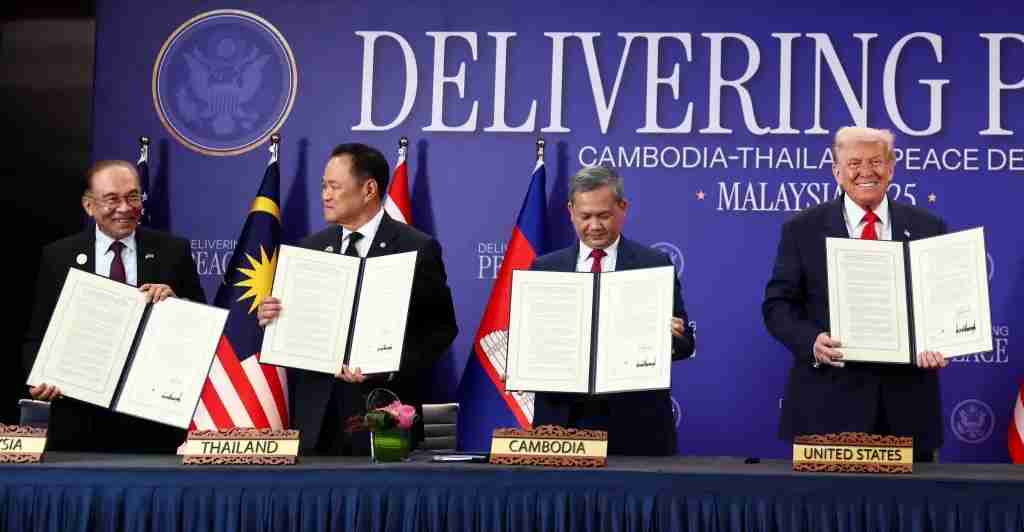
Thailand and Cambodia expanded a ceasefire into the Kuala Lumpur Peace Accord at the ASEAN Summit on October 26, 2025, witnessed by U.S. President Donald Trump, pledging disarmament, joint de-mining and an ASEAN Observer Team to monitor compliance.
Key takeaways
- Historic expansion: Cambodian PM Hun Manet and Thai PM Anutin Charnvirakul signed the Kuala Lumpur Peace Accord, witnessed by President Trump and regional mediators.
- Concrete terms: Immediate cessation of hostilities, release of detained soldiers, removal of heavy weapons, joint de-mining and deployment of an ASEAN Observer Team (AOT).
- Economic leverage: The U.S. tied trade and critical-minerals deals to the accord’s durability as an incentive for compliance.
- Open questions: Staffing, funding and verification of the AOT and weapons removal remain unresolved.
Main content
Background: a fast-escalating border crisis
The conflict between Thailand and Cambodia over disputed border areas intensified in 2025, peaking midyear with reports of dozens killed and hundreds of thousands displaced as clashes disrupted villages and trade. Malaysia, led by Prime Minister Anwar Ibrahim, helped broker an initial July ceasefire; the October agreement expands those terms into a broader political pact signed at the ASEAN Summit in Kuala Lumpur.
Key reporting and summaries on the conflict and the peace process are available from Channel News Asia, Fox News and an aggregated timeline on Wikipedia.
Terms of the Kuala Lumpur Peace Accord
The accord, publicly described as the Kuala Lumpur Peace Accord, sets out several practical commitments aimed at stabilizing the border and protecting civilians. Key provisions include:
- Full cessation of hostilities in the disputed border area.
- Release of 18 Cambodian soldiers who had been detained by Thai forces — an immediate confidence-building measure.
- Removal of heavy weapons from the border within a defined timeframe, with further talks planned on withdrawing other assets and clearing landmines.
- Joint de-mining operations to reduce civilian danger and enable the safe return of displaced people.
- Deployment of an ASEAN Observer Team (AOT) drawn from multiple member states to monitor implementation and report breaches.
- Mutual pledges to refrain from threats or use of force, pursue peaceful dispute settlement and respect international boundaries and law.
These terms are summarized in official and media coverage, including a joint declaration published by the White House and reporting by Channel News Asia.
Role of outside mediators and the United States
The October ceremony was notable for U.S. President Donald Trump presiding over the signing. Both Cambodian and Thai leaders, as well as Malaysia’s prime minister, credited Trump with exerting pressure toward settlement. Media reporting notes he used diplomatic leverage — reportedly including threats of tariffs — in talks leading to the accord (Channel News Asia).
Regional diplomacy was also central. Malaysia’s mediation early in the crisis paved the way for the July ceasefire and the expanded October terms. Observers note that both China and the U.S. have strategic interests in Southeast Asia; envoys from both powers engaged in parts of the peace process before the ceremony (Wikipedia).
Enforcement, monitoring and practical steps
Beyond signing a declaration, the accord lists practical steps intended to make the peace durable. Among them:
- Rapid weapons removal: heavy weapons are to be pulled back quickly, with a cited three-week target in prior discussions.
- Joint de-mining: operations are planned to reduce civilian risk and reopen safe movement.
- AOT monitoring: the ASEAN Observer Team will verify compliance, report breaches and reduce risk of renewed clashes.
- Practical measures: earlier talks referenced tackling cross-border online scams, normalizing control of key disputed areas, and resuming selected economic exchanges.
These implementation measures are outlined in combined media and official accounts, including Channel News Asia, the White House joint declaration and background timelines (Wikipedia).
Leaders’ statements and political signals
Hun Manet said removing weapons from the border demonstrates a willingness to sustain peace, while Anutin Charnvirakul pledged to implement the declaration “in good faith.”
“We will implement the declaration in good faith,” — Thai Prime Minister Anutin Charnvirakul (reported by Channel News Asia).
Cambodia announced it would nominate President Trump for a Nobel Peace Prize for his mediation role — a note recorded in public summaries (Wikipedia).
The ceremony also carried geopolitical signaling: reporting indicates Trump’s attendance was conditioned on the ceremonial signing and on China not participating in that specific ceremony, underscoring broader rivalry dynamics at ASEAN forums (Channel News Asia).
Economic incentives tied to peace
U.S. officials signaled that trade and critical-minerals pacts with Cambodia and Thailand would advance only if peace holds, explicitly linking market access and resource deals to security. For countries seeking investment and export opportunities, these conditional arrangements create material incentives for compliance (Channel News Asia).
Sources and media reporting
Key coverage and official documents include reporting from Channel News Asia, a Fox News report, and a joint declaration released by the White House. Background chronology is summarized on Wikipedia.
Questions that remain
An investigative view must note outstanding gaps:
- How will the AOT be staffed, funded and which ASEAN members will supply observers?
- What rules of engagement will observers follow, and how will violations be verified and remedied?
- Will weapons removal be independently verifiable and sustained beyond initial timelines?
- How will landmine clearance be funded and prioritized, and who will coordinate reconstruction and humanitarian support?
- How precisely will trade and mineral deals be conditioned and enforced if breaches occur?
Implications for California
Economic: California businesses could see indirect benefits if U.S. trade and critical-minerals deals with Thailand and Cambodia proceed — diversifying supply chains for electronics and clean-energy minerals that matter to tech and battery industries.
Security and geopolitical: A stable Southeast Asia aligns with U.S. strategic interests; California hosts major ports and logistics hubs tied to Indo-Pacific operations. Reduced regional conflict lowers risks of broader disruption to naval, air and commercial logistics.
Immigration and humanitarian: A durable peace could reduce refugee flows and shift NGO needs from emergency relief toward reconstruction and de-mining assistance, affecting local resettlement programs and community ties.
Investment: Peace may open opportunities for California investors in infrastructure, mining and technology projects in Thailand and Cambodia.
Practical applications for residents include steadier supply chains for imported goods, fewer price shocks for electronics and apparel, and improved safety for relatives in the region.
Reporting note
This article draws on coverage from Channel News Asia, Fox News, the White House joint declaration and background summaries on Wikipedia. Further verification and reporting on AOT deployment, weapons-removal verification and implementation timelines are ongoing.