Air Canada Express collision at LaGuardia kills two pilots, dozens injured; NTSB recovers cockpit recorder as runway incursion probe begins
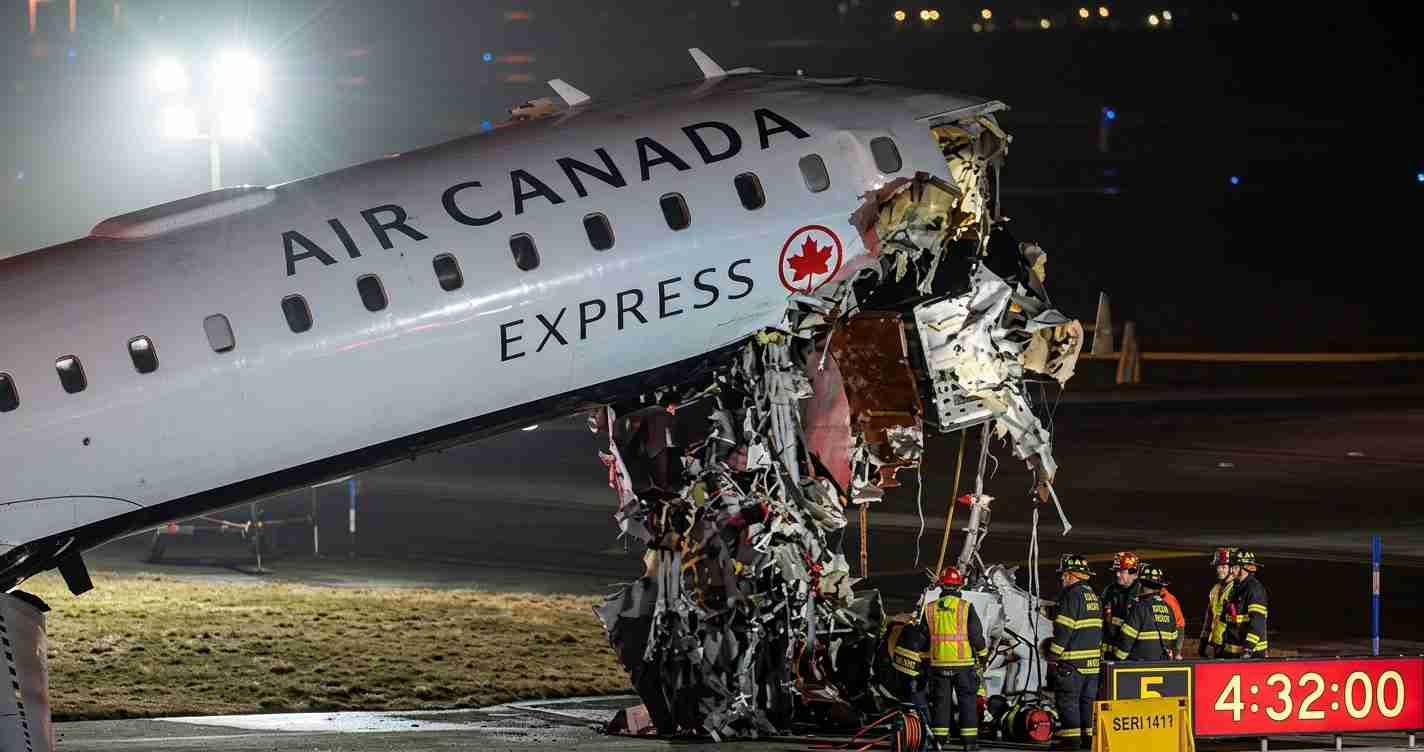
Two pilots were killed and dozens injured when Air Canada Express Flight 8646 collided with a Port Authority ARFF truck on LaGuardia Airport’s Runway 4 late March 22, 2026, closing the airport and prompting an NTSB investigation into a runway incursion.
Key takeaways
- Fatalities and injuries: The captain and first officer were killed; more than 39 people—including passengers, crew and two Port Authority firefighters—were hospitalized, with at least 32 released.
- Aircraft involved: Air Canada Express Flight 8646 (CRJ-900, operated by Jazz Aviation) arriving from Montreal.
- Investigation status: The NTSB recovered an intact cockpit voice recorder (CVR) and began work on the flight data recorder (FDR); investigators are reviewing surveillance, ATC and surface-detection replays.
- Operational impact: LaGuardia closed under an FAA ground stop; debris and wreckage removal will delay full reopening and cause cascading disruptions.
What happened
Officials say the CRJ-900 was rolling out on Runway 4 after touchdown when it struck a Port Authority Aircraft Rescue and Firefighting (ARFF) truck that had been deployed earlier. The truck had been responding to a separate incident—another aircraft reported an odor and made a rejected takeoff—prompting the ARFF dispatch. Eyewitness accounts and early reports describe a severe impact that ripped off the plane’s nose and left debris strewn across runways and taxiways. The timing and location are reported as roughly 11:45–11:47 p.m. ET, March 22, 2026 (Runway 4 timing and location).
Impact speed and positions
Reports differ on impact speed: some accounts describe lower taxi/rollout speeds while others cite much higher numbers. Investigators expect the FDR and surveillance replays to clarify the aircraft’s speed and the precise positions of both the aircraft and the ARFF truck in the moments before impact (speed analysis and FDR expectations).
Casualties and emergency response
The Port Authority confirmed two ARFF officers were injured and taken to hospital. Dozens of passengers and crew were treated at local hospitals; at least 32 patients have been released, though several hospitalized suffered serious injuries such as broken bones. U.S. Transportation Secretary Sean Duffy’s office confirmed multiple injuries among passengers, crew and firefighters. The identities of the two pilots killed have not been released (casualty and hospital updates).
First responders used specialized equipment to access the cockpit; to retrieve the recorders, crews cut a hole in the aircraft roof. Port Authority and airline personnel coordinated with hospitals and federal agencies to account for passengers and manage logistics at the scene (rescue and recovery actions).
NTSB investigation and early findings
NTSB Chair Jennifer Homendy said the cockpit voice recorder “was not damaged” and was transported to Washington, D.C. for analysis. Work on the flight data recorder began Tuesday; investigators hope the FDR will show the aircraft’s and truck’s positions in the seconds before impact. The agency is collecting surveillance footage, air traffic control data and a replay of the airport surface detection system used by controllers (NTSB statements and actions).
Audio captured by ATC recordings reportedly includes an air traffic controller shouting, “Truck 1, stop, stop, stop!” before impact; the NTSB plans to interview controllers as part of the probe.
Investigators will examine whether procedural, equipment, communication, or training lapses contributed to what officials are categorizing as a runway incursion—an unauthorized vehicle or person on an active runway (runway incursion context).
Why runway incursions matter
Runway incursions are among the most serious threats to aviation safety. They involve complex systems—air traffic control procedures, ground vehicle dispatch protocols, airport layout and lighting, radio communications, and human factors under stress. The NTSB will review whether the ARFF truck had proper clearance, whether controllers knew its position, and whether ground radar and automated alerts functioned as intended. The FAA is assisting the NTSB in the probe (FAA and NTSB coordination).
Operational disruption and broader effects
LaGuardia, one of the nation’s busiest airports, was shut down under an FAA ground stop that delayed or rerouted flights nationwide. The closure and partial reopening disrupted travel and created cascading airline and airport costs. Investigators describe the wreckage and debris field as extensive, meaning recovery and forensics will slow the return to normal operations (operational impact reporting).
Accountability and questions ahead
Officials face immediate questions about training, communication and systems: Why was an ARFF truck on an active runway at that time? Did controllers clearly communicate movements? Were visual aids, lighting and surface movement radar operating properly? Regulators and airport authorities will seek answers to assign responsibility and to prevent future tragedies. Families of the deceased and injured will expect a transparent, timely investigation and clear public-safety actions (questions and accountability).
Implications for California
Economic and travel impact
California travelers often pass through East Coast hubs; disruptions at LaGuardia can ripple across nationwide schedules. Delays, cancellations and aircraft repositioning raise costs for airlines and may affect fares and on-time performance for California routes. Airports and carriers in California should prepare for schedule shifts and increased customer-service demand (impact on connecting traffic).
Safety and policy consequences
The investigation will prompt federal and local scrutiny of runway-incursion prevention systems that affect California airports. State aviation officials should review ARFF protocols, controller communications, surface guidance and technology investments such as ground surveillance and automated alerts. Any federal recommendations could lead to new training requirements or equipment mandates with budgetary implications for airport operators and possibly local taxpayers (policy and safety implications).
Emergency response and preparedness
California’s large airports regularly train for aircraft incidents. This crash underscores the need for coordinated drills including ARFF crews, air traffic control, airport operations and local hospitals. Regional trauma networks should review protocols because hospitals may receive redirected patients during East Coast incidents (preparedness and response notes).
Political and regulatory considerations
For a politically moderate conservative audience in California, emphasis will likely be on effective, accountable action rather than expanded bureaucracy. Expect calls for practical, data-driven fixes: clearer clearance protocols, better use of approved technology, targeted training, and transparent timelines for changes—balancing public safety gains against costs and operational impacts (political and regulatory context).
What to watch next
- NTSB updates on FDR and CVR analysis.
- FAA guidance or safety directives resulting from the probe.
- Port Authority findings about ground operations and ARFF dispatch protocols.
- California airport advisories and local reviews of procedures based on lessons from LaGuardia.
Sources and documentation
This article is based on official statements and reporting from federal and local authorities and multiple news outlets, including live updates and briefings from the NTSB, Port Authority, FAA and the airline. Key reporting sources include: