Tiny, Glowing Shark Found in Gulf of Mexico Identified as New Species — the American Pocket Shark
Researchers from NOAA and Tulane University identified a new species in the Gulf of Mexico: the tiny, bioluminescent Mollisquama mississippiensis (American pocket shark), a 14 cm deep‑sea shark formally described in 2019 from a 2010 specimen.
- New species: Mollisquama mississippiensis, the American pocket shark — a 14 cm, bioluminescent deep‑sea shark.
- Extremely rare: One of only two pocket shark specimens known; the other was found off Chile in 1979.
- Unique traits: Glandular “pockets” near the gills that may secrete luminous fluid, plus body photophores.
- Discovery timeline: Collected in 2010, first examined 2013, formally described in 2019 using X‑ray and CT imaging.
Discovery and identification
How it was found: Scientists collected the specimen during a 2010 research cruise studying sperm whales in the Gulf of Mexico. The preserved animal was later examined at NOAA laboratories, where features inconsistent with known species became apparent.
Initial work at NOAA in 2013 suggested the specimen belonged to the pocket shark group (family Dalatiidae). Researchers from Tulane University news release, NOAA, the University of Florida and the American Museum of Natural History collaborated to analyze the specimen and published a formal description in 2019 naming it Mollisquama mississippiensis.
The team employed detailed anatomical study and modern imaging tools — including X‑rays and high‑resolution CT scans — to examine skeletal features, vertebral counts and internal structures. These methods confirmed distinctive traits that supported classification as a new species.
Physical characteristics and bioluminescence
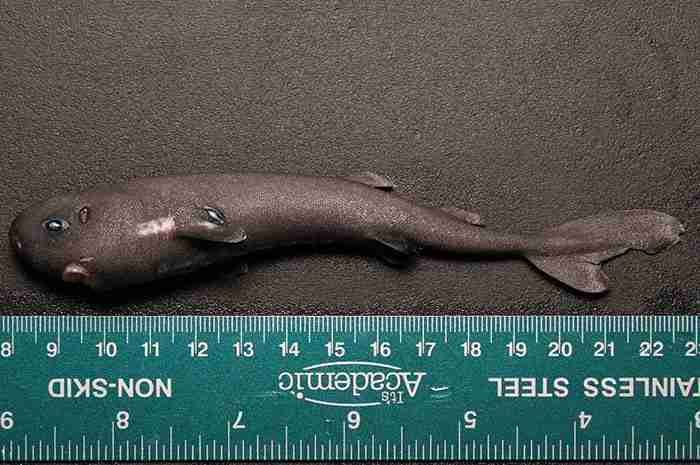
Size & appearance: The American pocket shark measures roughly 14 cm (5.5 inches), about the size of a human hand. It is grey with darker fins and cream‑colored areas near the gills, and has a somewhat bulbous head relative to its body.
Bioluminescent features: The species bears glandular “pockets” near the pectoral fins that can secrete a luminous fluid and clusters of photophores across the body. Scientists hypothesize the light may aid in hunting, camouflage or communication, though the precise function remains unknown.
“The pockets and photophores represent extreme specialization for life in near‑dark deep waters.”
Taxonomy and rarity
Family: Dalatiidae (kitefin sharks). Prior to this discovery, the genus Mollisquama included only M. parini, found off Chile in 1979. The American pocket shark differs from M. parini in body shape, vertebrae count and photophore patterns. Known specimens: Only one specimen of M. mississippiensis has been recorded, making assessment of population size, distribution, life history and conservation status impossible at present. Finding a new species in the well‑studied Gulf of Mexico underscores how much of the deep ocean remains undocumented. The discovery highlights the value of targeted sampling, advanced imaging and interinstitutional collaboration to reveal cryptic biodiversity. Studying this shark’s pockets and photophores may provide insight into deep‑sea adaptations, evolution of bioluminescence and roles of small predators within deep ocean food webs. Because only a single specimen is known, conservation status cannot be determined. Deep‑sea species face poorly quantified threats — habitat disturbance, bycatch and climate‑driven changes in deep‑ocean conditions among them. Recommended next steps: Economic and research opportunities: Although the American pocket shark is a Gulf of Mexico species, the find demonstrates the payoff from investing in modern imaging, targeted deep‑sea surveys and university–agency partnerships — strategies California institutions can adopt to document Pacific deep‑sea biodiversity. Policy perspective: For pragmatic policymakers, the discovery supports targeted, cost‑effective funding for marine science programs, telemetry and cooperative research that can yield measurable returns such as grants, job creation and technological advances. Public engagement: Museums, aquaria and outreach programs can leverage this story to boost science literacy, explain bioluminescence, and encourage stewardship. The narrative also aligns with California’s strengths in marine technology and biotech, suggesting possible translation of natural adaptations into innovation. Reporting by Times Media Service; research led by NOAA and Tulane University; sources cited above.Scientific and ecological significance
Conservation, data gaps and research needs
Implications for California
Sources and further reading