
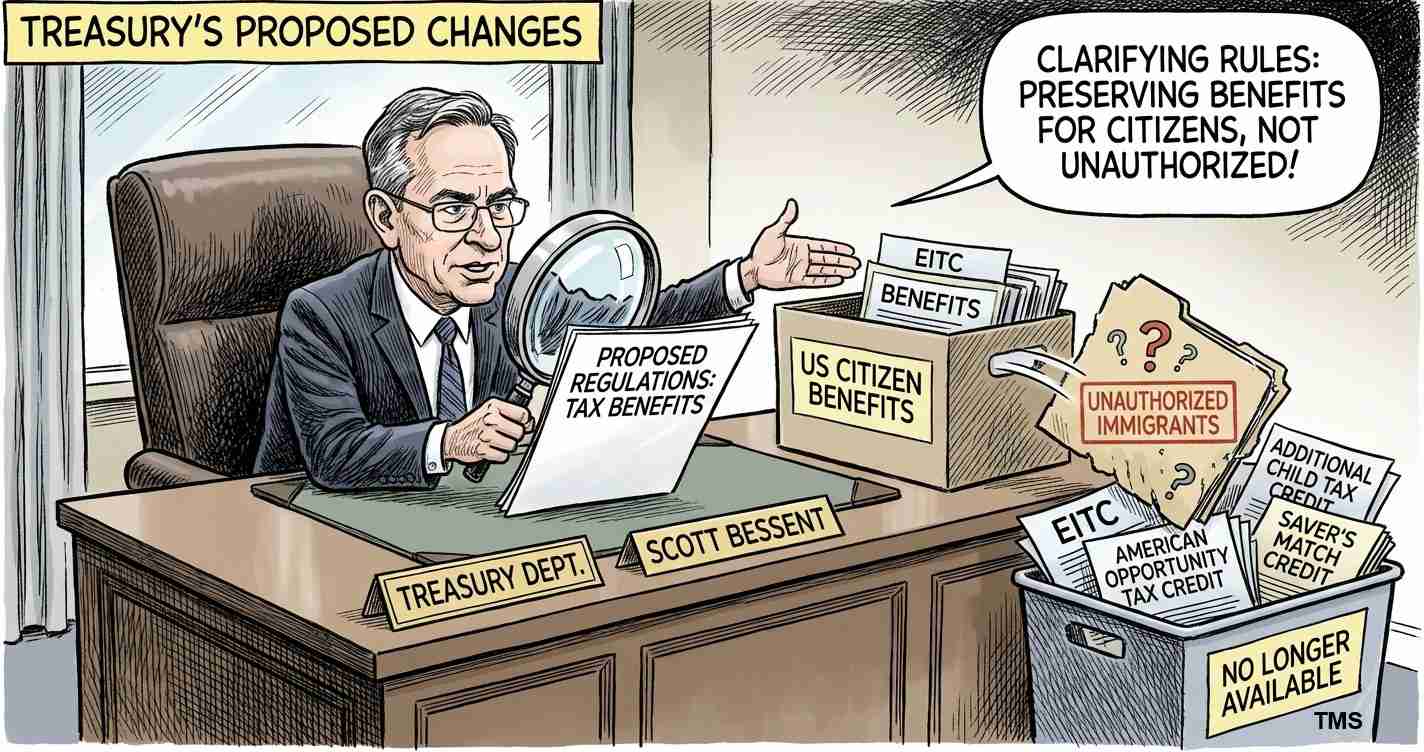
Treasury to Reclassify Refundable Tax Credits as “Federal Public Benefits,” Aiming to Bar Undocumented Immigrants
On November 28, 2025, Treasury Secretary Scott Bessent announced plans to reclassify refundable tax credits as “federal public benefits,” which would bar undocumented immigrants from receiving refunds beginning in tax year 2026 under proposed regulations.
Key takeaways
- Treasury will propose rules to treat refundable portions of certain tax credits as federal public benefits, potentially barring unauthorized and other non‑qualified aliens from those refunds (Fox Business; ABC News).
- Targeted refundable credits include the Earned Income Tax Credit (EITC), Additional Child Tax Credit (ACTC), American Opportunity Tax Credit and Saver’s Match Credit (Fox Business).
- Rulemaking and timing: proposed regulations will be published for public comment and, if finalized, take effect for tax year 2026 (Fox Business; ABC News).
Main content
Key information
Treasury officials said they plan to issue proposed regulations that would reclassify the refundable portions of specific tax credits as federal public benefits, which would make those refunded amounts unavailable to people who do not qualify as U.S. citizens, lawful permanent residents or other authorized immigrants under existing immigration rules. The department identified the credits targeted as the Earned Income Tax Credit (EITC), the Additional Child Tax Credit (ACTC), the American Opportunity Tax Credit and the Saver’s Match Credit (Fox Business).
Treasury says the change would apply starting in tax year 2026 after a public notice-and-comment period, and that the department sought and received an Office of Legal Counsel opinion that the refundable portions of these credits qualify as federal public benefits (ABC News).
Policy details and scope
Refundable credits differ from tax deductions: they can produce a payment to a filer even when tax liability is zero. The Treasury’s proposal focuses specifically on the refundable portion of each credit. Under the planned change, an undocumented filer could still claim nonrefundable benefits that reduce tax liability, but would not receive cash refunds tied to these credits if reclassified as public benefits (ABC News).
Implementation timeline and legal foundation
Treasury officials said the proposed rules will be published for public comment and that any final regulation would take effect for tax year 2026, giving taxpayers, tax professionals and advocacy groups time to respond during the rulemaking period (Fox Business).
The move is grounded in an opinion obtained from the Justice Department’s Office of Legal Counsel (OLC), which advised that refundable portions of certain tax credits fall under the statutory definition of federal public benefit. Treasury officials say they relied on that opinion in shaping the proposed regulation (ABC News).
Administration messaging
Bessent framed the action as protecting taxpayers and ensuring benefits go only to those legally entitled to them. He wrote on social media, “we are working to cut off federal benefits to illegal aliens and preserve them for U.S. Citizens,” describing the step as part of the administration’s effort to “uphold the integrity of our tax system.” (Fox Business)
Financial system enforcement
Separately, Treasury’s Financial Crimes Enforcement Network (FinCEN) issued an alert aimed at banks and money‑service businesses to watch for transactions that may involve unlawfully obtained income or misuse of financial services by people without legal status. The notice reiterates existing obligations for suspicious activity reporting and signals increased scrutiny of flows tied to unauthorized work or other illicit activity (Fox Business).
Under current reporting rules, money services businesses must file suspicious activity reports for transactions of $2,000 or more when funds are suspected to stem from unlawful employment income or other illicit sources; FinCEN’s notice reiterates those obligations (Fox Business).
Criticism and support
Advocacy and immigrant-support groups warn the change would harm low‑income families and children who depend on refundable credits. Supporters say the move protects taxpayer dollars and prevents benefits from reaching those here unlawfully. Both sides are expected to submit comments during the public rulemaking period, and legal challenges are possible.
What the change would mean for taxpayers
If finalized, the rule would affect filers who lack qualifying immigration status and who currently receive refundable portions of the EITC, ACTC, American Opportunity Credit or Saver’s Match. Practically, some low-income households could see smaller refunds or none at all. Treasury emphasizes the rule would be limited to the refundable part of each credit and would not affect nonrefundable tax benefits that only reduce a filer’s tax bill.
Tax preparers and community organizations should expect increased demand for help, and will need to update guidance materials and systems to reflect eligibility changes for tax year 2026. The IRS would also need to implement checks to verify immigration status for refundable credit eligibility under the new regulation.
Implications for California
Economic impact: California, home to a large immigrant population, could see reduced refunds for some families in 2026, lowering household spending and affecting local businesses, landlords and service providers.
Political consequences: The policy is likely to spark debate in state and local arenas. California leaders frequently push back on federal actions seen as harmful to immigrant communities; the change could drive legal challenges and state-level responses, such as relief funds or protective measures.
Social and cultural effects: Nonprofits, VITA sites and community tax-prep programs may face heavier demand. Reduced refundable credits could raise poverty risk for children and families who rely on refunds for essentials, and could deepen mistrust of federal systems among immigrant communities.
Practical steps: Californians who assist taxpayers — accountants, volunteers and clinics — should monitor Treasury rulemaking, update intake procedures, and prepare outreach and planning for possible relief or information campaigns for tax year 2026.
Sources and further reading
- Fox Business: Treasury’s Bessent says department working to cut federal tax benefits for illegal immigrants
- ABC News: Treasury plans change to tax credit eligibility; move draws critics
Note: The Treasury has said it will publish proposed regulations for public comment. The final shape and legal effect of any rule will depend on that process and any legal challenges that follow.



