
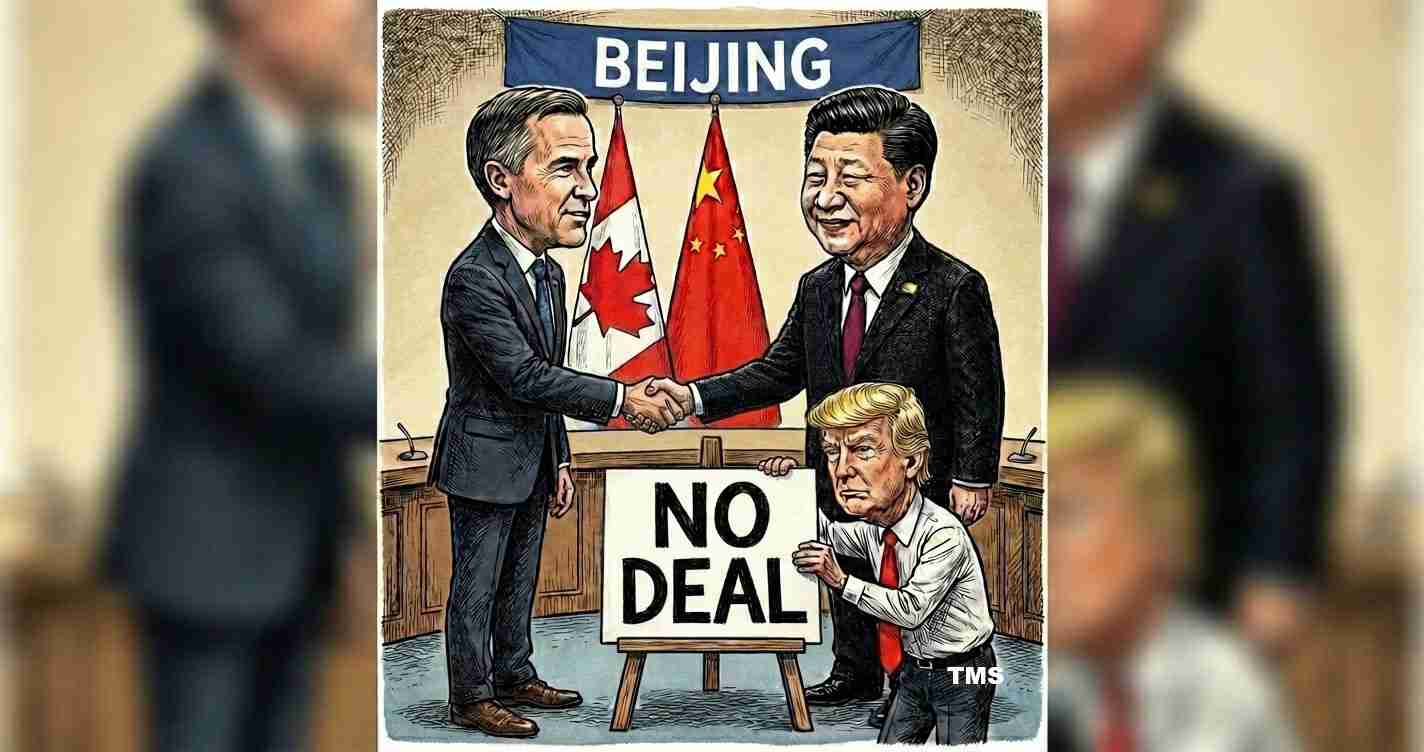
Trump warns Canada tariffs: president threatens 100% duties if Ottawa strikes China trade deal
President Donald Trump warned Canada on Truth Social that a Canada–China trade arrangement could prompt the United States to impose a 100% tariff on all Canadian goods entering the U.S., escalating tensions over EV tariffs and bilateral trade rules.
Key takeaways
- 100% tariff threat: Trump said on Truth Social any Canada–China arrangement that routes Chinese goods into the U.S. “will immediately be hit with a 100% tariff.”
- Canadian pushback: Ottawa denies pursuing a free trade pact with China and calls the recent EV tariff understanding limited and sector-specific; see ABC News and KUTV.
- Broader stakes: Analysts say a blanket tariff would raise legal, economic and supply-chain questions and likely prompt WTO and U.S. trade-law challenges.
Main content
TRUMP’S POST AND THREAT
In a Truth Social post Saturday, President Trump framed the dispute as one of national security and economic fairness. He warned that any Canada–China arrangement that could let Chinese goods be routed into the United States “will immediately be hit with a 100% tariff.”
“If Canada makes a deal with China, it will immediately be hit with a 100% Tariff against all Canadian goods and products coming into the U.S.A.”
The post did not specify legal steps for imposing such sweeping duties, nor how the administration would distinguish goods merely transiting Canada from goods of Canadian origin. Reporting of the post and context is available from ABC News.
CANADA PUSHES BACK
Canadian officials rejected Mr. Trump’s premise. Dominic LeBlanc, minister for Canada–U.S. trade, said Canada is not pursuing a free trade agreement with China and emphasized the “remarkable partnership” with the United States. Prime Minister Mark Carney asserted, “Canada doesn’t live because of the United States. Canada thrives because we are Canadian.”
Ottawa described last week’s exchange with Beijing as limited and sector-specific — aimed at lowering prior 100% tariffs on some Chinese-made electric vehicles in return for reduced Chinese tariffs on select Canadian agricultural exports. Canadian officials insisted talks do not amount to a broad pact that would let China use Canada to access U.S. markets; see reporting by ABC News.
TRADE CONTEXT AND STAKES
The dispute sits at the intersection of trade policy, national security and domestic politics. Canada is the United States’ second-largest trading partner, with a large share of Canadian exports destined for the U.S. A blanket 100% tariff on Canadian goods would ripple through cross-border supply chains and raise costs for businesses and consumers on both sides of the border.
Analysts note such a move would be unprecedented in modern U.S.–Canada relations and would likely face legal challenge under World Trade Organization rules and U.S. trade law, requiring specific legal justification before implementation.
HISTORICAL RHETORIC AND POLITICAL SIGNALS
Observers highlighted that Trump’s use of labels — including calling Prime Minister Carney “Governor Carney” — echoes prior rhetoric and past public comments about annexation ideas. The exchange follows previous public sparring, including the revocation of Carney’s invitation to a proposed “Board of Peace” and warnings from Carney at Davos about potential ruptures in the world order. Local coverage is available from KUTV.
LEGAL AND PRACTICAL QUESTIONS
Experts say several practical questions would need answers before any tariff could be implemented:
- How would U.S. authorities determine which goods are “Canadian” versus merely transiting Canadian ports?
- Would U.S. Customs alter origin rules or impose penalties on re-exported Chinese goods?
- How would higher tariffs affect U.S. firms that rely on Canadian inputs across agriculture, technology and EV supply chains?
These issues touch customs law, international agreements and long-standing supply-chain relationships, and would likely draw legal challenges and intense diplomatic negotiations.
MEDIA COVERAGE AND CONFIRMATION
Multiple outlets confirmed the text of Trump’s post and contextual reporting on the Canada–China understanding over EVs and agricultural tariffs. Video coverage and reporting include sources such as ABC News, KUTV, and broadcast video coverage available on YouTube and YouTube.
IMPLICATIONS FOR CALIFORNIA
Economic impact: California’s manufacturing and ports are tightly linked to North American trade. A 100% tariff on Canadian goods could raise costs for manufacturers that import Canadian raw materials and components, affecting sectors from agriculture to high tech.
Agriculture and food supply: Higher tariffs could increase costs for farm inputs and equipment sourced from Canada and make California exports less competitive if retaliation disrupts markets.
Jobs and ports: West Coast ports and the logistics sector could see disrupted cargo flows, affecting trucking, warehousing and rail employment and investment.
Industry and supply chains: EV and clean-technology supply chains that cross North America could face delays and higher costs, increasing uncertainty for companies and potential investors.
Political consequences: Broad tariffs would likely prompt bipartisan pushback from California’s congressional delegation and business groups seeking exemptions or mitigations to protect trade ties.
Practical steps for businesses: California companies should begin scenario planning: assess Canadian dependencies, review contracts, and explore alternative suppliers and contingency logistics plans.
SOURCES
Reporting draws on statements and social posts by President Trump, comments from Canadian officials, and public reporting by ABC News, KUTV, and broadcast video coverage on YouTube and YouTube.



