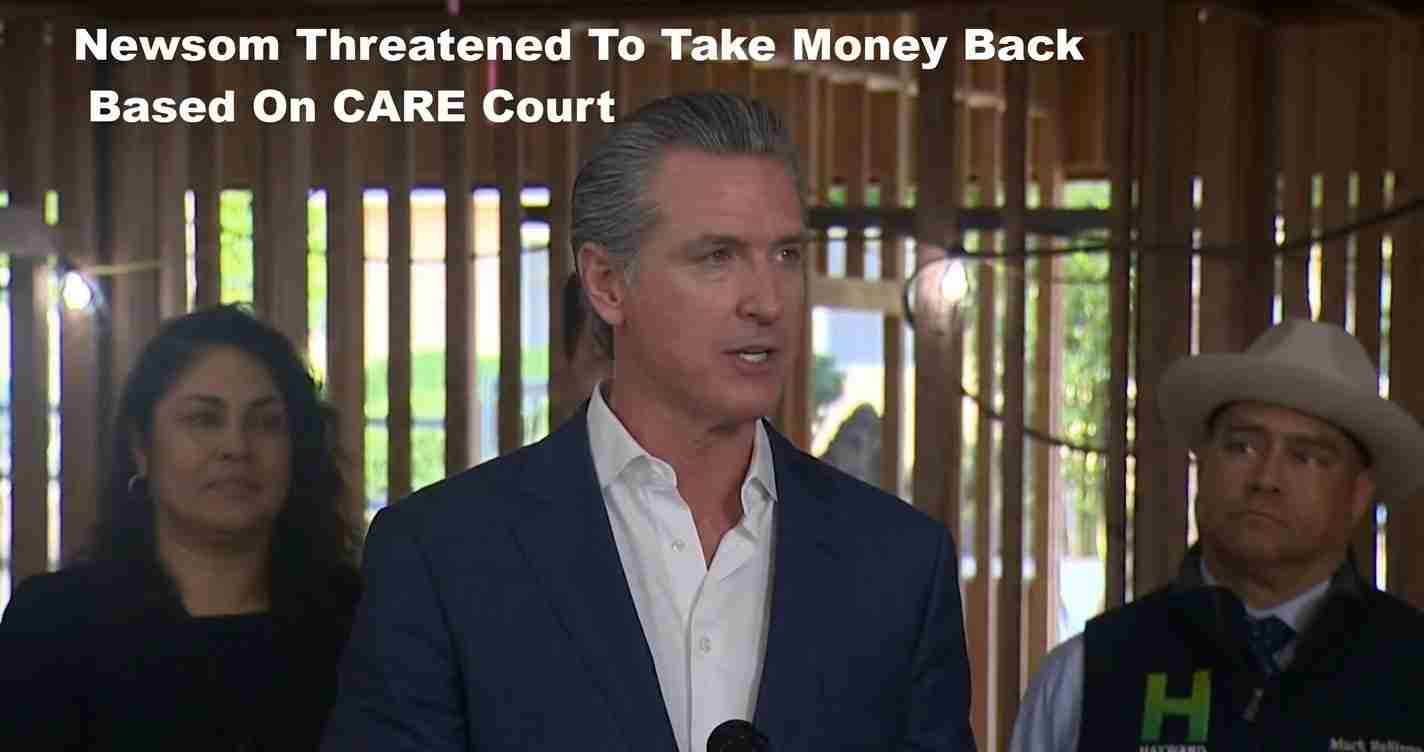
Newsom threatens CARE Court funding for 10 counties, launches public scorecard as critics question single benchmark
Gov. Gavin Newsom on March 2, 2026, warned 10 California counties — labeled ‘CARE ICU’ — they could lose or see redirected CARE Court funding after falling short of benchmarks aimed at connecting people with severe mental illness to treatment.
Lede
Newsom announced the state set a numeric benchmark and published county results on a new public portal, while offering new housing grants and threatening to redirect funds to jurisdictions that meet CARE Court goals.
Key takeaways
- Ten counties fell below the state benchmark of about 6.2 CARE Court petitions per 100,000 residents and were labeled “CARE ICU” by the governor. (Source: KFIA Mornings; YouTube press conference)
- The state launched a public accountability portal at accountability.ca.gov and announced housing and homelessness grants tied to behavioral health initiatives.
- State data show CARE Court filings (3,817 petitions by early 2026) fell short of earlier projections, raising questions about measurement, outcomes and long-term tracking.
Background: What CARE Court is and where it came from
CARE Court is a statewide program Gov. Newsom advanced as part of a broader effort to modernize California’s behavioral health system. First discussed in 2019, the program uses civil courts to help people with severe mental illness access treatment, housing and services. Family members, law enforcement or others can file petitions seeking care plans that may be voluntary or court-ordered. The state piloted CARE Court in select counties in 2023 and expanded it statewide by late 2024. (Source: KFIA Mornings)
Why the state set a benchmark
Newsom said the state adopted a numeric benchmark — roughly 6.2 petitions per 100,000 residents — to measure whether counties are using CARE Court to move people into treatment. He described the benchmark as a baseline to reach people in crisis and warned he has “run out of patience” with counties that miss the mark, saying the state may redirect funding toward jurisdictions that meet goals. (Sources: KFIA Mornings; YouTube)
Performance so far: numbers and state data
State-collected figures show CARE Court has not matched early expectations. Officials once anticipated 7,000 to 12,000 Californians would qualify, but by early 2026 just 3,817 petitions had been filed statewide. Of those, 893 resulted in approved treatment agreements and 32 led to court orders. More than 4,000 referrals were redirected to other services without clear public tracking of long-term outcomes — a gap that has driven the administration’s push for faster, broader adoption. (Source: KFIA Mornings)
Who the state labeled “CARE ICU” and who were “CARE Champions”
Using 2025 county-level data, Newsom identified 10 counties that fell below the 6.2 petitions-per-100,000 benchmark. The governor dubbed them the “CARE ICU”: Fresno, Kern, Los Angeles, Monterey, Orange, Riverside, San Bernardino, San Francisco, Santa Clara and Yolo. (Source: KFIA Mornings)
At the same event, Newsom praised 10 counties as “CARE Champions” for meeting or exceeding the benchmark: Alameda, Humboldt, Imperial, Marin, Merced, Napa, San Mateo, Santa Barbara, Sutter and Tuolumne. (Source: KFIA Mornings)
County responses and the debate over metrics
Several county leaders pushed back, arguing a single metric does not capture local context or progress:
- Orange County officials noted their jurisdiction ranks fifth in total petitions statewide and said 79 residents are receiving housing, medication and services through CARE Court, urging that local context and services factor into any assessment. (Source: KFIA Mornings)
- Santa Clara County leaders said they have expanded treatment and housing and warned against judging complex systems by “a single scorecard.” (Source: KFIA Mornings)
- San Francisco officials pointed to shrinking encampments, more shelter beds and expanded treatment access and welcomed state assistance to continue progress. (Source: KFIA Mornings)
Advocates and associations also raised objections. Michelle Doty Cabrera of the County Behavioral Health Directors Association said the petition metric fails to credit prevention efforts. The California State Association of Counties emphasized counties are following the law as written. Republican State Sen. Roger Niello argued the state must accept some accountability for outcomes given billions allocated to behavioral health and housing. (Sources: KFIA Mornings; YouTube)
State support, new tools and funding tied to performance
Newsom presented the move as both accountability and assistance. The state launched the public portal accountability.ca.gov to display county progress on CARE Court and other behavioral health efforts. He also announced housing and service grants, including $131.8 million in Homekey+ awards for 443 homes focused on mental health and substance use needs and $159 million from Homeless Housing, Assistance and Prevention funds. Some counties labeled underperforming still received portions of those funds. (Sources: accountability.ca.gov; KFIA Mornings)
“I’m happy to redirect every damn penny in these programs to the counties that are getting things done, period, full stop,” Newsom said, signaling budget moves in his May 2026 revision to reward jurisdictions that meet objectives. (Source: KFIA Mornings; YouTube)
Questions about outcomes and long-term tracking
A large share of referrals were diverted to other services rather than culminating in CARE Court treatment agreements, and public data do not clearly track long-term outcomes — such as sustained housing, continuous treatment or reduced future crises. Reporting and oversight note practical challenges in staffing, case management and housing availability that affect county capacity to meet benchmarks. (Source: KFIA Mornings)
Implications for California
Economic and budget impacts
The governor’s threat to redirect funds puts fiscal pressure on counties that depend on state behavioral health allocations. Midyear reallocations in the May budget revision could disrupt local programs and spark debate about whether redirected funds would improve outcomes or destabilize existing services. (Sources: KFIA Mornings; YouTube)
Political consequences
The dispute touches on accountability for state spending, local control and public safety. Newsom’s hard line may appeal to voters demanding faster action on homelessness and public order while prompting legislative fights over withholding or redirecting funds. Expect heightened debate during the May budget process. (Source: KFIA Mornings)
Social and community effects
If counties increase CARE Court petitions to meet benchmarks, more people may enter court-connected treatment, which could benefit families and first responders. Critics caution that emphasizing petition counts risks overreliance on courts instead of strengthening voluntary community care, prevention, and housing supply. Success depends on pairing petitions with timely access to beds, medication, case managers and stable housing. (Source: KFIA Mornings)
Practical implications for daily life in California
Residents could see faster referrals, increased outreach and potentially greater court involvement for people in crisis if counties respond to the benchmark pressure. Local law enforcement, emergency personnel and families may face changes in how and when they file petitions. For taxpayers, the debate centers on whether state funds are being spent effectively and how success should be measured in complex behavioral health work. (Sources: KFIA Mornings; accountability.ca.gov)
Reporting and transparency
The new accountability.ca.gov portal gives Californians a public view into county performance and may increase pressure for faster change. However, transparency focused on a narrow metric risks missing prevention efforts, local capacity constraints and nuanced outcomes. Careful public reporting and oversight will be required to ensure metrics lead to better care rather than mere box-checking. (Source: accountability.ca.gov)
Reporting note and sources
This report is based on coverage and Gov. Newsom’s March 2 public remarks. Primary source material includes KFIA Mornings, Gov. Newsom’s remarks on YouTube, and the state accountability portal at accountability.ca.gov.