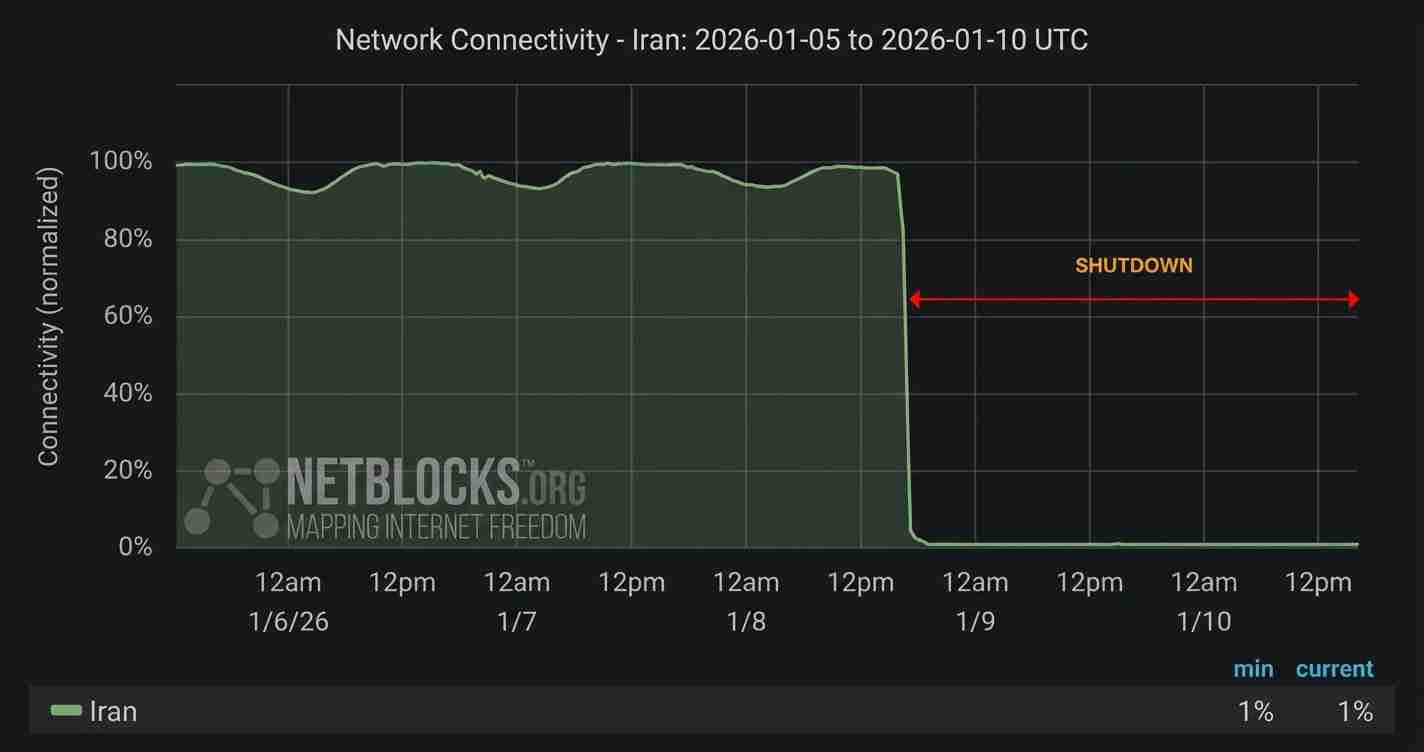
Iran’s nationwide “kill switch” blackouts internet as rights groups say shutdown hides lethal force and mass arrests
Iranian authorities initiated a nationwide internet and telecommunications shutdown across Iran on January 8, 2026, as protesters confronted security forces; human rights groups warn the blackout aims to conceal lethal force and mass arrests, with dozens killed and thousands detained.
- Deliberate nationwide shutdown: Amnesty International says Iran imposed a coordinated internet and phone blackout on Jan. 8 to obstruct reporting of abuses.
- Connectivity collapsed: Monitors and media, including a Global News video report and the Institute for the Study of War / Understanding War, report connectivity fell to a fraction of normal levels while deadly force and large-scale arrests were recorded.
- Confirmed and likely higher tolls: Rights groups have documented dozens of confirmed deaths and report figures — about 65 killed and thousands detained in some outlets — that are difficult to verify under the blackout (Amnesty International).
What happened: the nature of the shutdown
Amnesty International describes the Jan. 8 action as a “blanket internet shutdown” ordered to obstruct reporting of rights violations and to stymie independent verification. Broadcasters and analysts report that mobile and landline services were cut or severely throttled across many areas, leaving large parts of the country in digital darkness and making independent reporting nearly impossible (Amnesty International; Global News video report; Institute for the Study of War / Understanding War).
The “kill switch” characterization
Cybersecurity experts often refer to centrally ordered, nationwide cutoffs as a “kill switch.” Iranian officials have not used that label publicly, but the pattern reported by Amnesty International, media and analysts matches a deliberate state-level closure or severe throttling of networks to stop images, video and messages from leaving the country.
Stated and inferred purpose of the blackout
Rights groups and analysts say the blackout is intended to silence dissent and shield security forces from outside scrutiny. Amnesty International warns the shutdown “provides cover for security forces who commit grave violations,” noting it is intended to hide the true extent of unlawful killings and mass arrests (Amnesty International).
“Using [the blackout] as a weapon” — an Iranian activist and cyber expert described the tactic as a repeat of earlier moves to stop documentation and delay independent verification of abuses (Global News video report).
Scale and geography of the protests
The unrest began on Dec. 28, 2025 after a sharp currency collapse and surging inflation, quickly expanding beyond economic grievances. Amnesty International reports protests began in Tehran and “spread nationwide.” Media accounts say demonstrations reached many provinces and cities, with some outlets describing unrest across “every province and some 100 cities” (see Global News video report; Institute for the Study of War / Understanding War).
Reported deaths, arrests and victims
Amnesty International has documented at least 28 confirmed deaths, including protesters and bystanders, and is investigating further killings after Jan. 8. Other reports place the toll at roughly 65 killed and thousands detained during nearly two weeks of unrest; such figures are provisional and hard to verify while communications remain cut (Amnesty International; Global News video report).
Methods of repression reported
Rights groups document a violent crackdown: unlawful use of firearms, mass arbitrary arrests, and heavy policing of demonstrations. Iran’s Revolutionary Guard and other security bodies have framed unrest as a threat to national stability and emphasized security as a “red line,” rhetoric that has often preceded tougher measures in previous crackdowns (Global News video report).
Context: past shutdowns and a pattern of repression
This is not the first time Iran has used large-scale internet blackouts during unrest. Amnesty International notes near-total cuts during the fuel protests of Nov. 2019 — when security forces killed hundreds — and widescale cuts during the “Woman, Life, Freedom” protests of 2022, when several hundred were reportedly killed. Rights groups say blanket cuts are disproportionate and violate international human rights standards, enabling impunity by limiting outside monitoring (Amnesty International).
Political demands and regime response
What began as protests over the economy has broadened into calls for systemic change and, in some cases, the fall of the Islamic Republic, according to Amnesty International and media reporting. Iranian leaders have adopted tough rhetoric and a security-first approach, often linking unrest to foreign interference — a framing that can justify heavy-handed responses (Global News video report).
Information gaps and uncertainties
Because the shutdown limits communications, independent observers stress available figures are incomplete. Amnesty International warns the confirmed death toll is likely an undercount and investigations are ongoing. Media reports of ~65 killed or ~2,300 arrests should be treated as provisional and may change as more evidence emerges (Amnesty International; Global News video report; Institute for the Study of War / Understanding War).
Implications for California
Economic and humanitarian links: California hosts one of the largest Iranian diasporas in the U.S.; families, students and institutions will monitor developments closely. Expect increased requests for information, humanitarian support and immigration assistance.
Tech, cybersecurity and free-speech concerns: Silicon Valley firms and civil-society groups may be asked to support circumvention tools, monitoring, or analytic expertise while weighing legal and ethical limits.
Political and security stakes: Think tanks, universities and policy communities in California will likely watch for U.S. responses, sanctions, or other measures that could affect national security and dual-nationals.
Humanitarian and legal responses: Advocacy groups and legal clinics may prepare to assist asylum seekers and families of detainees; rights organizations may press for documentation and targeted measures.
Practical steps for residents: Residents with ties to Iran should check official State Department travel guidance and consular resources and support verified humanitarian organizations rather than unverified online appeals.