Scientists Confirm Moai “Walked” Across Easter Island, Solving Centuries-Old Engineering Mystery
A new study in the Journal of Archaeological Science uses 3D scans, physics simulations and field experiments to confirm Rapa Nui oral tradition: the Moai were transported upright in a controlled rocking “walking” motion, redefining ancient engineering on Easter Island.
Key takeaways
- Researchers used scans, 3D modeling, physics simulations and practical tests to demonstrate the upright, rocking “walking” transport method (Journal of Archaeological Science study; ScienceDaily summary).
- Design features — low center of mass, D-shaped bases and forward leans — made rocking stable and efficient (Live Science).
- Small teams (as few as 15 people) could guide statues with ropes; experimental runs reproduce realistic speeds and manpower estimates (Binghamton University; Local12 report).
Main content
How the study was done
The research team combined modern digital tools with hands-on fieldwork. They scanned nearly 1,000 statues to create detailed 3D models and ran physics simulations to test stability and energy use when statues were rocked from side to side. The team then conducted field experiments using full-scale replicas and rope teams to measure speed, effort and steering control. See the Journal of Archaeological Science study and the ScienceDaily summary for methodology and data.
The digital models revealed consistent physical traits: a low center of gravity, a D-shaped base and a forward lean. These features permit a stable pivot, letting a statue rock forward and then back to complete a step. Simulations showed the motion is dynamically stable and surprisingly energy-efficient once rocking begins (Live Science analysis).
Field experiments and measurements
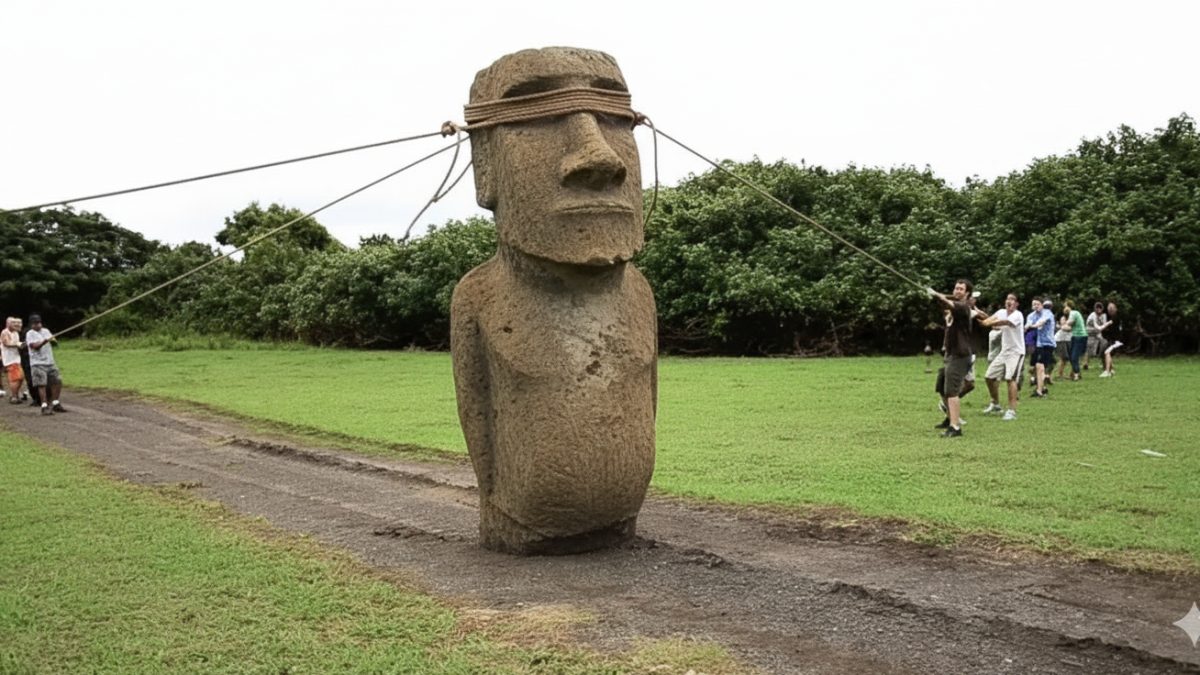
Practical trials used ropes looped around replica heads and teams that alternately pulled to create the rocking motion. Experimental runs recorded that an 18-person team covered 328 feet in 40 minutes, and once rocking stabilized, statues could average about 1,000 feet per hour. Tests also showed that larger statues could take longer strides and therefore move faster per rock (Local12 report; Live Science).
Why the “walking” idea matters
For decades the dominant explanations invoked massive sleds, rollers or huge labor forces, narratives that fed a wider story of ecological overuse and collapse. This research demonstrates a low-resource, high-skill method that requires few people and little wood, challenging simpler collapse conclusions and highlighting Rapa Nui engineering ingenuity (Binghamton University; ScienceDaily).
Oral tradition meets science
“They ‘walked’ to their places” — Rapa Nui oral tradition
The phrase that islanders used for the statues’ movement — commonly reported as the Moai “walking” — is given a practical, physical interpretation by the study. Rather than invoking only supernatural agency, the oral account likely encoded an effective transport technique using coordinated human power and clever geometry. Independent experts praised the work as an ingenious reconciliation of tradition and physics (Live Science).
Details about movement and roads
The study also considers how statues were guided across the island. Researchers documented evidence for intentionally shaped paths and zig-zag routes that helped control sway and allowed teams to steer without excessive effort. Pullers used long ropes on either side of the statue head; by altering rope tension they could nudge direction. The zig-zag alignment reduced toppling risk and smoothed the walking motion over long distances (Binghamton University; ScienceDaily).
What this means for Rapa Nui history
The findings reframe islanders as skilled engineers rather than ecologically reckless laborers. Large public works, including statue transport and platform construction, can be seen as the product of planning, ceremony and technical skill executed by relatively small, coordinated groups. This perspective restores agency to Rapa Nui people and suggests alternative narratives of responsibility and ingenuity rather than simple collapse (Binghamton University).
Implications for California
Cultural tourism: Renewed interest in Pacific history may boost visits to museums and cultural programs in California; exhibits can feature the walking technique to attract students and the public (Live Science).
Education and STEM: The Moai case ties physics, engineering and archaeology into classroom lessons on modeling, simulation and testing (Journal of Archaeological Science study; ScienceDaily).
Cultural respect: California’s Pacific Islander communities should be consulted for exhibits and programs. The study’s match between oral tradition and science creates a chance to highlight indigenous knowledge and collaboration (Local12 report).
Conservation messaging: The work weakens simplistic deforestation-collapse narratives and supports nuanced discussions about stewardship, engineering and long-term planning (Binghamton University; ScienceDaily).
State and local agencies that fund museums and curricula may find value in supporting exhibits that blend engineering and public history. The Moai research is a clear example of how scientific methods can validate traditional knowledge while reshaping public narratives.
Sources and further reading
- Journal of Archaeological Science study (authors include Carl P. Lipo and Terry L. Hunt)
- ScienceDaily summary of the research
- Live Science explanation and physics analysis
- Binghamton University coverage of the physics tests
- Local12 report summarizing the findings
- Fox News travel piece summarizing the study
Summary: This research returns agency to Rapa Nui people by demonstrating a realistic, low-resource transport method for the Moai that matches oral tradition. Museums, schools and communities can use the story to teach physics, honor indigenous history and inspire real-world problem solving.