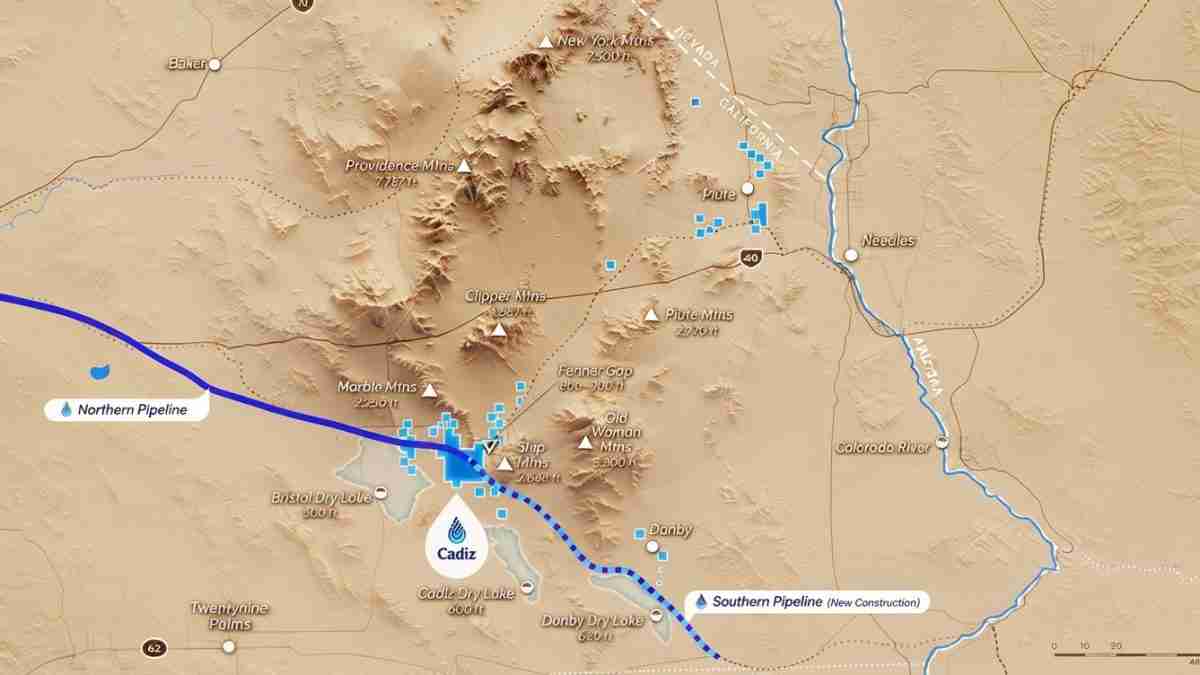
VICTORVILLE, Calif., July 18 (High Desert News Online) — The U.S. Bureau of Land Management has approved a 50-year right-of-way that lets Cadiz Inc. convert a buried pipeline across federal land in the Mojave Desert into a water line. Cadiz says the system could move about 25,000 acre-feet of water a year from its desert groundwater project to California communities, and the company says it plans to pump as much as 50,000 acre-feet annually.
An acre-foot is a standard water measure equal to one acre of land covered by one foot of water.
What did the BLM approve?
The federal action gives Cadiz permission to use BLM-managed land for the pipeline conversion. In its decision record, the agency issued a Finding of No Significant Impact, which means it decided a full environmental impact statement was not necessary.
Cadiz says the approval clears the way for construction to begin on its Mojave water project, which it ties to the Fenner Basin aquifer area in eastern San Bernardino County.
Why is the approval controversial?
The biggest dispute is over what the BLM reviewed and what it did not.
According to the agency’s explanation, the environmental review covered the pipeline conversion on federal land. It did not analyze the effects of groundwater pumping on the aquifer, springs or wildlife. The BLM said that pumping would take place on private property and fall under state and local oversight, so it was outside the agency’s authority.
Environmental advocates and Native tribes have criticized that approach, saying the project could threaten desert springs and habitat in a fragile part of the Mojave.
What does Cadiz say the project will do?
Cadiz says the pipeline is part of its broader Mojave Groundwater Bank plan, which it describes as a way to move water from the desert to communities in California.
In a company statement, Cadiz chair and chief executive Susan Kennedy called the approval a “pivotal milestone” and said the project has reached the construction stage.
The company’s project descriptions and reporting say the pipeline would carry water from the High Desert region toward users in Southern California, including communities in the state’s Inland Empire.
Why do the numbers matter?
The scale is one reason the plan has drawn so much attention. Cadiz says the system could move about 25,000 acre-feet of water each year. Over time, that adds up to a large withdrawal from a desert groundwater basin in a region where water is already scarce.
The company’s overall project description has also been reported as targeting 1.25 million acre-feet of groundwater over 50 years.
Has the legal fight ended?
No. Earthjustice says it previously challenged an earlier approval for the pipeline and that a federal judge later ruled the project should not have been approved.
The current BLM decision is the latest chapter in a long-running dispute over desert water, federal land use and the limits of agency review. Reporting also indicates that the separate groundwater-pumping approval has not yet been issued.
For now, the BLM decision gives Cadiz a major federal approval for the pipeline itself. It does not settle the larger debate over whether taking groundwater from the Mojave Desert is sustainable, or whether the project will harm the springs and wildlife that depend on it.