
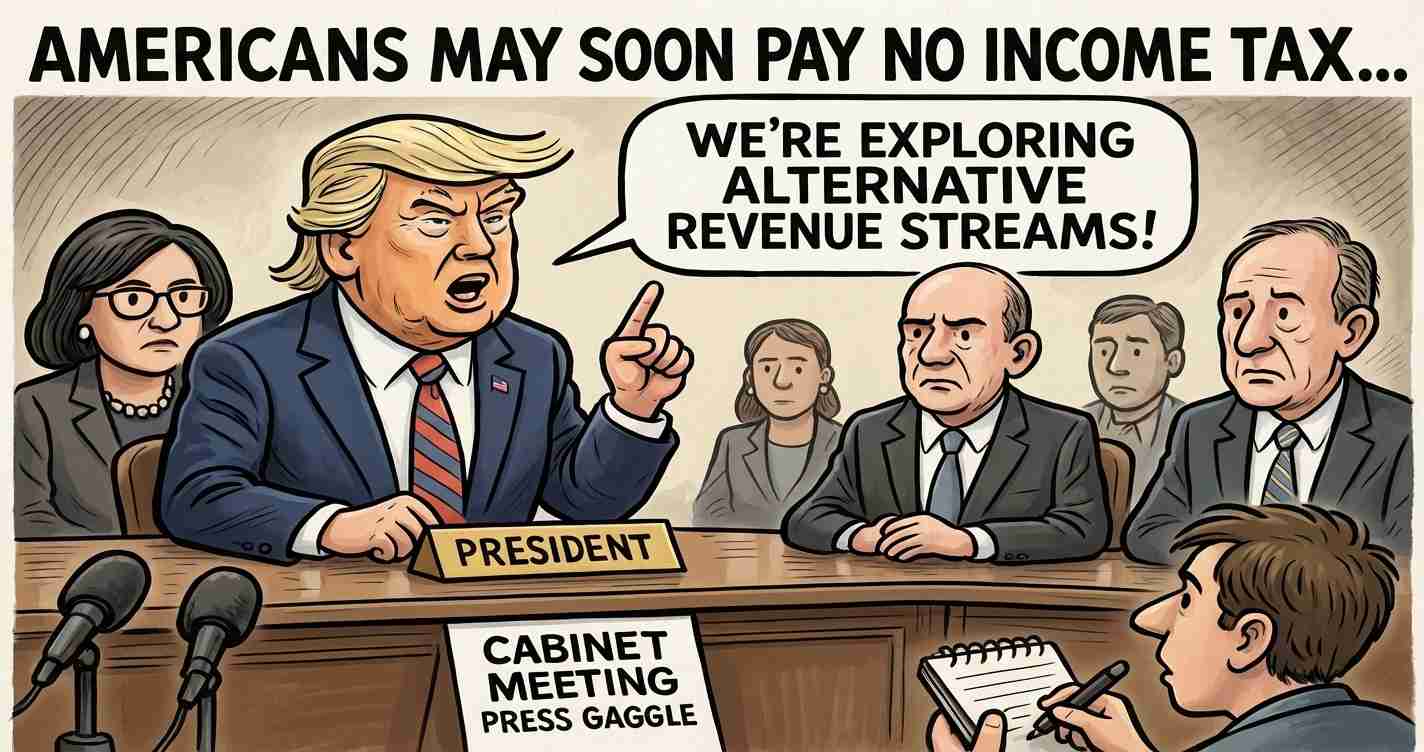
Trump says tariff windfall could let Americans stop paying income tax as White House weighs alternatives
President Donald Trump proposed eliminating the federal income tax, arguing tariff revenue could cover government costs; economists warn the numbers don’t add up, and lawmakers are weighing narrower, targeted tax relief or competing plans in Congress.
Key takeaways
- Trump said tariff receipts could be “literally trillions of dollars” and might one day eliminate income tax; the White House is exploring alternatives. (CPA Practice Advisor)
- Tariff totals for 2025 are estimated near $258.1 billion, versus roughly $2.7 trillion from individual income taxes — a sizable gap critics say is fiscally unrealistic. (CPA Practice Advisor)
- Economists estimate replacing income-tax revenue with tariffs could raise the annual deficit by about $2.3 trillion, pushing deficits toward $4 trillion. (CPA Practice Advisor)
- Congressional alternatives include the FairTax Act of 2025 (H.R. 25), which would replace many federal levies with a national sales tax. (congress.gov)
What the president said and how the White House frames the plan
At a Cabinet meeting on Dec. 2, 2025, President Trump told reporters that tariff-driven revenue could become so large that “at some point in the not-too-distant future you won’t even have income tax to pay.” He added the government might be “giving back refunds out of the tariffs because we’re taking in literally trillions of dollars.” (CPA Practice Advisor)
Trump offered a flexible timeline — “over the next two, three, four years” — and suggested income tax might instead be held at very low rates. White House officials describe the idea as part of a broader search for alternative revenue streams to fund priorities and reduce federal debt. (Fox Business)
Treasury Secretary Scott Bessent offered a narrower framework: using tariffs to finance targeted tax relief such as removing taxes on tips, Social Security income, overtime pay and restoring interest deductibility for American-made autos, rather than full abolition of income taxes. (CPA Practice Advisor)
The fiscal math and expert skepticism
The central critique is arithmetic. Individual income taxes recently contributed roughly $2.7 trillion annually — about 54% of federal revenue — while estimated tariff receipts in 2025 were about $258.1 billion, roughly one-tenth of income-tax revenue. Replacing the former with the latter would create a large shortfall. (CPA Practice Advisor)
“Tariffs alone would not be enough to replace the revenue lost by eliminating income tax,”
— Economist Dean Baker, Center for Economic and Policy Research
Dean Baker estimates that eliminating about $2.6 trillion in income-tax receipts and replacing them with current tariffs would boost the deficit by roughly $2.3 trillion annually, driving total deficits toward $4 trillion (about 13% of GDP). Other economists warn of second-order effects: higher import prices, squeezed consumer purchasing power, retaliatory tariffs, reduced exports and erosion of the tariff base over time. (CPA Practice Advisor; Fox Business)
Legislative hurdles and competing proposals
A full repeal of federal income tax would require sweeping changes to the tax code and intense congressional debate. Even with a narrow House majority, passage of transformational tax legislation would likely need bipartisan support and face complex legal, administrative and political obstacles.
One legislative alternative already in Congress is the FairTax Act of 2025 (H.R. 25), which proposes repealing income, payroll, estate and gift taxes and replacing them with a national sales tax while abolishing the IRS. That bill remains under consideration as one possible path for lawmakers. (congress.gov)
Implications for California
Economic impact
California receives significant flows from federal programs; changes to federal revenue would ripple into state and local budgets. While lower federal income taxes could raise take-home pay, tariff-driven price increases on imported goods — many of which enter via Los Angeles and Long Beach ports — could raise costs for retailers, consumers and small businesses across the state. (CPA Practice Advisor)
Political consequences
California leaders — largely Democratic — and many constituents are likely to resist policies that raise living costs even if they lower federal income tax bills. Tariff-funded budgets could spark friction between state and federal priorities and potentially harm exporters in agriculture and technology through retaliatory measures. (Fox Business)
Social effects
Lower or no federal income tax could boost take-home pay, offering short-term stimulus. Yet tariff-induced price spikes could disproportionately hit lower- and middle-income households, retirees on fixed incomes and service-sector workers in tourism regions. Proposals exempting Social Security from taxation would ease pressure on seniors, but broad protections remain uncertain. (CPA Practice Advisor)
Cultural and business relevance
California’s economy is deeply tied to global trade. Tariff-driven policy can alter supply chains, incentivize relocation, or force firms to absorb costs and reduce hiring. For conservative-leaning business owners, the trade-off is clear: weigh potential income-tax relief against higher input costs and uncertain international retaliation. (CPA Practice Advisor; Fox Business)
Practical applications for Californians
- Tax filings: Eliminating federal income tax would simplify returns for many households but require a transition plan for refunds, payroll withholding and coordination with state tax systems. (CPA Practice Advisor)
- Consumer prices: Expect upward pressure on prices for imported goods — from electronics to food — that move through California ports.
- Local budgets: Cities reliant on federal grants for transportation, housing and social services could face funding shifts if federal revenue structures change.
- Employers: Wage and benefit decisions may shift if payroll taxes change or the federal role in programs such as Social Security is adjusted.
Legislative watch and next steps
Any serious push to eliminate federal income tax would require major congressional votes and extensive legal and policy debate. Lawmakers already have a competing framework in the FairTax Act (H.R. 25), which would end many federal taxes and create a national sales tax. Californians should monitor both White House discussions and congressional action to assess protections, trade-offs and implementation details. (congress.gov)
Bottom line: The White House proposal shifts the policy conversation toward a bold and uncertain direction — policymakers, economists and state leaders will be watching to see whether tariff revenue can realistically fund major tax cuts without creating unsustainable deficits or harming consumers. (CPA Practice Advisor; Fox Business)



