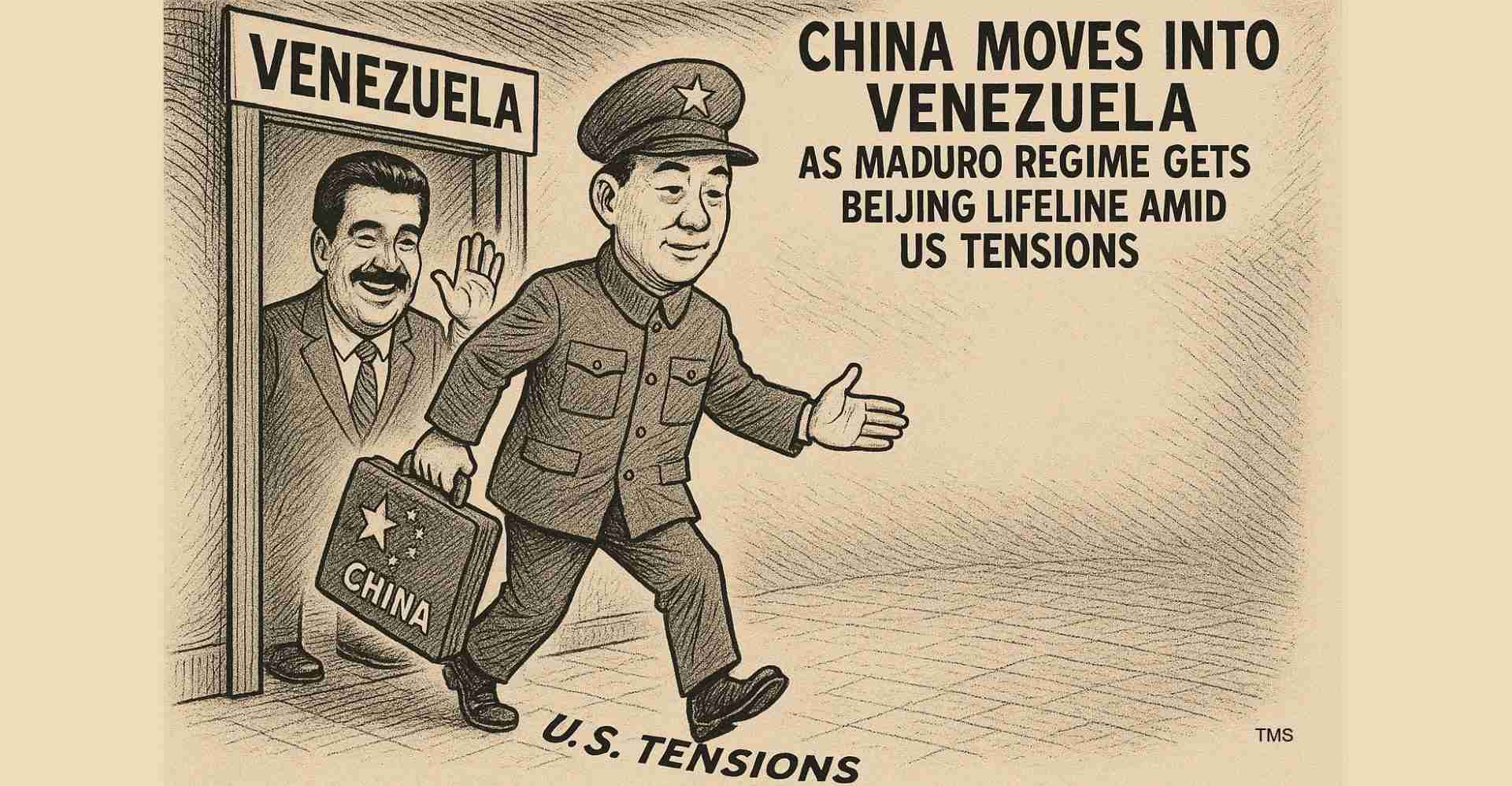
China moves into Venezuela as Beijing gives Maduro regime a decisive economic lifeline
China has sharply increased economic and political engagement with Venezuela, offering the Maduro government hundreds of new deals and a zero‑tariff trade pact that deepens integration, counters US pressure and reshapes long‑term Venezuelan geopolitical influence.
Key takeaways
- Productive shift: Beijing plans more than 600 new bilateral agreements in 2025 focused on joint ventures and investment rather than pure lending (El País; Chinese Foreign Ministry).
- Legal and trade anchors: A Bilateral Investment Treaty entered into force in April 2025 and a zero‑tariff trade deal was announced at the Shanghai Expo, lowering barriers for Chinese investors and trade (Fietta Law; Fox News).
- Debt and leverage: Venezuela has accumulated more than $60 billion in Chinese state-backed loans since the early 2000s, often secured against future oil, making it China’s largest Latin American debtor (Global Policy; CFR).
- Geopolitical impact: The partnership reduces the leverage of US sanctions and extends Chinese political backing and model exchanges inside Venezuela (CIDCA).
Key information
Official statements and reporting show a rapid institutionalization of Sino‑Venezuelan ties: Beijing and Caracas announced plans for more than 600 new bilateral agreements in 2025 centered on productive cooperation rather than fresh loans (El País; Chinese Foreign Ministry). China upgraded relations to an “all‑weather strategic partnership” in 2023 and has expanded cooperation across trade, energy, agriculture and education (CIDCA; Chinese Foreign Ministry).
From loans to productive deals: how the partnership changed
Historically, Beijing extended large, state‑backed loans secured against PDVSA oil shipments. That model produced deep indebtedness—more than $60 billion since the early 2000s—but limited modern investment. Chinese officials now emphasize “productive contracts”: joint ventures, technology partnerships and investment promotion instead of unconditional credit (El País; Chinese Foreign Ministry).
Analysts say the model shift reduces short‑term credit risk for China while exporting Chinese business models and securing long‑term market access.
Special Economic Zones: operating on Chinese terms
A prominent element of new cooperation is the creation of Special Economic Zones (SEZs) intended to attract Chinese firms with tax incentives and regulatory carve‑outs. Reporting suggests these SEZs rely on lower labor costs and relaxed oversight, prompting concerns they could become economic enclaves that favor foreign investors over local control (El País).
Critics warn SEZs may reduce transparency and limit local sourcing; supporters argue they can rebuild supply chains and create jobs if governed with clear oversight and labor safeguards.
Trade, oil and the limits of Chinese appetite
Trade flows show deepening ties: China exported about $3.45 billion to Venezuela in 2023, while Venezuelan exports to China rose 105% year‑on‑year in 2025 (OEC).
Nevertheless, Chinese oil companies remain cautious about major new investments in Venezuela’s troubled petroleum sector due to payment delays, PDVSA mismanagement and past write‑offs. Some Chinese firms prefer more stable opportunities in the region such as Guyana (El País; CFR).
Legal guarantees and the BIT
In April 2025 Caracas and Beijing ratified a Bilateral Investment Treaty (BIT) to modernize investor protections and dispute resolution, reducing legal uncertainty for Chinese outbound investment and signaling a shift toward direct investment over lending (Fietta Law).
Political coordination and diplomatic backing
Beyond economics, the relationship includes political coordination. Since 2023 the two governments have labeled ties an “all‑weather strategic partnership”, and China routinely backs Venezuela’s sovereignty claims in multilateral forums while opposing external pressure for regime change (CIDCA; Chinese Foreign Ministry).
Internal exchanges include political training and governance exchanges between ruling PSUV cadres and Chinese counterparts, reflecting selective adoption of Chinese methods (El País).
Analyst warnings: sovereignty, leverage and the risk of control
Observers caution the shift to structured investments may embed long‑term leverage: joint ventures, infrastructure projects and legal protections can lock Venezuela into trade patterns and rules that favor Chinese firms. Conservative commentator Gordon Chang warned China could “completely take over the Venezuelan economy” through SEZs and extensive contracts (Fox News).
Why US sanctions may be less effective
Washington’s sanctions and isolation tools face limits if Beijing furnishes alternative trade, finance and legal frameworks. The announced zero‑tariff trade agreement at the Shanghai Expo reduces Caracas’s reliance on Western markets and can blunt some effects of US measures (Fox News; El País).
Implications for California
Economic ties and supply chains: Deeper China‑Venezuela integration could reroute regional trade toward Chinese networks, create competition for California exporters, and affect supply‑chain sourcing if Chinese firms operating in SEZs displace local suppliers (OEC).
Security and geopolitics: A strengthened Chinese foothold in Venezuela narrows US strategic options in the hemisphere; California officials should monitor port security, Pacific trade routes and coordinate with federal partners (CIDCA; CFR).
Migration and humanitarian effects: Projects that stabilize some sectors but bypass local communities could cause displacement and altered migration flows toward the US and California.
Investment screening: California firms and regulators should weigh the BIT’s protections, strengthen due diligence on SEZ‑tied projects and coordinate policy to safeguard labor, environment and sensitive technology transfer (Fietta Law).
Sources and further reading
- Venezuela and China showcase partnership through productive deals, not loans — El País (July 6, 2025)
- Chinese Foreign Ministry statement (May 13, 2025)
- CIDCA — statement (May 10, 2025)
- China, Trump and regime change in Venezuela — Global Policy Journal (May 11, 2025)
- CFR backgrounder on China in Latin America
- Fietta Law — China‑Venezuela BIT analysis (2025)
- OEC — China–Venezuela bilateral trade profile
- Fox News — coverage of China‑Venezuela ties
- CounterPunch commentary on China, Venezuela and global politics