Newsom Hails Proposition 50 Victory as a Win for American Democracy, Targets Trump Ahead of 2026 Fight
Gov. Gavin Newsom hailed California voters’ approval of Proposition 50 as a victory for American democracy and used the win to directly challenge former President Trump while urging Democratic states to prepare for the 2026 midterms.
- Passage framed as national defense of democratic norms — Newsom said the vote was a victory for the nation and for the Democratic Party (video; video).
- Direct criticism of Trump — Newsom accused the former president of voter intimidation and “vandaliz[ing]” the republic, declaring “in the U.S., there are no crowns, no thrones, no kings” (video).
- 2026 strategy — He urged allied states to coordinate for 2026 and argued Proposition 50 could help Democrats gain up to five House seats (video).
- What Proposition 50 does — The measure would let the Democratic-controlled Legislature replace maps drawn by the independent Citizens Redistricting Commission with maps set by lawmakers (video).
Newsom frames the vote as national, not merely partisan
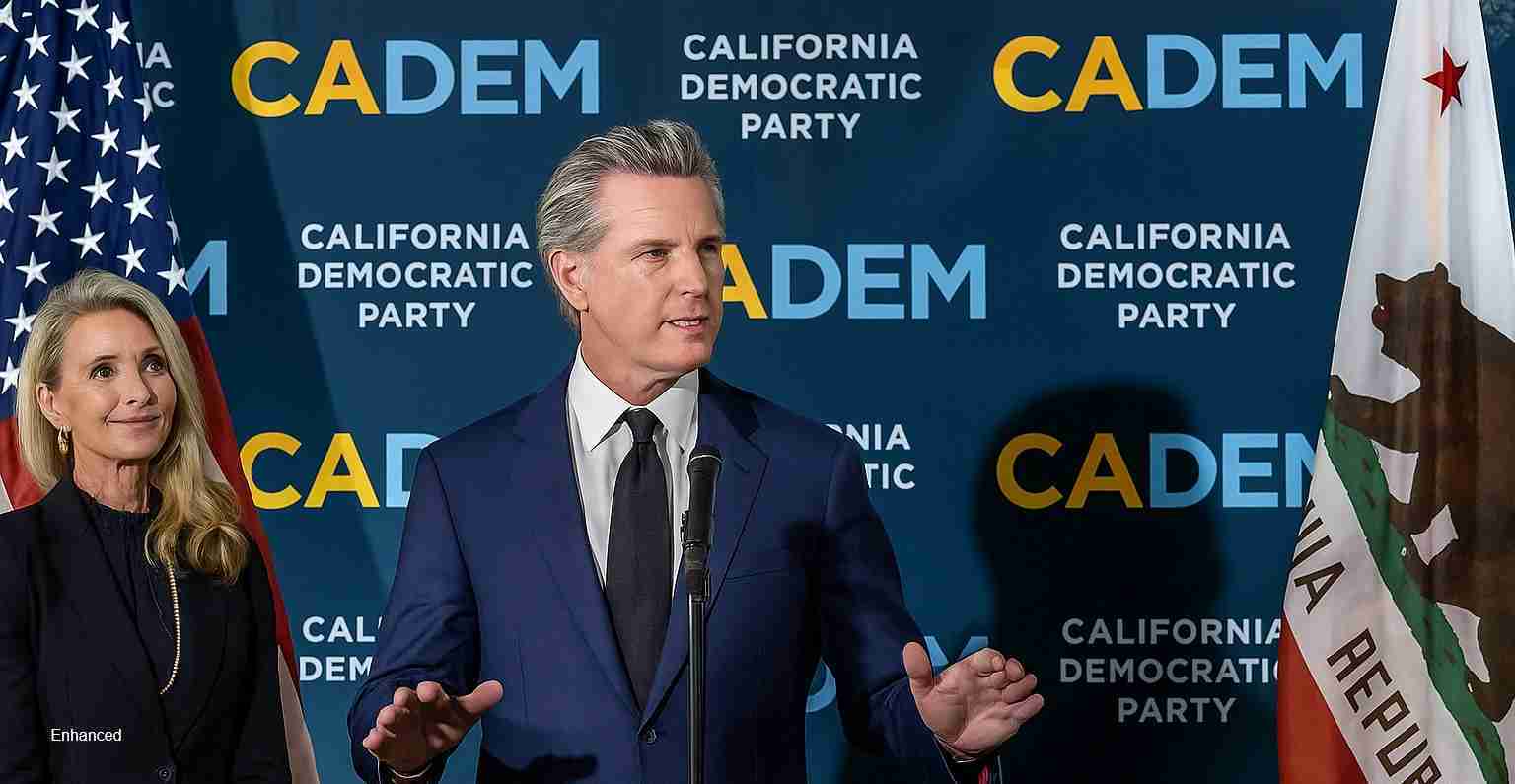
On election night, Gov. Newsom presented the passage of Proposition 50 as more than a state ballot win. He told supporters that California sent “a powerful message to an historic president” and that voters had acted to protect the country’s founding principles (video; video).
“This is a victory for the United States of America,” Newsom said, adding that it was also a victory for the Democratic Party. He emphasized the national stakes repeatedly, arguing the result proved that voters nationwide could reject actions he characterized as threats to democratic norms (video).
Direct criticism of Trump and call to stop intimidation
A central theme of Newsom’s remarks was a sharp critique of former President Donald Trump. Newsom accused Trump of seeking to “vandalize” the republic and urged an end to voter intimidation. He warned:
“The founding fathers did not live and die to see the kind of vandalism to this republic and our democracy that Donald Trump is trying to perpetuate.”
He later declared: “In the U.S., there are no crowns, no thrones, no kings.” Newsom framed these comments as a defense of institutional norms rather than personal attacks, saying California’s vote sent a message that leaders cannot undermine elections or rely on intimidation tactics to secure power (video; video).
2026 strategy: rallying allied states and targeting House power
Newsom used the moment to lay out a strategy for the 2026 midterms. He called on Democratic-led states — including Virginia, Maryland, New York, Illinois and Colorado — to “meet this moment head on” and prepare coordinated efforts to protect and expand congressional power (video).
He linked Proposition 50 directly to the balance of power in Washington, saying the measure could yield up to five additional Democratic seats in 2026 and shift prospects for House control. In stark language he warned:
“We can de facto end Donald Trump’s presidency as we know it. The minute Speaker Jeff gets sworn in as Speaker of the House of Representatives… it is all on the line, a bright line in 2026.”
(video).
What Proposition 50 would change
Proposition 50 would allow the California Legislature — currently controlled by Democrats — to replace the state legislative and congressional district maps produced by the independent Citizens Redistricting Commission with new maps drawn by lawmakers (video).
Backers say the change gives elected officials the power to correct problems or make maps more accountable to voters. Opponents argue that allowing lawmakers to draw their own districts can encourage partisan gerrymandering and weaken independent oversight. Newsom and supporters framed the measure as a tool to respond to what they view as anti-democratic pressures at the federal level (video).
Promises and concerns about potential seat gains
During his remarks, Newsom cited projections that Proposition 50 could produce up to five additional Democratic seats in the 2026 midterms. If realized, that would have significant national impact. For a moderate conservative audience in California, the prospect raises two central questions: whether lawmakers should have authority to redraw districts they will campaign in, and whether the change will stabilize representation or further entrench partisan advantage.
Newsom presented potential gains as a defensive move against what he described as attacks on American democracy. Critics counter that taking map drawing away from an independent commission undermines a reform aimed at reducing partisan influence. Both viewpoints were central to the debate preceding the vote.
Verification and sources
The governor’s election night remarks were captured in multiple videos posted online. Key clips of his speech and assertions are available here: Gov. Newsom remarks (video), Gov. Newsom remarks (video), Gov. Newsom remarks (video). Those videos contain the quotes and statements attributed to Newsom in this article.
Implications for California
Economic impact
If Proposition 50 leads to new maps drawn by the Legislature and gives Democrats additional congressional seats, California could gain greater influence over federal funding and policy affecting the state. That may benefit programs tied to infrastructure, wildfire response, housing aid and climate initiatives. However, apparent partisan changes could raise uncertainty among businesses that prefer stable, predictable governance.
Political consequences
For California’s moderate conservatives, the measure shifts a longstanding balance. The independent Citizens Redistricting Commission was created to reduce partisan mapmaking; Proposition 50 reverses that approach by giving lawmakers direct control. That can change the calculus for local campaigns, increase the stakes of state legislative races, and alter how California weighs in on national politics.
Social effects
Redrawing districts can affect representation for communities of color and neighborhoods long fighting for voice and resources. Supporters say legislative mapping can better reflect policy needs. Critics worry communities could be divided or combined in ways that dilute influence. The immediate effect for Californians will be seen in which names and issues appear on 2026 ballots.
Cultural relevance
Newsom’s rhetoric — invoking the founding fathers, democracy and resistance to intimidation — sought to tap into broad American themes that resonate across divides. For voters who value institutions and civic norms, the message is that the state is acting defensively and proactively. For moderate conservatives, these themes raise questions about institutional checks and whether changing map rules strengthens or weakens democratic safeguards.
Practical applications
Voters will likely see new district lines in the run-up to the 2026 midterms if Proposition 50 remains in effect and is implemented by the Legislature. That could change candidate fields, campaign geography, and targeted issues. Californians paying attention to local and congressional races should expect more contested primaries and retooled campaign strategies across the state.
Reporting by Times Media Service.