Crypto bloodbath wipes out billions, but signs of stabilization emerge as leveraged traders take the hit
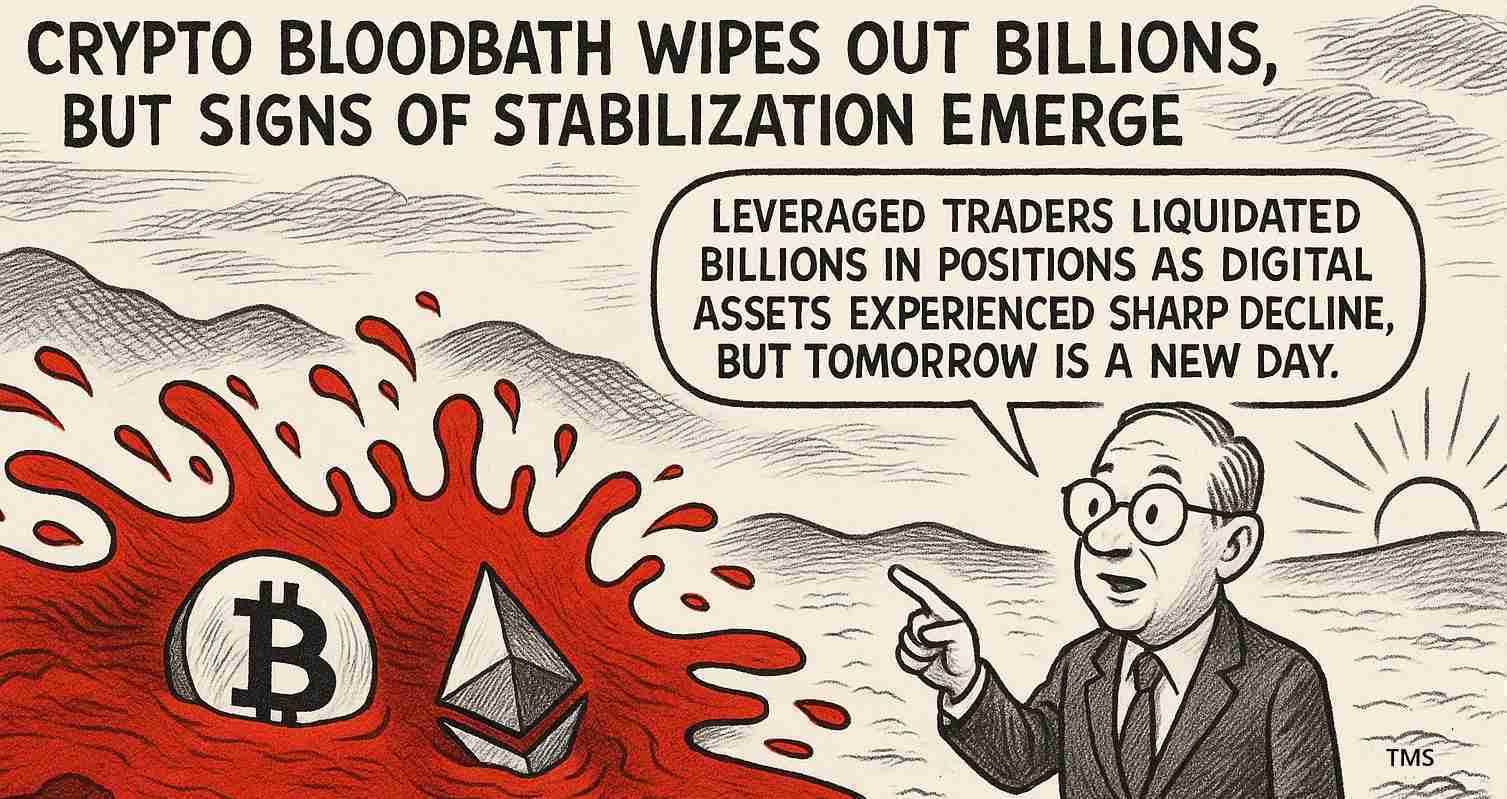
Amid escalating US-China trade tensions, the cryptocurrency market suffered a dramatic crash that liquidated billions in leveraged positions, sending Bitcoin and Ethereum sharply lower and erasing over $200 billion in market capitalization before signs of stabilization emerged.
Key takeaways
- Massive liquidations: Over $19 billion in leveraged positions were wiped out in roughly a day, with ~$7 billion lost in a single hour.
- Market cap shock: Bitcoin and Ethereum falls contributed to a >$200 billion decline in total crypto market capitalization (estimates up to $280B).
- Geopolitical trigger: New US-China tariffs and export controls sparked broad risk-off selling across stocks and crypto.
- Cautious optimism: Analysts flagged early signs of stabilization and the potential for an October rebound and an ensuing “altcoin season.”
Key information
Trigger: Sudden US-China trade measures prompted broad risk-off selling across equities and cryptocurrencies. Coverage of the tariff announcement and market impact was reported by Times of India.
Price moves: Bitcoin plunged from above $125,000 to briefly below $102,000 — an intraday drop near 8.4% and part of an overall decline approaching 18% (TradingView).
Market-cap loss: The total crypto market cap loss exceeded $200 billion, with some estimates nearing $280 billion within 24 hours (247WallStreet).
Liquidations: Data indicated more than $19 billion in leveraged positions liquidated, affecting up to 1.6 million traders and wiping out about $7 billion in a single hour (TradingView; DL News).
Market moves and immediate impact
The rout began when geopolitical news set off a wide risk-off response among investors. Bitcoin, Ethereum and many large altcoins tumbled as holders rushed to sell. Bitcoin’s slide from near $125,000 to about $102,000 erased substantial short-term gains and forced many leveraged traders into automatic liquidations (TradingView).
Ethereum fell below $3,800, while tokens such as Binance Coin and XRP also plunged sharply. Market trackers reported XRP lost nearly 23% during the move, and the broader market cap contraction exceeded $200 billion within 24 hours (Times of India; 247WallStreet).
Why leverage amplified the rout
A central driver was the widespread use of leverage — borrowing to amplify exposure. When prices fall rapidly, leveraged positions face margin calls and forced liquidations. Those automatic closures create a rapid feedback loop of selling that pushes prices further down, triggering yet more liquidations. Analysts described this as the “dark side of leverage.”
“Automatic liquidations overwhelmed the market’s bid side, magnifying losses for retail traders and smaller funds.”
Recorded data showed more than $19 billion in crypto leverage liquidations under a day and about $7 billion in a single hour, a volume of forced selling that considerably worsened market depth (TradingView; DL News).
Geopolitics: US-China trade tariffs and contagion fears
The immediate spark was geopolitical: an announcement of steep new US-China trade tariffs and tighter export controls that hit global technology supply chains. That move pushed investors toward safer assets and away from risk-on positions, including cryptocurrencies (Times of India).
Markets treated crypto as a high-beta asset during the shock. Tariff-driven uncertainty also raised fears of financial contagion — potential knock-on losses among counterparties, exchanges and over-levered lenders — which further pressured prices (DL News).
Expert analysis: why some see stabilization
Despite the sell-off’s scale, several analysts flagged early signs of stabilization within hours. Observers cited technical indicators, order-book depth and Bitcoin’s quick partial recovery after the worst of the drop as reasons for cautious optimism (TradingView).
Market commentators: Ash Crypto — who had forecasted volatility — now anticipates a swift rebound in late October and the possibility of new highs for Bitcoin and Ethereum before year-end if momentum returns (TradingView). Edul Patel, CEO of Mudrex, noted Bitcoin’s quick bounce could signal a capitulation event that opens the door to a recovery and a potential ~21% rally if risk appetite returns and regulatory clarity improves (Times of India).
Sentiment: some traders summed it up simply — “tomorrow is a new day” — indicating belief that forced selling removed short-term risk and left oversold assets for strategic buyers as volatility cools.
Short-term volatility, longer-term questions
Analysts warn high volatility will likely persist as markets digest both the geopolitical shock and the technical aftershocks of massive liquidations. A sustained recovery depends on no further major shocks, improved macro sentiment and clearer regulatory signals — including outcomes around spot U.S. altcoin ETFs and how U.S. policymakers respond to crypto market risk (TradingView; 247WallStreet).
Several analysts forecast a possible rebound later in October and a stronger Q4 run, suggesting an eventual “altcoin season” could follow a recovery in Bitcoin and Ethereum if investor confidence returns (TradingView).
Implications for California
California’s concentration of crypto activity and deep ties to tech mean the state is particularly exposed to swings in digital asset markets. Key areas of impact include:
- Tech firms and startups: Abrupt token markdowns can damage balance sheets, reduce fundraising and slow hiring for crypto startups and trading desks.
- Investors and retail traders: Large shares of U.S. retail crypto trading and tech-worker wealth are concentrated in California metros; forced liquidations can pressure household balance sheets and local spending.
- Pension funds and institutional exposure: While public pensions typically limit direct crypto exposure, indirect links via venture funds could lead to mark-to-market impacts on local investment plans.
- Regulatory and political fallout: State lawmakers may push for tighter consumer protections, disclosure rules and limits on retail access to leveraged products in response to the crash.
- Trade and supply chains: The same US-China tariffs that helped trigger the crash also affect California’s tech manufacturing and software sectors, potentially compounding stress for firms with crypto and hardware exposure (Times of India).
Reporting and market transparency
This episode underscores the need for clearer data and improved transparency across crypto markets. Regulators, exchanges and custodians face pressure to enhance reporting on leverage, derivatives and counterparty risk. Better independent market surveillance and timely data could reduce the scope of sudden liquidations in future shocks (DL News).
For individual investors, the event is a stark reminder about risk management: high leverage can magnify gains but can also erase capital quickly when markets move against a position. Financial advisers and platforms may need to provide stronger education and clearer warnings for leveraged products.
Market data and sources
Key reporting and analysis used for this article include market coverage and liquidation tallies from TradingView, coverage of tariff impacts by Times of India, leverage liquidation reporting by DL News, and market-cap loss estimates from 247WallStreet.
Journalists and market monitors will be watching order books, liquidation statistics and policy developments closely as volatility continues and traders assess whether forced selling has run its course.