Berkeley Scientists Witness Magnetar Birth, Confirm Power Source Behind Superluminous Supernovae and Detect a New “General Relativity Chirp”
Berkeley astronomers directly observed the birth of a magnetar inside supernova SN 2024afav, about one billion light-years away, confirming magnetars power superluminous supernovae and revealing a distinct general-relativity “chirp” in the light curve in unprecedented detail.
- Direct observation: Birth of a magnetar seen in SN 2024afav, ~1 billion light-years away.
- Theory confirmed: Supports the 2010 magnetar-powered SLSNe-I theory explaining long-lasting brightness.
- New signal: A characteristic “general relativity chirp” in the light curve ties Einstein’s theory to the magnetar’s spin-down (Berkeley release).
- Data & publication: Analysis based on continuous Las Cumbres Observatory monitoring and published March 11, 2026, in Nature (UC Berkeley news).
How the magnetar birth was observed
A team of astronomers tracked the brightening and fading of SN 2024afav after its discovery in December 2024. The supernova’s light curve deviated from a normal stellar explosion: instead of a smooth rise and steady fade, researchers recorded distinct bumps and a short, rising chirp in brightness that matched predictions for a newborn magnetar transferring rotational energy to expanding debris.
The team relied on continuous monitoring from the global network of small telescopes at Las Cumbres Observatory (LCO). That uninterrupted coverage allowed detection of rapid changes that larger, sparser surveys can miss — changes that reveal a compact object’s effects as it spins down and injects energetic particles into the debris, keeping the supernova far brighter and longer-lived than ordinary core-collapse events.
What a magnetar is — and why it powers superluminous supernovae
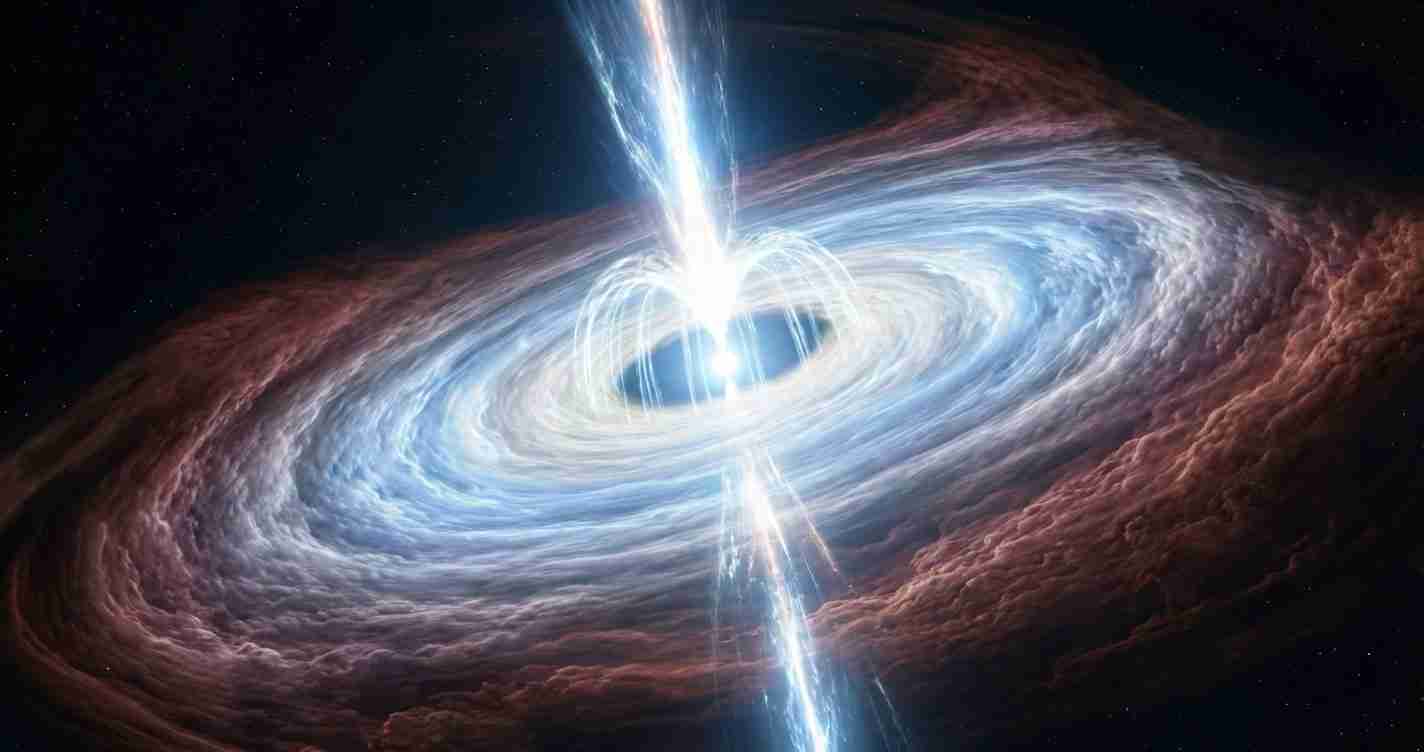
When a very massive star exhausts its nuclear fuel its core can collapse into a neutron star roughly 10 miles across. If the progenitor carried a strong magnetic field, that field can be dramatically amplified during collapse, producing a magnetar with fields hundreds to thousands of times stronger than typical pulsars.
Newborn magnetars can spin extremely fast — hundreds to over a thousand rotations per second. Their spinning magnetic fields accelerate charged particles that slam into the expanding stellar debris, heating it and sustaining extreme luminosity. This mechanism can produce superluminous supernovae (SLSNe-I) that are an order of magnitude or more luminous than typical core-collapse explosions.
Details from SN 2024afav
Modeling of SN 2024afav indicates the newborn compact object had a spin period near 4.2 milliseconds and a magnetic field about 300 trillion times that of Earth — figures consistent with magnetar expectations and far more extreme than ordinary neutron stars.
The observed chirp in the light curve is a key diagnostic: it traces how rotational energy is extracted and deposited into the expanding debris. The research team interprets subtle rises and falls in brightness as a general-relativistic signature tied to the magnetar’s changing spin and frame-dragging effects, directly linking Einstein’s theory to an evolving stellar explosion (LS Berkeley summary, UC Berkeley release).
Historical context — a theory confirmed
In 2010 UC Berkeley theoretical astrophysicist Dan Kasen (with Lars Bildsten) proposed that magnetars could power superluminous supernovae; similar ideas were suggested independently by Stan Woosley. For years SLSNe puzzled astronomers because of their exceptional brightness and prolonged light curves. The detection in SN 2024afav provides direct support for Kasen’s 2010 proposal, turning a long-standing theoretical explanation into an observed physical process (LS Berkeley, UC Berkeley).
Who led the work
The study was led by graduate student Joseph Farah, affiliated with UC Santa Barbara and Las Cumbres Observatory, who will soon join UC Berkeley as a Miller Fellow in Dan Kasen’s group. Key contributors include UC Berkeley professor Alex Filippenko, D. Andrew Howell (LCO/UCSB), Logan Prust (Flatiron Institute), and Yuan Qi Ni (UCSB). The team’s paper was published March 11, 2026, in Nature (UC Berkeley news).
Selected quotes from the team
Alex Filippenko: “To see a clear effect of Einstein’s general theory of relativity is always exciting, but seeing it for the first time in a supernova is especially rewarding.” — National Today
Joseph Farah: “This is the most exciting thing I have ever had the privilege to be a part of… It’s the universe telling us… that we don’t fully understand it yet, and challenging us to explain it.” — UC Berkeley
D. Andrew Howell: “Joseph has found the smoking gun… explained everything with… general relativity. It is incredibly elegant.” — UC Berkeley
Broader scientific implications
The discovery provides a new observational fingerprint — the general relativity chirp — to identify magnetar-powered events and separate SLSNe-I from other bright transients. Building a larger sample of such events will help determine how common magnetar births are and which progenitor stars produce them.
These events probe extreme physics: ultra-strong magnetic fields, rapid rotation, and matter at densities and energies unattainable on Earth. Some magnetars are also suspected sources of fast radio bursts (FRBs); understanding magnetar formation and energy release could clarify connections to FRBs and other millisecond-scale transients (UC Berkeley).
Implications for California
The work was led by California researchers and used networks with strong state ties, reinforcing the state’s leadership in astronomy. Institutions such as UC Berkeley, UC Santa Barbara, and Las Cumbres Observatory played central roles, strengthening the case for federal and private research funding and supporting science jobs across California.
The discovery offers educational and workforce development opportunities: community colleges and universities can use this local success story to recruit students into physics, data science, and instrumentation. Technology and industry ties — robotic telescopes, electronics, software, and remote sensing — may spur demand for California-built instruments and data platforms.
Public interest in planetariums, science centers, and university outreach could increase, boosting cultural tourism and local programming. For policymakers, the result demonstrates measurable returns from basic research: breakthroughs that produce trained graduates, potential patents, startups, and broader economic benefits.
Where researchers go from here
The team plans to search for additional supernovae that exhibit the general relativity chirp. A larger sample will enable tests of frequency and progenitor types for magnetar-powered SLSNe-I. Improved monitoring networks and faster follow-up observations will be essential to catch these brief signals in future explosions (LS Berkeley, UC Berkeley).
Source links
- UC Berkeley news release
- UC Berkeley College of Letters & Science summary
- National Today summary
- Smithsonian Magazine overview
- Research paper: Published March 11, 2026, in Nature (see UC Berkeley news release for citation and links to the journal article).
This observation — the magnetar birth in SN 2024afav and the detection of a general relativity chirp in its light curve — marks a new chapter in the study of superluminous supernovae, bolstering a theory proposed in 2010 and opening paths for future discovery and local scientific investment.