6-million-year-old ice in Antarctica yields ancient air bubbles — a new window on Earth’s Pliocene past
Researchers recovered roughly six-million-year-old ice in East Antarctica’s Allan Hills, containing trapped air bubbles — the oldest directly dated ice and ancient atmosphere yet recovered, providing a direct window into Earth’s warmer Pliocene climate and greenhouse gases.
- What was found: Ice dated to about 6 million years from the Allan Hills Blue Ice Area — see the WHOI press release.
- Why it matters: The ice contains ancient air bubbles that preserve atmospheric samples from the Pliocene — detailed in reporting by IFLScience.
- Who led the work: The effort is part of the Center for Oldest Ice Exploration (COLDEX, WHOI), with Sarah Shackleton (WHOI) and John Higgins (Princeton) among principal investigators.
- Main result: Isotopic analyses indicate roughly a 12°C (22°F) long-term cooling in Antarctica since the Pliocene — see coverage and analysis at ClimateChange.Umaine.edu and the WHOI release.
Fresh air from the deep past
The most striking element of the discovery is the ancient air trapped within tiny bubbles in the ice. When snow compacts into ice, those bubbles become sealed time capsules. Sampling them lets scientists measure gases such as carbon dioxide and methane as they existed millions of years ago — a direct archive noted by IFLScience.
The research team used isotopes of noble gases — notably argon isotopes — trapped in the bubbles to directly date the ice, avoiding reliance on indirect proxies. That precise dating is essential to link atmospheric composition to known Pliocene climate events (WHOI; PNAS).
Where the ice came from
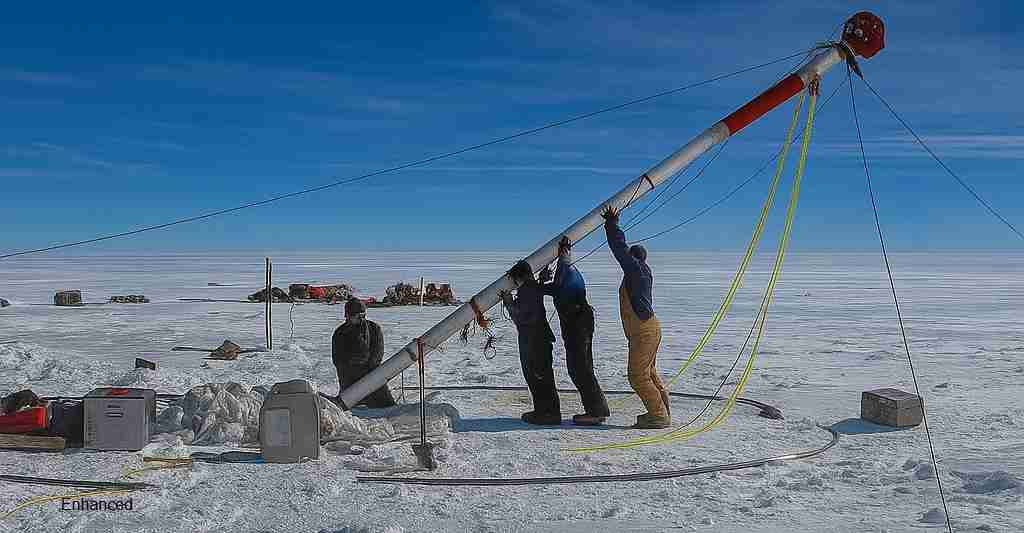
The samples were recovered from the Allan Hills blue ice area, where strong winds and local topography expose very old ice at the surface. These exposures make blue ice areas prime targets to find ancient material without drilling through kilometers of newer snowfall (WHOI).
Blue ice areas do not provide continuous records like deep, unbroken cores from the East Antarctic Plateau. Instead, the Allan Hills material offers snapshots that—when combined—can extend direct atmospheric records far beyond the ~800,000‑year limit of previous continuous ice cores (PNAS).
Major scientific findings so far
Oxygen isotope analyses of the ice indicate a long-term Antarctic cooling of roughly 12°C since the Pliocene. That magnitude of cooling helps explain the growth of ice sheets and falling sea levels over millions of years (ClimateChange.Umaine.edu; WHOI).
Crucially, the trapped bubbles allow direct measurement of greenhouse gases during that long cooling phase. Quantifying ancient CO₂ and CH₄ will help refine estimates of climate sensitivity and natural variability, and provide benchmarks to test model simulations.
Research team and next steps
The project is led by the Center for Oldest Ice Exploration (COLDEX, WHOI), an NSF-funded collaboration among universities and labs. Principal investigators include Sarah Shackleton (Woods Hole Oceanographic Institution) and John Higgins (Princeton University).
Teams plan targeted drilling in Allan Hills between 2026 and 2031 to recover older sections and build a more detailed mid‑to‑late Pliocene timeline. Upcoming studies will emphasize greenhouse‑gas measurements and comparisons with younger, continuous Antarctic cores.
Limits and caveats
Scientists emphasize that Allan Hills deposits are patchwork exposures rather than continuous timelines. Researchers must carefully match samples and dates before drawing broad conclusions. Nevertheless, direct air samples reduce some uncertainties inherent in proxy reconstructions (PNAS).
“These snapshots provide new, independent tests for climate models and for understanding long-term changes—not a simple, continuous record but a powerful complement to deep cores,” the team notes.
Implications for California
Economic impact: California’s coastal economy depends on accurate sea-level projections. The Pliocene was warmer with higher seas; direct measurements of ancient atmospheric gases and temperatures can improve models used for estimating coastal risk and infrastructure costs (WHOI).
Political consequences: High-quality data can help policymakers prioritize spending on zoning, building codes, and mitigation. Better-tested models reduce uncertainty and support fiscally prudent approaches to long-term coastal defense (PNAS).
Social effects and practical applications: Improved risk assessments inform emergency planning, insurance, and infrastructure design—helping communities, utilities, and transportation agencies implement staged, cost‑effective upgrades rather than emergency reactive spending (ClimateChange.Umaine.edu).
For policy‑minded readers, the discovery strengthens the scientific toolkit available to decisionmakers: direct records of ancient greenhouse gases and temperatures provide benchmarks for testing and improving climate models, which in turn reduce uncertainty for long-term planning.
Ongoing science and access to data
The team will continue sampling, analysis, and peer‑reviewed publication. Public data releases and independent replication are planned so state agencies and researchers can incorporate results into regional risk assessments (WHOI; PNAS).
Researchers caution that translating million‑year timescales into immediate policy actions requires care, but the Allan Hills discovery provides sharper tools to plan for long‑term risks and make defensible decisions about infrastructure, zoning, and emergency response.
Sources and further reading
- WHOI: Six-million-year-old ice discovered in Antarctica offers unprecedented window into a warmer Earth
- IFLScience: The oldest ice ever recovered contains Antarctic air bubbles from 6 million years ago
- ClimateChange.Umaine.edu: Ice-core analysis reveals cooling period 6m years ago
- Proceedings of the National Academy of Sciences (PNAS): Peer-reviewed analysis