
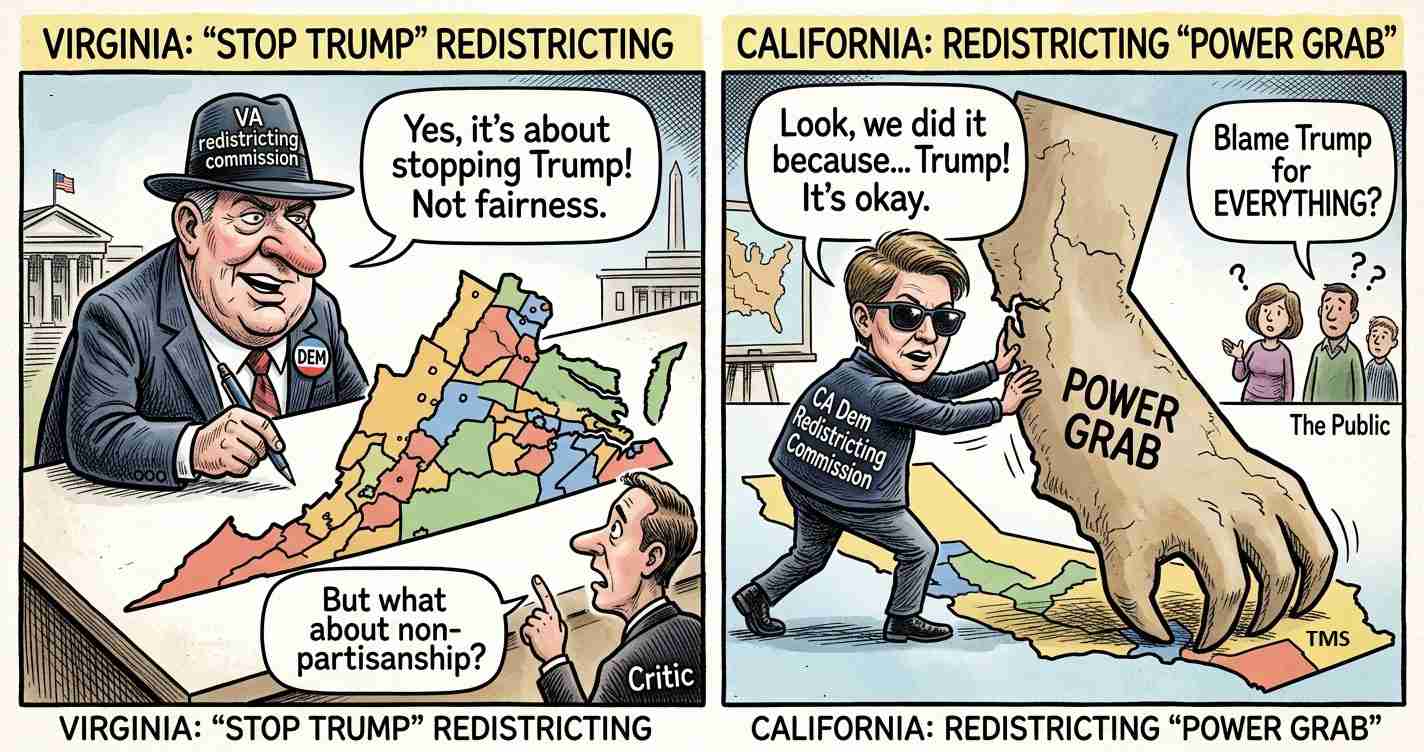
Virginia redistricting amendment draws fire — critics say map is about stopping Trump, not restoring fairness
Virginia Democrats have proposed an amendment to suspend the bipartisan redistricting commission and redraw congressional lines before the 2026 midterms — a move critics call a partisan gerrymander that could create a 10–1 Democratic map if approved in April 2026.
Key takeaways
- What’s proposed: Letting the General Assembly temporarily adopt new congressional districts instead of the bipartisan commission — supporters call it corrective, critics call it partisan. YouTube video (RXC6Q4VJ6z4), YouTube video (zsyDVr2oW_Q)
- When: Referendum set for a special election on April 21, 2026; early voting begins March 6, 2026. YouTube video (RXC6Q4VJ6z4)
- Political stakes: Critics say it’s a power grab designed to help Democrats win multiple House seats in 2026; supporters say it restores fairness after other states’ maps. CBS News
Main content
Key information
What: A proposed constitutional amendment would allow the General Assembly to temporarily adopt new congressional districts instead of the bipartisan commission established after the 2020 redistricting cycle. Support material and public statements are documented in video coverage. YouTube video (RXC6Q4VJ6z4), YouTube video (zsyDVr2oW_Q)
When: The referendum is slated for a special election on April 21, 2026; early voting begins March 6, 2026. YouTube video (RXC6Q4VJ6z4)
What it would do: Democrats say it would restore fairness after aggressive redistricting elsewhere; critics say the draft would produce a potential 10–1 Democratic map by shifting several Republican districts into suburban Northern Virginia. YouTube video (H5EBfHVe3XE), YouTube video (tb2WGxnNc98)
Drafted map and Democratic defense
In February 2026, Democratic lawmakers in Richmond finalized a proposed map they say would “level the playing field.” The plan shifts from the current 6D–5R split toward a possible 10D–1R arrangement. Supporters frame the measure as a temporary, extraordinary corrective step through the decade. YouTube video (H5EBfHVe3XE)
Governor Abigail Spanberger and other Democratic leaders have urged voters to support the amendment, arguing it responds to partisan maps in other states and protects representative balance. YouTube video (RXC6Q4VJ6z4)
Critics: partisan map, “manifestly unfair”
Republican leaders have blasted the plan. House Minority Leader Terry Kilgore called the map “manifestly unfair” for a state that votes nearly evenly in national elections. Rep. Ben Cline said the proposal is about political power rather than constituent representation, warning it would carve Republican areas into Fairfax-connected pieces favoring Democrats. YouTube video (RXC6Q4VJ6z4), YouTube video (zsyDVr2oW_Q)
Republican state lawmakers and national GOP groups have filed lawsuits challenging the process. A lower court found procedural flaws in parts of the legislative process; appeals and further litigation are ongoing. The RNC and NRCC joined challenges. YouTube video (H5EBfHVe3XE), YouTube video (dAZCPHhXk5Y)
The Beyer comment and perceptions of motive
Tensions escalated after comments by Rep. Donald Beyer in an interview about early voting that opponents say exposed political motives. Republicans highlighted the exchange as evidence Democrats view the exercise as a way to “stop Donald Trump” and reclaim the House. There is no full-text clip confirming an exact phrase matching those accusations, but the exchange intensified GOP claims that the amendment is nationally motivated rather than solely about state fairness. YouTube video (RXC6Q4VJ6z4), YouTube video (zsyDVr2oW_Q)
Public opinion and polling
Polling indicates many Virginians favor the existing independent commission. A February 2026 Roanoke College Poll found 62% support for the independent commission created in 2020. When asked about the amendment, 52% said they would vote no, 44% yes, and 4% unsure — signaling public skepticism for replacing an impartial process with legislator-drawn lines. YouTube video (zsyDVr2oW_Q)
Map details and district changes
Draft maps would draw heavily on dense, Democratic-leaning Northern Virginia—especially Fairfax County—to power multiple districts, producing oddly shaped, elongated districts critics label “spaghetti” or “scorpion” maps. Several current Republican-held districts, including the 7th, could see their composition reshaped to favor Democratic challengers. YouTube video (zsyDVr2oW_Q), YouTube video (tb2WGxnNc98)
Legal fight and timeline
Democrats advanced the measure in special sessions in late 2025 and finalized it by February 2026. The plan requires voter approval in the April referendum to take effect. Meanwhile, litigation challenges both process and substance; lower courts have flagged procedural problems and appeals are pending — the legal outcome could determine whether the map is used in the 2026 midterms. YouTube video (H5EBfHVe3XE), YouTube video (dAZCPHhXk5Y)
National context
Virginia’s effort is part of a broader national battle over congressional maps ahead of 2026. Both parties are pursuing state-level strategies to affect U.S. House control; Virginia is closely watched because flipping multiple seats there could offset gains elsewhere and shape the House majority. CBS News
Transparency concerns and messaging
Opponents argue the ballot language — which asks voters to allow the General Assembly to “temporarily adopt” congressional districts to “restore fairness” — obscures the political consequences. The tagline “restore fairness” has become a flashpoint: supporters say it corrects imbalance, while critics say the definition of fairness used here is narrow and politically motivated. Campaign ads and billboards have amplified confusion and anger on both sides. YouTube video (RXC6Q4VJ6z4)
Who stands to gain or lose
If enacted, up to four Republican seats could be reshaped into heavily Democratic districts drawing their voting power from Fairfax and other urban centers; one Republican district would remain favorable to GOP voters. Democrats argue the map reflects population shifts and counters outside partisan maps; Republicans contend it strips meaningful representation from many Virginians. YouTube video (H5EBfHVe3XE), YouTube video (tb2WGxnNc98)
Implications for California
Economic impact: California businesses and political donors monitor national balance of power. A 10–1 Democratic map in Virginia could help Democrats retain a U.S. House majority, affecting federal tax, spending, infrastructure grants and wildfire funding that matter to California jurisdictions. CBS News
Political consequences: House control influences federal policy on immigration, trade and regulation important to California’s economy. The controversy also offers a messaging template — “fairness” vs. “partisan power grabs” — that California actors may cite in future redistricting debates. YouTube video (RXC6Q4VJ6z4), YouTube video (zsyDVr2oW_Q)
Social and cultural effects: The fight underscores urban–rural representation tensions. Virginia’s debate over using dense urban populations to reshape neighboring districts may echo in California’s coastal-versus-inland clashes and test faith in institutions like independent commissions. YouTube video (zsyDVr2oW_Q)
Practical applications: California election officials, campaign strategists and civic groups should watch legal rulings and voter reactions in Virginia; outcomes could inform how parties allocate resources and influence local redistricting discussions. YouTube video (H5EBfHVe3XE)
Sources and further reading
- YouTube video (RXC6Q4VJ6z4)
- YouTube video (H5EBfHVe3XE)
- YouTube video (SdsyJ-FMWwM)
- YouTube video (tb2WGxnNc98)
- YouTube video (zsyDVr2oW_Q)
- YouTube video (dAZCPHhXk5Y)
- CBS News: What Virginia Democrats’ redistricting effort could mean for control of the House
“The ballot language to ‘temporarily adopt’ districts to restore fairness has become the central flashpoint — what supporters call correction, opponents call a power grab.” — Reporting from Richmond, Virginia
Reporting compiled from legislative sessions, public statements, polling and the linked video and news sources above. All original facts and URLs are preserved through the linked sources.



