Wild scene as protesters trap federal agents at Tucson Taco Giro parking lot in Tucson Taco Giro raid; multiple arrests, pepper spray used
On Friday, December 5, 2025, a federal immigration and tax investigation at Taco Giro in Tucson escalated into a chaotic confrontation as protesters surrounded agents, briefly trapping some in a gated parking lot while officers used crowd-control measures.
Key takeaways
- Large protest: An estimated 100–200 demonstrators surrounded federal agents at the Taco Giro on North Grande Avenue, blocking a gated parking lot exit.
- Federal operation: ICE HSI, IRS Criminal Investigation and other federal partners executed warrants in a wider immigration and tax probe.
- Force used: Agents deployed flash-bangs, pepper spray, pepper balls and tear gas; at least two protesters were arrested.
- Local reaction: Tucson leaders condemned the tactics as disproportionate; Tucson Police said it did not deploy munitions or make arrests.
Background of the operation
Federal agents executed 16 search warrants across southern Arizona on Friday as part of a yearslong federal immigration and tax investigation targeting the Taco Giro restaurant chain and related locations, including residences and businesses in Tucson and Sierra Vista.
The operation included agents from ICE, ICE Homeland Security Investigations (HSI), IRS Criminal Investigation and other federal partners, according to reporting by local and national outlets.
Agents arrived at the Taco Giro on North Grande Avenue at about 9 a.m., before the restaurant opened. They searched the restaurant and arrested workers and others linked to the probe. Photos circulated showing several men in handcuffs being loaded into federal vehicles; local outlets covered the sweep in the broader enforcement context.
Protest and confrontation
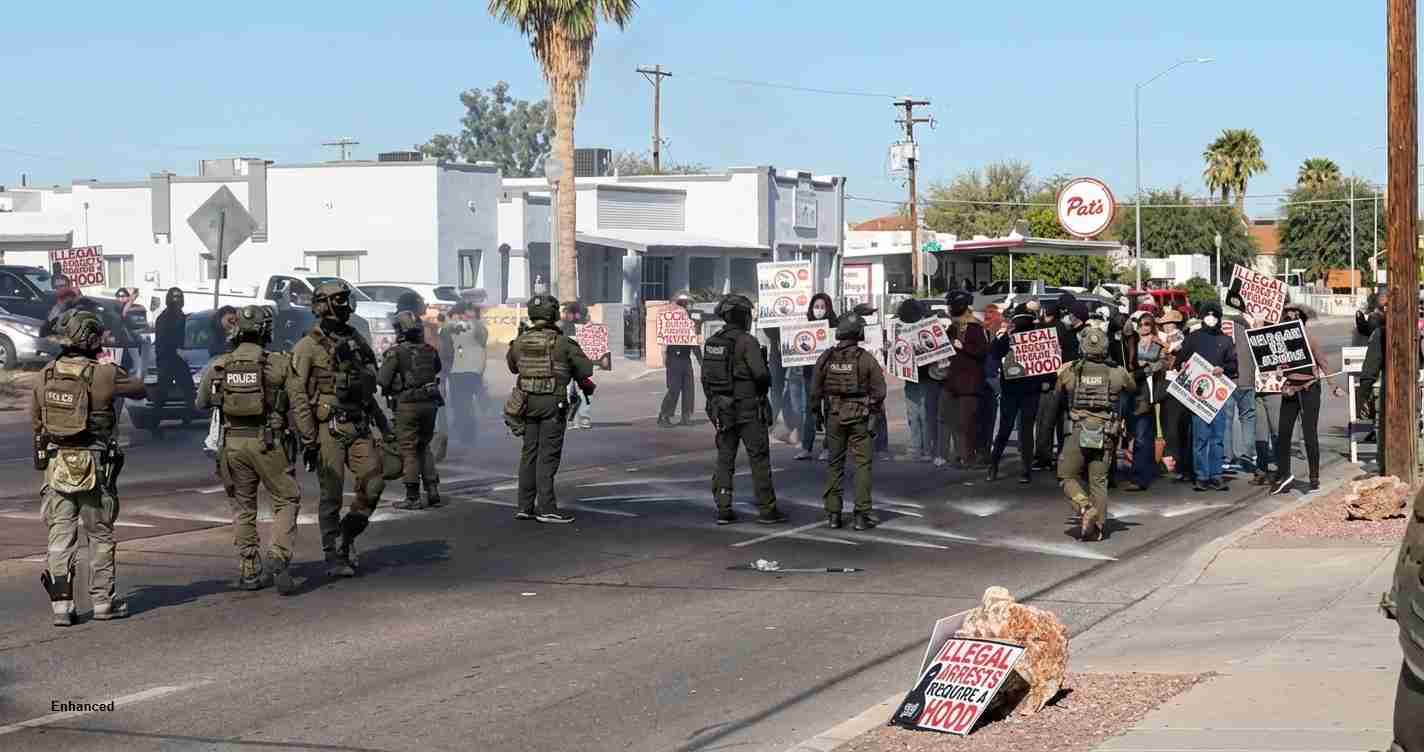
Within roughly an hour of the raids, neighbors and activists gathered. Estimates put the crowd between 100 and 200 people chanting slogans such as “Go home ICE” and “¡No pasarán!” — a mix of immigrant-rights supporters, community members and neighbors who said they were protecting restaurant workers.
A group of demonstrators moved to the gated parking lot where agents were operating. Video shows people surrounding the lot and preventing agents from leaving; witnesses and footage indicate some protesters used a bike lock and other objects to secure the gate, temporarily trapping agents inside.
“People outside the gate sang and chanted while others physically blocked the exit,” said witnesses and local journalists who documented the standoff.
Use of force and arrests
As agents sought to clear a path, they deployed flash-bang devices, pepper spray, pepper balls and released tear gas canisters into the crowd, according to video and reporting. Demonstrators coughed and staggered from chemical irritants as clouds moved across the street.
At least two protesters were taken into custody and held in the back of a federal vehicle; authorities did not immediately release names or formal charges. The use of munitions and chemical agents prompted swift criticism from city leaders and community groups.
Rep. Adelita Grijalva at the scene
U.S. Representative Adelita Grijalva visited the site to observe and question agents about detainees. Grijalva and members of her staff said they identified themselves as congressional aides and were pepper-sprayed while engaging with agents.
She described seeing roughly 40 agents in tactical gear, many wearing masks and helmets, and called for greater oversight of federal immigration enforcement and clarity about officers wearing nontraditional or unmarked uniforms.
Local officials and law enforcement roles
Tucson Mayor Regina Romero and Vice Mayor Lane Santa Cruz condemned the federal response as “disproportionate” and urged witnesses to preserve video and photos for possible review. They emphasized that the Tucson Police Department did not deploy munitions or make arrests; TPD said its role was limited to traffic control and public safety.
TPD later responded to a separate protest at the ICE field office on Tucson’s south side, where some demonstrators reportedly banged on a fence; federal agents inside that site again used pepper spray, but no major injuries were reported, TPD said.
Media coverage and documentation
Local and national outlets, community journalists and bystanders documented the raid and confrontation with photos and video. Multiple organizations published images of agents in tactical gear, crowds affected by chemical agents and moments when gates were blocked.
Notable coverage includes reporting by Arizona Daily Star, The Marshall Project, KGUN9 and Fox News.
Ongoing context
The Taco Giro confrontation lands amid national debates over immigration enforcement, sanctuary policies and federal law enforcement in local communities. Tucson voters rejected a formal sanctuary ordinance in 2019; advocacy groups have renewed calls for stronger local protections after high-profile enforcement actions.
City leaders and advocates say the episode raises questions about federal power, community safety and respect for due process as enforcement actions play out in neighborhoods.
Implications for California
Economic impact
Restaurants and small businesses in California that serve immigrant communities may feel a chill after widely circulated images of agents in tactical gear. Patrons and workers could stay away from restaurants and markets that serve immigrant populations, affecting sales and staffing.
Regions with close economic ties to Arizona, and California areas with large immigrant workforces — such as the Central Valley, Los Angeles and Imperial counties — could see hiring pressures if workers fear enforcement actions.
Political consequences
The event may deepen tensions for moderate conservative Californians balancing law enforcement with community trust. California lawmakers could invoke the raid in debates over federal tactics, sanctuary policies and rules governing local cooperation with federal immigration agents.
Social effects
Community organizers in California often mobilize quickly after high-profile raids to offer legal aid, document encounters and encourage preservation of evidence. Fear of enforcement can reduce crime reporting and cooperation with local police, undermining public safety.
Cultural relevance
Images of federal agents in unmarked gear confronting residents resonate in California, where debates over public safety and civil liberties are ongoing. The clash underscores the challenge of balancing enforcement with due process and community trust.
Practical applications for residents
- Employers & managers: Review workplace policies, ensure access to legal counsel and inform employees about rights during federal actions.
- Community members: Preserve video and photos, note times and locations, and contact legal-aid groups if anyone is detained.
- Elected leaders: Clarify how local law enforcement will respond to federal actions and inform the public about available protections.
Reporting note and sources
This article draws on reporting and documentation from local and national news organizations and official agency sites. See coverage and resources from: Arizona Daily Star; The Marshall Project; KGUN9; Fox News; ICE; ICE Homeland Security Investigations (HSI); IRS Criminal Investigation; and the Tucson Police Department.
Reporting by Times Media Service; additional local and national outlet coverage cited above.