
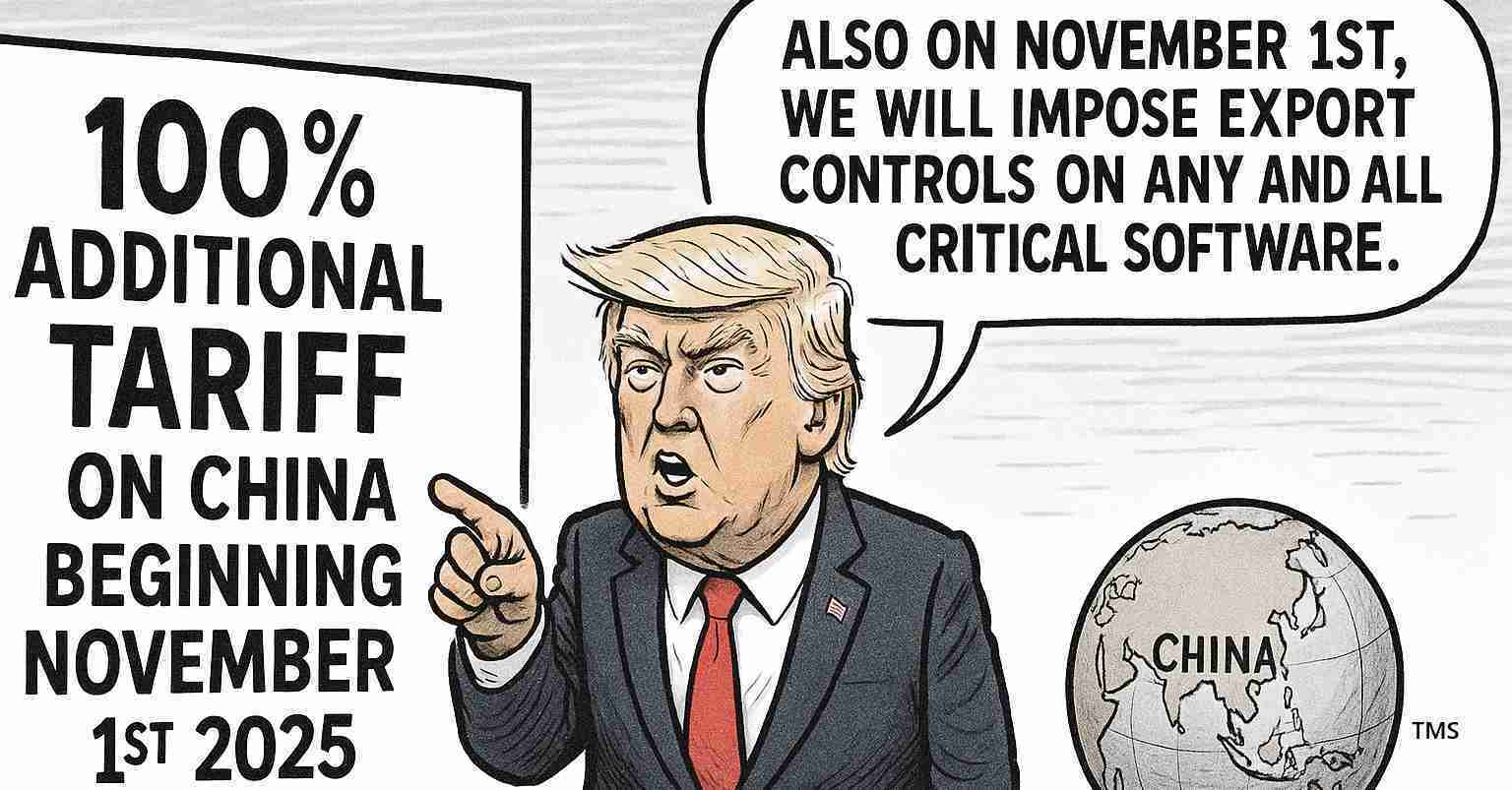
Trump Announces 100% Additional Tariff on China, Cites Beijing’s Rare Earth Export Controls
President Donald Trump announced an additional 100% tariff on all imports from China, effective November 1, 2025, and new export controls on critical software, citing Beijing’s tightened rare earth export rules as the trigger for the escalation.
Key takeaways
- 100% extra tariff: An additional 100% tariff on all Chinese imports will apply beginning Nov. 1, 2025, added to existing duties — reported by CBS News and the Economic Times.
- Export controls: The package includes export controls on “any and all critical software” to restrict access to sensitive code and systems (CBS News).
- Response to rare earth curbs: The administration framed the action as retaliation for China’s expanded export controls on rare earths and related production technologies (Economic Times).
Main story
Background: China’s expanded export controls
China has broadened rules limiting exports of certain rare earth elements and related technologies. The new controls add elements such as holmium, erbium, thulium, europium and ytterbium, bringing the number of controlled rare earth types to 12 of 17, according to reporting by the Economic Times.
The rules also target production technologies and overseas uses. Under Beijing’s guidance, any product containing trace amounts of Chinese rare earths — even if assembled outside China — may now require special export approval. China’s Ministry of Commerce frames the measures as steps to protect national security and prevent sensitive military or defense-related uses (Economic Times; CBS News).
U.S. rationale and escalation
The administration called Beijing’s move “extraordinarily aggressive” and presented the new U.S. measures as necessary to protect American security and industry. President Trump described China’s export curbs as hostile and harmful to global markets in public remarks (CBS News).
Officials said the tariffs and export controls will remain in place until conditions change; one trade tracker noted they could last “until the war in Ukraine ends,” per Trade Compliance Resource Hub, though that phrasing is not widely repeated in mainstream outlets.
Diplomatic signals: The White House warned the start date could move earlier depending on China’s actions and signaled a broader freeze in high-level diplomacy, even threatening to cancel a planned summit with President Xi Jinping (thejournal.ie).
What the measures include
- 100% additional tariff on all imports from China, added to duties that in many cases already reach ~30% (CBS News).
- Export controls on “any and all critical software” described as tools to restrict Chinese access to sensitive code and systems (CBS News).
- Unilateral implementation: The U.S. is acting without waiting for multilateral coordination to counter what officials call China’s strategic chokehold on rare earths (CBS News; Economic Times).
Economic and global implications
China supplies an estimated up to 95% of the world’s rare earth magnets — essential for electric motors, wind turbines, semiconductors, batteries and many defense systems (CBS News).
The U.S. response aims to blunt Beijing’s leverage but could cause rapid ripple effects. For manufacturers, the extra tariff could double import costs for many Chinese-made components, forcing them to absorb costs, raise consumer prices, or shift suppliers and production. Sectors likely affected include semiconductors, electric vehicles, aerospace and defense (CBS News; Economic Times).
Economists warn supply-chain fragmentation could raise prices and slow growth, while trade partners may face export-approval burdens if products contain Chinese inputs.
Legal and diplomatic risks
The sweeping, unilateral tariff increase exposes the administration to possible World Trade Organization challenges and disputes with trade partners. Beijing could retaliate with its own tariffs or tighter export rules, deepening diplomatic tensions amid existing technology and security disputes (CBS News; Economic Times).
Implications for California
Economic impact
California’s economy is tightly linked to tech and clean-energy supply chains reliant on rare earths. The extra 100% tariff could raise component costs for EV makers, battery firms, semiconductor companies and other high-tech manufacturers, squeezing margins and increasing consumer prices (CBS News; CBS News).
Ports and logistics
California ports — notably Los Angeles and Long Beach — handle a large share of U.S.-China trade. Sharp tariff changes could disrupt cargo flows, reduce volumes, and affect trucking, warehousing and port employment.
Technology and manufacturing
Silicon Valley and other hubs may face higher hardware costs and supply risks. Semiconductor fabs, defense contractors and hardware manufacturers could see production pressure if rare earth shortages or export controls limit access to critical inputs (CBS News).
Labor and jobs
While higher costs may accelerate reshoring and create U.S. jobs over time, in the short term many manufacturers could delay expansion or reduce operations, putting jobs in logistics and manufacturing at risk.
Political consequences for the state
California leaders must weigh consumer and business cost concerns against security arguments for countering China. The debate may spur incentives for domestic manufacturing, strategic mineral stockpiles, and allied cooperation to reduce reliance on Chinese inputs (CBS News).
Practical effects for residents
Consumers could see higher prices for electronics, electric vehicles and appliances, and face potential short-term shortages or longer delivery times. Californians working in ports, logistics and manufacturing may face uncertainty as markets and supply chains adjust (CBS News; Economic Times).
Legal and diplomatic aftermath — what to watch
“The broad, unilateral nature of these measures makes legal challenges and reciprocal actions likely, and the geopolitical fallout could reshape trade alliances and supply-chain strategies.”
Watch for WTO filings, retaliatory tariffs from Beijing, changes to export-approval processes for products with Chinese inputs, and shifts in corporate supply-chain strategies.
Sources and further reading
- CBS News reporting on the U.S. tariff announcement and measures
- CBS News reporting on rare earth elements and implications
- Economic Times coverage of China’s expanded rare earth controls
- Trade Compliance Resource Hub tariff tracker
- Report on diplomatic tensions and potential summit cancellation (thejournal.ie)
Reporting for CNN from Times Media Service.



