Palantir CTO Says AI Is Driving a Blue-Collar Productivity Boom — Sanders Warns of Job Losses, Calls for Data Center Moratorium
Palantir CTO Shyam Sankar says AI is driving a blue-collar productivity boom in manufacturing and frontline sectors, boosting hiring, shortening training and improving operations — a claim that clashes with Sen. Bernie Sanders’ warnings about mass job losses.
Key takeaways
- AI boosts frontline productivity: Sankar describes an “AI blue-collar productivity boom” that helped some factories add shifts and hire more workers, according to Fox Business.
- Policy clash: Sen. Bernie Sanders warned of “massive unemployment” and urged a moratorium on data center construction to slow AI deployment and allow regulation, per Fox Business.
- Evidence is anecdotal: Sankar’s examples come from pilots and company anecdotes; broader labor-market effects remain unproven (coverage includes moomoo and MLQ).
Main story
What Sankar told Fox Business
Shyam Sankar, Palantir’s chief technology officer, told Fox Business on December 17, 2025, that many AI stories focus on software engineers and venture capital — while missing how AI helps frontline workers do more, faster, with less training. He pointed to customers in manufacturing where production-planning and labor-scheduling tools allowed a plant to add a third shift by using labor more profitably, creating new U.S. jobs instead of cutting them.
“AI blue-collar productivity boom” — Sankar used this phrase to summarize benefits for factory foremen, ICU nurses and battery technicians, saying AI shortened training times and improved labor use.
Sankar’s specific examples
Sankar cited concrete instances where AI allegedly improved outcomes:
- Factory floors: AI systems that balance production lines and schedule labor freed up time for workers to assemble parts and meet demand (coverage includes MLQ).
- Battery plants: He pointed to Panasonic Energy, claiming AI tools cut training for skilled battery technicians from three years to three months, enabling hiring from other industries (examples summarized by moomoo and Fox Business).
- Health care: AI can reduce the time nurses spend gathering patient data, giving ICU staff more time for direct patient care, Sankar said (Fox Business).
Sankar’s framing and prescriptions
Sankar argued automation and AI will often change job tasks rather than eliminate livelihoods, calling talk of mass joblessness “propaganda” from parts of Silicon Valley. He also urged stronger focus on the “demand side” — getting tools into businesses and workers — and recommended hands-on training programs, including Palantir’s meritocracy fellowship for high school seniors (Sankar’s essay; Fox Business).
Sanders’ warning and policy push
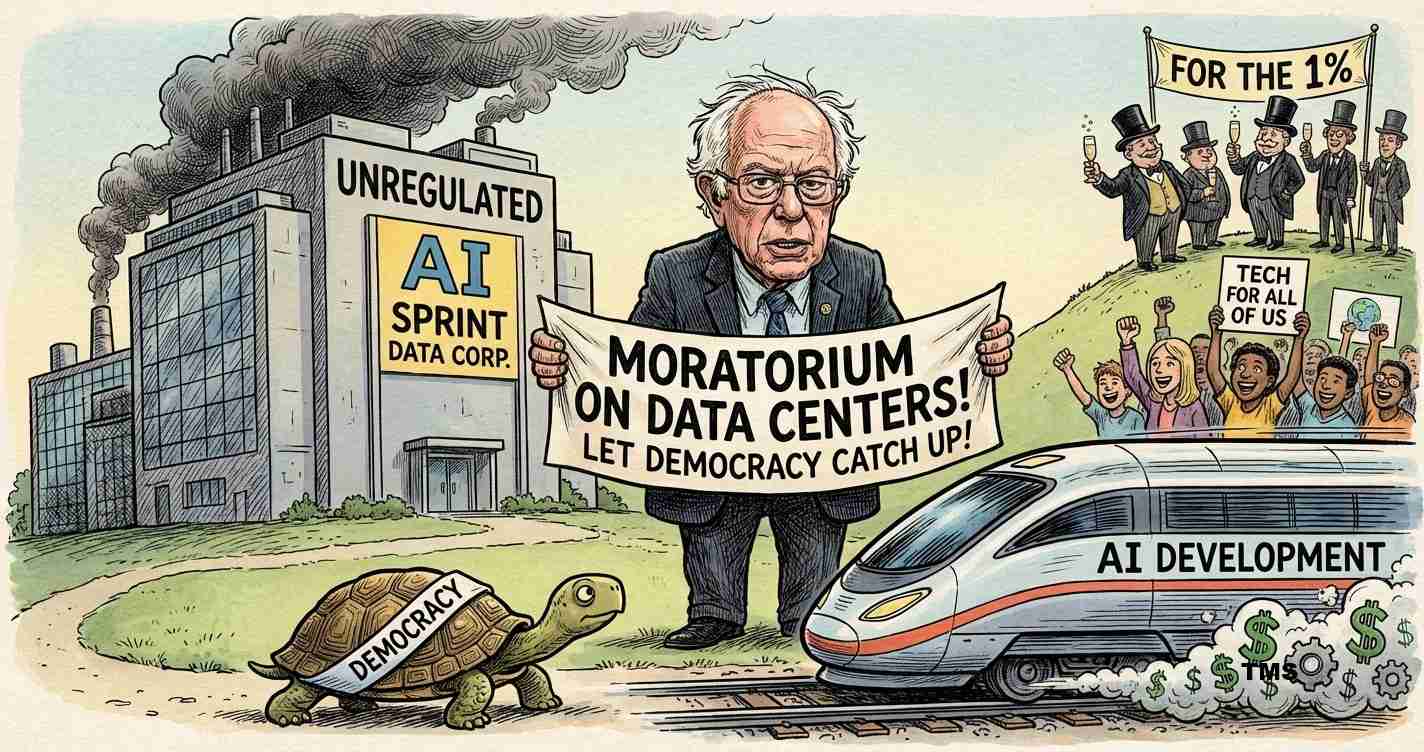
Sen. Bernie Sanders posted a video on X warning of “massive unemployment” from AI and robotics and urged a moratorium on building more data centers — the backbone of fast AI development — arguing a pause would give lawmakers time to create regulations so AI’s gains don’t go only to billionaires (Fox Business).
Sanders framed the moratorium as a way to let “democracy catch up” and bring national debate about the distribution of AI’s gains, stressing systemic risks — from unemployment to concentration of wealth — while focusing on precautionary policy rather than new empirical job-loss estimates.
Where the evidence stands
Assessment: Sankar’s claims are largely supported by company anecdotes and pilot projects where AI tools improved throughput or cut training time. These examples are vivid but do not prove broad labor-market trends. Reporting on these claims includes Fox Business and investment summaries like moomoo.
Sankar himself notes technology alone does not solve stagnation; implementation and company incentives matter, and training on the job is critical (Sankar’s essay).
Gaps and questions investigators should watch
- Scale: Are the manufacturing and healthcare examples replicable at scale across U.S. industry? Public data remain limited (Fox Business; MLQ).
- Job quality: Do new roles maintain wages and benefits comparable to the jobs replaced? Reporting has not fully documented outcomes.
- Regional impact: How would a data center moratorium affect states differently — infrastructure, tax revenue and local jobs are at stake (Fox Business).
Implications for California
Economic impact
California sits at the center of this debate: it hosts major data center clusters, big tech firms building AI models, and large manufacturing and logistics operations that could benefit from Palantir-style tools. A moratorium on data centers could slow new cloud capacity and delay productivity gains, while unchecked growth can strain local infrastructure and raise costs for electricity and real estate (Fox Business).
Jobs and workforce
If Palantir AI manufacturing tools scale, California could see faster training pipelines for blue-collar work and more hiring in advanced manufacturing, energy storage and medical services. Training programs that cut battery technician onboarding, for example, could help meet EV supply-chain demand. But without safeguards, outcomes could be uneven; community colleges and workforce programs may need expanded funding (Sankar’s essay).
Political consequences
Moderate voters often favor pro-jobs, pro-business strategies that protect communities. Policymakers must balance economic growth from AI tools with concerns about local impacts from data center expansion; targeted rules on energy, zoning and worker protections may be more politically palatable than a blanket moratorium.
Social and practical effects
For frontline workers — from ICU nurses in Los Angeles to battery technicians in the Central Valley — AI promises tools that could reduce routine tasks and speed training, translating into more time for patient care and pathways for nontraditional entrants. Local leaders should plan for retraining, portable benefits and community investments where automation changes job composition (moomoo).
Cultural relevance
Californians value both innovation and fairness. The debate between Sankar’s “AI blue-collar productivity boom” and Sanders’ warnings about inequality will play out here; business and policy leaders must demonstrate how AI-driven growth benefits broad communities, not just shareholders.
Policy levers for the state
California can pilot balanced steps: invest in workforce training and community college partnerships, require energy and land-use reviews for new data centers, and create tax incentives tied to local hiring and wage standards. Such measures aim to capture productivity gains while addressing distributional concerns (Fox Business; Sankar’s essay).
Reporting notes and sources
This article draws on Shyam Sankar’s interview on Fox Business (December 17, 2025), reporting summaries such as moomoo, Sankar’s writing on technology (Sankar essay), production-line coverage (MLQ), and a short video example (YouTube short).
Key sources preserved: Fox Business; moomoo; Sankar essay; MLQ; YouTube short.