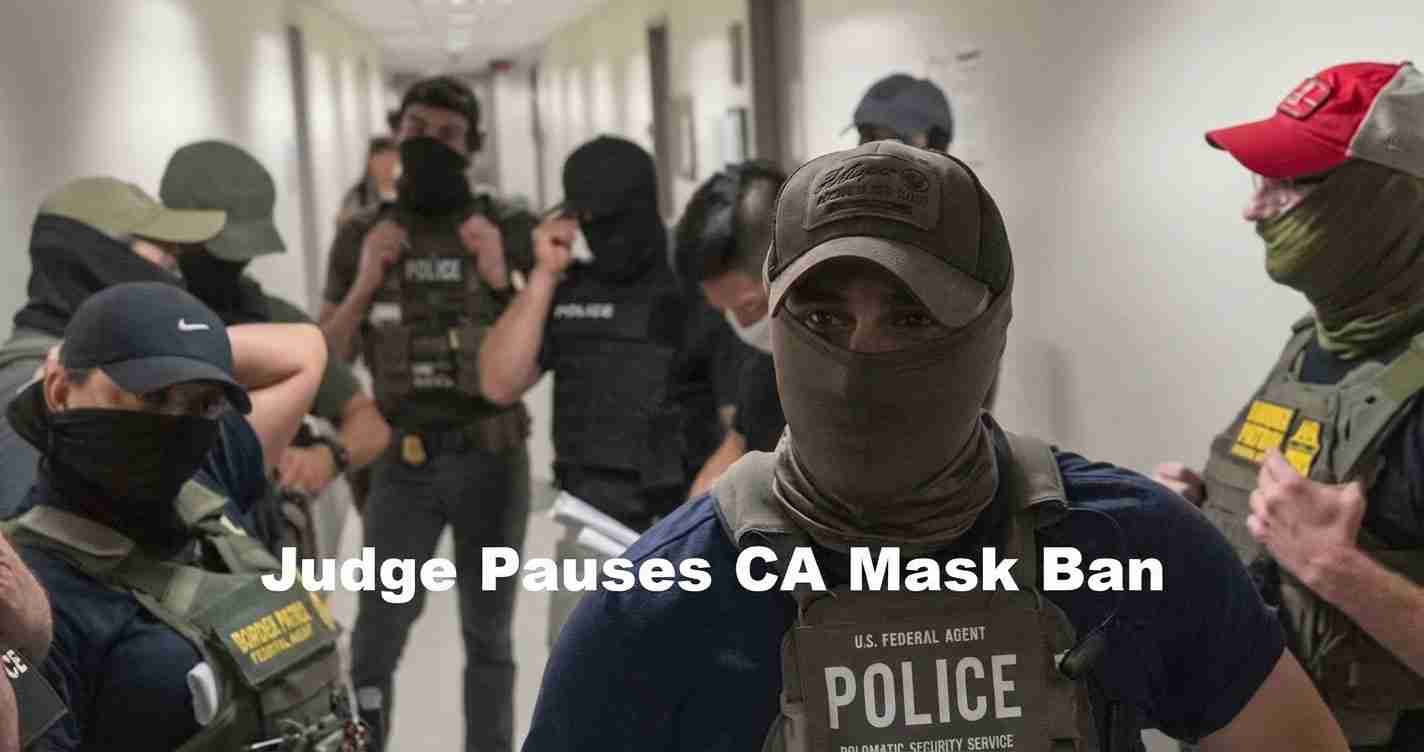
Federal judge blocks California’s mask ban for ICE and other federal agents, upholds ID rule in split ruling
A federal judge in Los Angeles issued a preliminary injunction blocking California’s SB 627 mask ban for federal officers while upholding SB 805 requiring on‑duty identification, citing Supremacy Clause concerns over unequal treatment and accountability.
Key takeaways
- Preliminary injunction on SB 627: U.S. District Judge Christina A. Snyder barred California from enforcing the No Secret Police Act against federal officers, finding it discriminates against federal personnel. (Source: Cal O’News article)
- SB 805 survives: The No Vigilantes Act — requiring non‑uniformed officers to display name or badge number — was left intact because it applies evenly and does not regulate federal functions. (Sources: Cal O’News article; KTVZ report)
- Ongoing litigation and legislative options: The injunction is preliminary; California may amend SB 627 to apply uniformly or seek further rulings while the federal government may seek a final judgment. (Source: Cal O’News article)
Background: what the laws sought to do
In late 2025, California passed two bills aimed at increasing transparency after widely reported summer 2025 immigration raids that used masked federal agents. SB 627, the No Secret Police Act, would bar most officers from wearing face coverings — e.g., ski masks or neck gaiters — while carrying out enforcement duties, with limited exceptions for undercover work, medical needs or tactical gear. SB 805, the No Vigilantes Act, requires non‑uniformed officers to display clear identification such as a nameplate or badge number. Both bills were signed by Gov. Gavin Newsom in September 2025 and took effect Jan. 1, 2026. (Source: Cal O’News article)
The federal challenge
The U.S. Department of Justice, under the Trump administration, sued California in November 2025. The federal complaint argued the laws would endanger federal agents by exposing their identities and locations, increasing risks of doxxing, harassment and potential violence. The government also contended the state laws unlawfully regulate federal enforcement activities and stated it would not comply. (Sources: Cal O’News article; FOX LA report)
Ruling details: Snyder’s reasoning
U.S. District Judge Christina A. Snyder issued a preliminary injunction on SB 627. The court found the No Secret Police Act discriminated against federal officers because California exempted its own state officers while penalizing federal agents. That differential treatment, the judge said, conflicts with the Supremacy Clause, which gives federal law precedence over conflicting state law.
“The Court finds that federal officers can perform their federal functions without wearing masks,” Judge Snyder wrote, emphasizing that SB 627’s unequal application is what rendered it unlawful as applied to federal officers.
Snyder’s injunction blocks enforcement of the mask ban against federal personnel while litigation continues. By contrast, the judge left SB 805 in place, finding the identification requirement does not regulate federal functions and applies evenly to all officers — federal and state — supporting accountability in enforcement operations. (Sources: Cal O’News article; KTVZ report)
Why the Supremacy Clause matters here
The Supremacy Clause holds that federal law takes precedence when state law conflicts with federal law. Snyder’s ruling hinged on whether California treated federal agents differently from its own officers. Because SB 627 exempted state officers, the court concluded it singled out federal agents and interfered with federal operations — an unequal treatment the judge blocked, not a blanket prohibition on state safety rules. (Source: Cal O’News article)
Reactions: political and public safety voices
The split ruling drew immediate reactions across the political spectrum:
- Federal officials: Former Attorney General Pamela Bondi praised the injunction on X, arguing federal agents face growing targeting risks and that the law could have heightened safety threats. (Source: Cal O’News article)
- California leaders: Gov. Gavin Newsom called the ID law ruling a “clear win for the rule of law,” stressing the aim of boosting accountability. Attorney General Rob Bonta emphasized transparency as critical to public safety. (Sources: Cal O’News article; KTVZ report)
- Legislative response: Sen. Scott Wiener (D‑11), co‑author of the No Secret Police Act, said he will pursue new legislation to fix the exemption Snyder found problematic; lawmakers may expand the mask prohibition to state officers so the law applies uniformly. Sen. Lena Gonzalez (D‑33) framed the ID requirement as protection against “authoritarian” federal tactics. (Source: Cal O’News article)
On-the-ground implications and enforcement
For now, SB 627 remains blocked only as to federal officers while SB 805 is enforceable for all. Practically, that means:
- Federal agents operating in California are not required by state law to remove masks during operations while the injunction stands.
- All officers — federal and state — must display identification such as a name or badge number when carrying out certain enforcement duties.
- There is no nationwide federal policy that broadly requires or bans masks for federal agents beyond routine exceptions for undercover work, according to legal observers. (Source: KTVZ report)
Implications for California
Economic impact: The split ruling may affect federal‑state cooperation on law enforcement operations in California. Agencies partnering with federal authorities could face new administrative steps to ensure identification rules are followed, changing how operations are planned and funded. A legislative fix to SB 627 could alter these costs again. (Source: Cal O’News article)
Political consequences: The decision pressures state lawmakers and the governor’s office to decide whether to revise the mask ban. For audiences focused on rule‑of‑law and public safety, the ruling underscores tension between state authority and constitutional limits protecting federal operations.
Social effects: Communities that demanded transparency after the 2025 immigration raids will see the ID requirement enforced immediately. That change aims to help residents verify who is entering neighborhoods during enforcement actions, although concerns about mask use in some operations persist while the injunction remains. (Sources: Cal O’News article; FOX LA report)
Practical effects for residents
Residents may notice plain‑clothes officers displaying agency information more often. That change is immediate under SB 805. Whether federal agents will be required to appear unmasked in future operations depends on whether the state revises SB 627 to apply uniformly to state officers or the court reaches a different conclusion in later proceedings. (Source: KTVZ report)
What comes next
The injunction on SB 627 is preliminary. California lawmakers may try to rewrite the statute so it applies equally to state officers, asking the court to lift the injunction. The federal government may seek a final ruling. Both paths could produce further litigation and political debate over the limits of state power versus federal authority. For now, identification rules remain in place and the mask ban is blocked for federal officers as the case proceeds. (Sources: Cal O’News article; FOX LA report)