
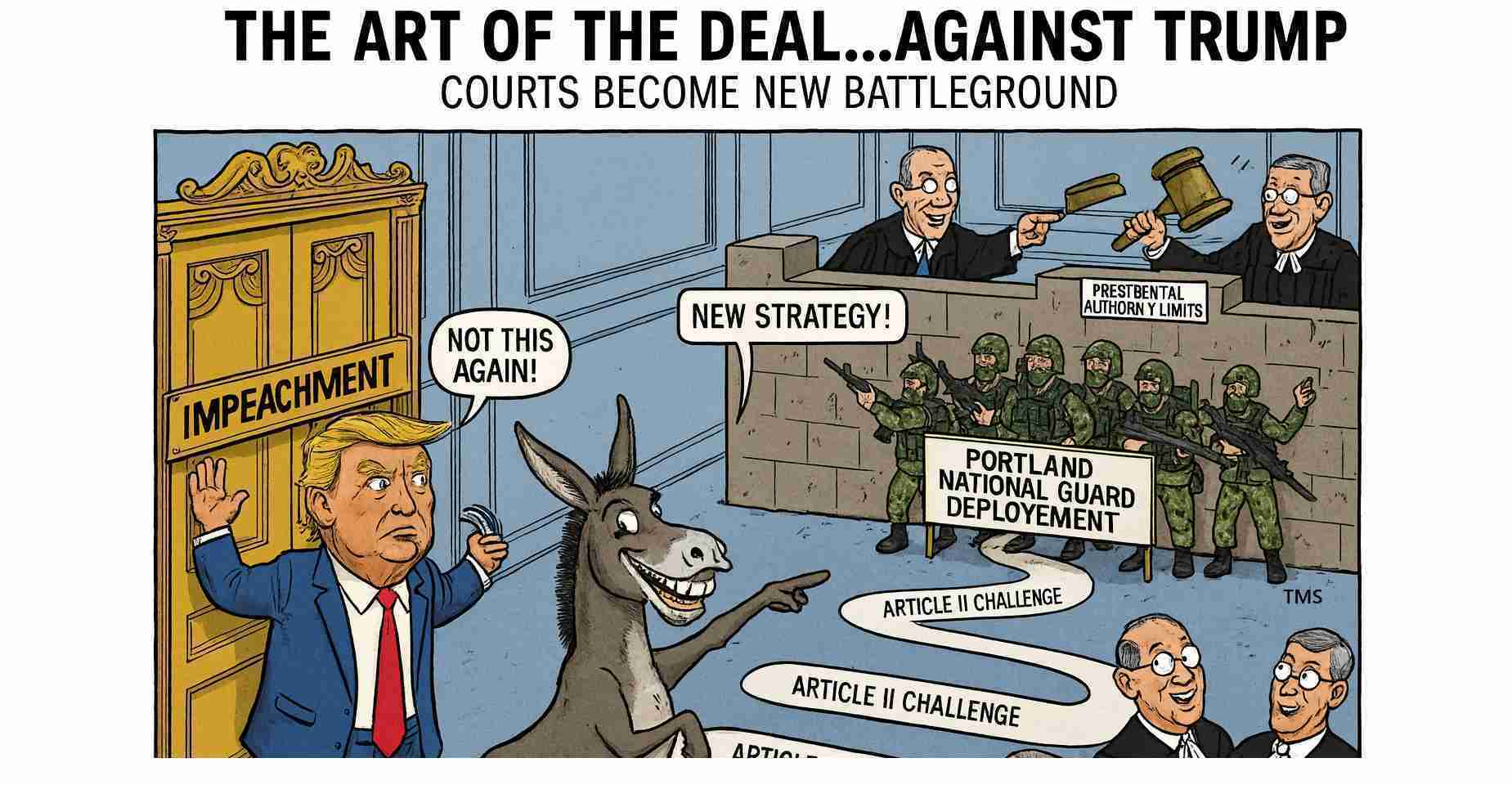
Dems Shift From Impeachment to Article II Legal Challenges as Portland Guard Deployment Tests Limits on Trump’s Power
Democrats are turning to Article II lawsuits in federal court to curb President Trump’s broad executive actions — notably the Portland National Guard deployment — seeking judicial limits under the Take Care and Commander in Chief clauses.
- Tracker of litigation: Democrats and allied groups are filing Article II challenges in federal court to limit presidential actions they say exceed authority.
- Portland deployment as a test: The National Guard deployment in Portland raises federalism and civil‑liberties questions about federal intervention in state policing (Regulatory Review analysis).
- Judicial checks matter: Courts have at times blocked executive steps, including orders tied to anti‑diversity policies (example), but rulings vary across courts.
THE STRATEGIC SHIFT: WHY COURTS, NOT IMPEACHMENT
After two impeachment efforts with mixed political outcomes, many Democrats and allied groups favor litigation over a partisan process. Lawsuits grounded in Article II ask federal judges to decide whether specified presidential acts are lawful under constitutional provisions such as the Take Care Clause and the Commander in Chief Clause.
Advocates say courts can issue immediate orders to halt actions — for example, troop movements or executive orders — without relying on a fragile bipartisan vote in Congress. The rise in these cases is documented in the Just Security litigation tracker, which shows a pattern of Article II-based challenges aimed at limiting major steps by the administration.
“Litigation places constitutional boundaries before neutral judges who can grant immediate relief,” say legal teams pursuing these claims.
PORTLAND AS A LEGAL BATTLEGROUND
The Portland National Guard deployment has emerged as a litmus test. Plaintiffs in multiple suits argue the President and federal officials overstepped by directing Guard forces or federal officers in ways that interfere with state and local policing and civil liberties. These suits raise core federalism questions: when can the federal government send uniformed forces into a state, and who controls them once present?
Legal analysts ask courts to balance national security, public safety, and state sovereignty — a tension explored in the Regulatory Review analysis. A ruling that limits the President’s authority could block similar deployments elsewhere; a ruling affirming broad power would ease federal operations in states opposed by governors and local officials.
COURTS PUSH BACK — SOMETIMES
Federal courts have already issued rulings that limit some Trump administration actions. For example, judges temporarily blocked enforcement of executive orders tied to anti‑diversity and equity initiatives (see example).
The Just Security tracker lists more than a dozen Article II cases challenging agency restructuring, military and law‑enforcement deployments, and other major moves. However, inconsistent lower-court outcomes increase the likelihood that key disputes will reach the Supreme Court, where the stakes for presidential power are higher.
SUPREME COURT DECISIONS AND THE SCOPE OF EXECUTIVE POWER
Recent Supreme Court rulings have at times been read as expanding executive authority — with some opinions moving toward a broad conception of presidential control over the executive branch. Critics warn that such a trajectory could weaken Congressional checks and independent agencies.
Still, other decisions leave room for judicial limits. The mixed jurisprudence fuels debate over the proper line between legitimate presidential direction and unconstitutional overreach. Many scholars urge that Congress exercise clearer oversight and that courts enforce statutory constraints to preserve separation of powers.
LEGAL EXPERTS AND POLITICAL STRATEGISTS WEIGH IN
Conservative-leaning scholars who favor a strong presidency argue efficient executive action is essential to respond to threats and implement policy. Moderate conservatives express concern about concentrated power overriding local control and the rule of law.
Liberal and progressive experts contend that unchecked executive authority endangers democratic norms and civil liberties. Both camps note that Article II litigation places detailed constitutional questions before judges who can set concrete rules for governance.
Impact in practice: Courts are already deciding control over agencies, federal aid, law enforcement, and deployments — outcomes that will echo across government and daily life.
CONGRESSIONAL OVERSIGHT: A CALL FROM SCHOLARS
Scholars urge Congress to bolster oversight and enact legislation to check any executive overreach. While lawsuits can stop specific actions, durable limits require statutes, investigations, and sustained oversight. Some experts warn courts should avoid reading Article II so broadly that it hollows out congressional power.
This approach appeals to moderate conservatives who value separation of powers, predictability, and legal clarity for businesses, states, and citizens.
IMPLICATIONS FOR CALIFORNIA
Economic impact
Federal court limits on presidential authority could reduce sudden shifts in enforcement or policy that affect California businesses. If courts block broad federal deployments or abrupt regulatory changes, companies may face fewer operational interruptions. Conversely, rulings that expand executive reach could create regulatory uncertainty for industries dependent on stable federal policy.
Political consequences
A decision affirming broad deployment powers would heighten tensions between California leaders and the federal government, likely prompting more state lawsuits. Litigation outcomes will shape campaigning and messaging, with moderate conservatives pressing leaders to defend state authority while emphasizing law and order.
Social effects
Court rulings could set rules for when federal troops or federalized forces operate in cities — vital for California’s large urban areas. Clear judicial limits may reassure residents; broader federal authority could drive escalated legal and political responses from community groups.
Cultural relevance
Article II challenges touch on Californians’ values of local control, civic freedom, and predictable law. The debate will cut across cultural lines: moderate conservatives emphasize public safety and order while warning against unchecked national power.
Practical applications for daily life
- If courts restrict presidential deployment authority, California law enforcement and emergency planners can expect fewer sudden federal interventions.
- If courts expand presidential latitude, residents could see federal officers or Guard units operating more often in-state, affecting protests, demonstrations, and emergency responses.



