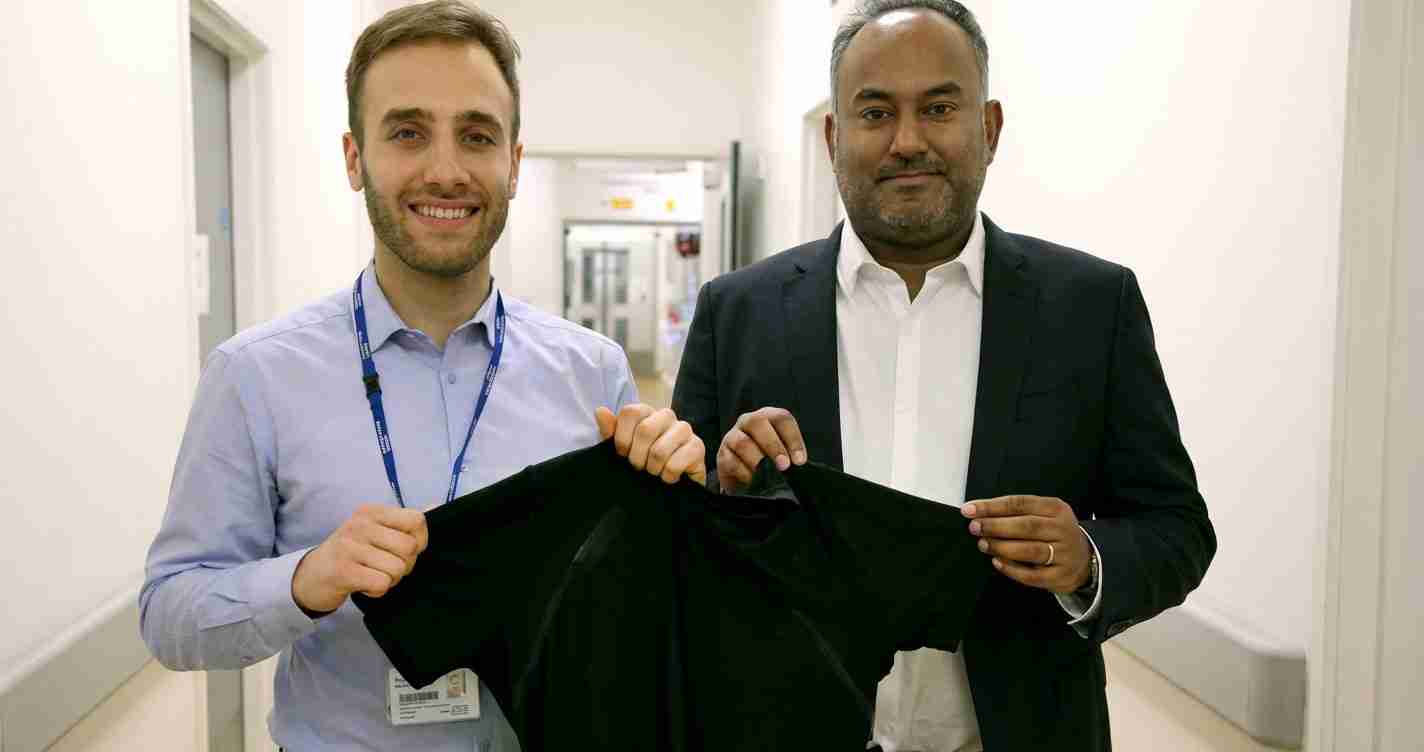
Your next heart test might start in your dresser drawer — AI smart T-shirt aims to spot hidden rhythm disorders
Researchers at Imperial College London have developed an AI-powered smart T-shirt with 50 embedded ECG sensors for long-term, continuous heart monitoring — aiming to detect intermittent inherited rhythm disorders such as Brugada syndrome that short clinic ECGs often miss.
Key takeaways
- What it is: An AI smart T-shirt that records continuous ECG-style signals using up to 50 sensors woven into soft sportswear fabric (Imperial College news release).
- Why it matters: Inherited rhythm disorders can be intermittent and missed by brief clinic ECGs; longer monitoring may reveal dangerous patterns (Imperial College summary).
- How it works: Continuous wear logs electrical signals during daily life and an AI trained on >1,000 ECGs looks for patterns linked to inherited disorders (Imperial College news release; Medical Xpress).
- Testing & funding: A 200‑person feasibility study will run for up to three months; funding from the British Heart Foundation (~£340,000) with NIHR Imperial BRC support; clinical rollout could take ~five years after trials and approvals (British Heart Foundation; Imperial College summary).
Why current tests can miss dangerous heart problems
Most clinic electrocardiograms connect patients to sensors for only a few minutes, providing a useful snapshot for many conditions. But inherited rhythm disorders are often fleeting: a dangerous electrical pattern can appear for minutes and then disappear. If the clinic ECG occurs during a calm period, the result may look normal even though risk persists.
Portable monitors extend surveillance but have practical limits: sticky electrodes, waist-worn recorders, and the need to remove equipment for showering interrupt continuous recording. Discomfort and inconvenience reduce adherence for days or weeks of monitoring, leaving gaps that may hide intermittent abnormalities (Imperial College summary).
How the AI smart T-shirt is built and used
The garment looks and feels like athletic wear. Up to 50 ECG-style contacts are stitched or woven into soft fabric and wired to a small recorder. The design allows people to wear it under everyday clothes, sleep in it, and wash it. Continuous logging captures electrical activity across work, exercise, sleep, and meals — offering clinicians a far broader view than a short clinic ECG (Imperial College news release).
An AI algorithm then analyses the continuous data. The team trained the model on ECG recordings from more than 1,000 people, including both affected patients and healthy volunteers, to help distinguish benign variations from patterns that suggest higher risk of sudden dangerous rhythms, such as those seen in Brugada syndrome (Imperial College summary; Medical Xpress).
The research plan and what researchers will look for
Lead team: Imperial’s National Heart & Lung Institute, led by Professor Zachary Whinnett, will run a feasibility study at Hammersmith Hospital’s Peart‑Rose Research Unit.
Study design: Roughly 200 volunteers (a mix of patients and healthy people) will wear the shirt for up to three months. Investigators will compare the smart T-shirt’s detections against standard monitoring and clinical follow-up, while assessing wearability, data quality in real life, and the AI’s sensitivity and specificity for inherited rhythm disorders (Imperial College summary).
Funding & timeline: The British Heart Foundation provided about £340,000 and the project has backing from the NIHR Imperial Biomedical Research Centre. Researchers estimate potential clinical use in about five years, dependent on larger trials and regulatory review (British Heart Foundation; Imperial College news release).
What the science still needs to prove
Promising as the concept is, several issues must be settled before wide adoption:
- Sensitivity vs. false alarms: The AI must flag true risk without creating excessive false positives that drive unnecessary tests and anxiety.
- Durability and adherence: Comfort, long-term durability, washability, battery life, and replacement schedules will influence real-world use and costs.
- Data privacy and security: Continuous monitoring produces rich health records; encrypted transmission, secure storage, and clear consent rules are essential.
- Regulatory approval: Robust evidence of safety and effectiveness will be required across jurisdictions before clinical deployment (Medical Xpress; Imperial College news release).
Why this matters to patients and the health system
Detecting inherited rhythm disorders before symptoms appear can be lifesaving. Many conditions are treatable — with medication, implantable devices, or lifestyle changes — and early detection reduces the risk of sudden cardiac arrest. From a systems perspective, accurate community-based screening could lower emergency care costs and improve outcomes if tests prove reliable and affordable.
A comfortable, washable T-shirt that patients will actually wear is a practical step toward broader, long-term monitoring — but only if the AI is accurate and privacy safeguards are strong.
Implications for California
Economic impact: Adoption would require investment in devices, data infrastructure, and clinical programs. Potential savings could come from earlier detection and fewer emergency admissions, but health systems and insurers must evaluate purchase/rental models and reimbursement rules.
Regulatory & policy issues: In the U.S., the device and its AI will need FDA review and likely additional approvals. California privacy laws, including the California Consumer Privacy Act, will apply to continuous health data; hospitals must set strict protocols for data security and patient consent (Imperial College news release).
Access & equity: Wearable monitoring could help bridge care gaps in rural areas via telehealth, but inequities may arise if devices are costly or uninsured. Programs should prioritize outreach to underserved communities and ensure pathways for follow-up care after a positive detection.
Privacy & trust: Californians and policymakers typically demand strong privacy protections. Any deployment should prioritize encrypted data flows, transparent consent, and explicit prohibitions on commercial resale of sensitive health data to maintain trust (Medical Xpress).
What’s next
The Imperial team will report findings from the 200‑person feasibility study and refine the AI. If results are strong, larger trials and regulatory submissions would follow. Researchers estimate the technology could reach clinical practice in about five years, depending on trial results and approvals. Expansion to children or broader rhythm conditions like atrial fibrillation may be considered if safety and performance are proven (Imperial College summary; British Heart Foundation).
Reporting and sources
- Imperial College London
- Imperial College summary
- British Heart Foundation
- Medical Xpress
- Fox News coverage (English)
- Fox News coverage (Spanish)
“A comfortable, washable T-shirt that patients will wear is a practical step — but only if the AI is accurate, durable, and privacy safeguards are strong.”