
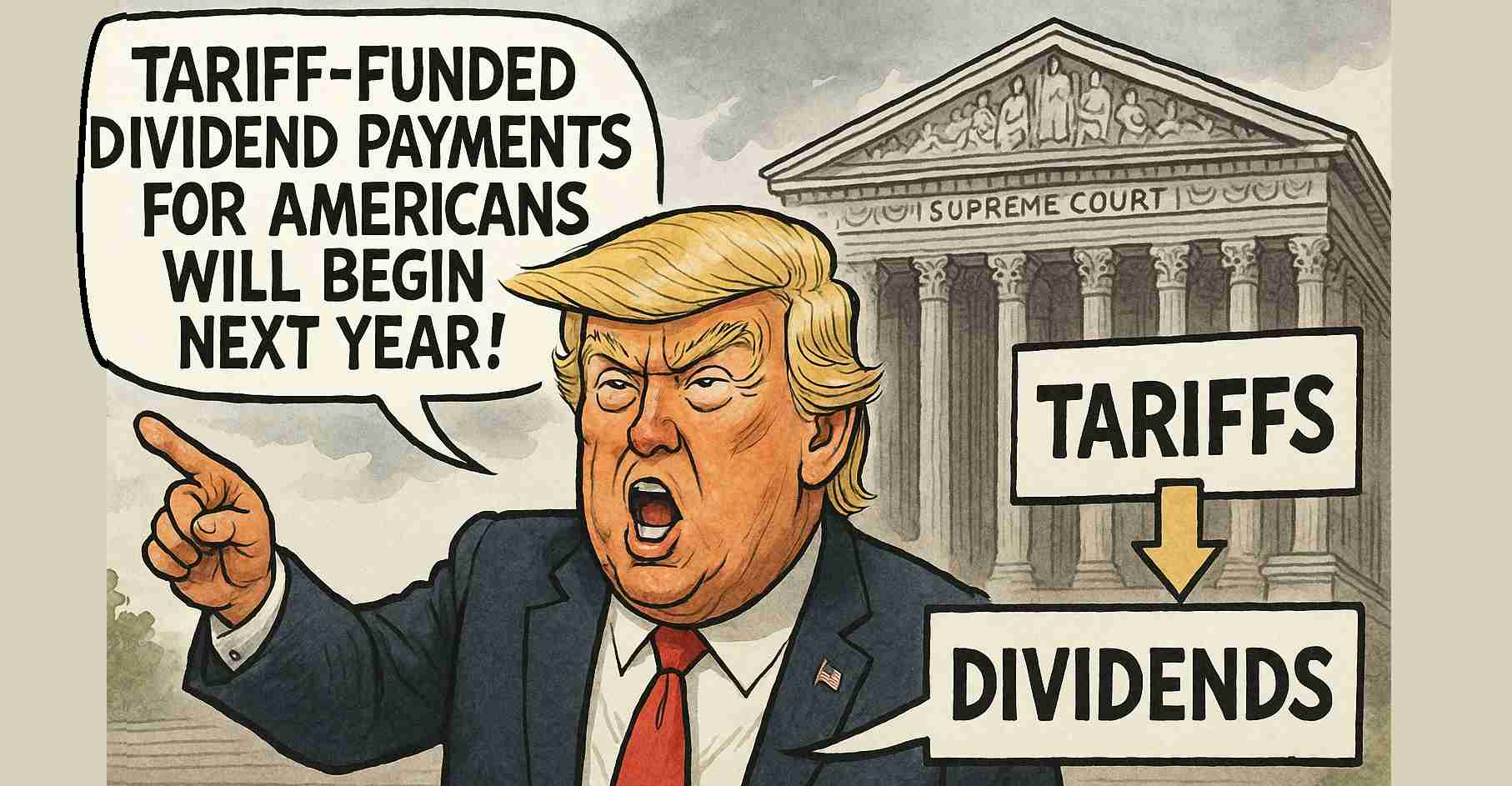
Trump Tariff Dividend Plan: Trump Says Tariff-Funded Direct Payments to Americans Could Begin by 2026
Former President Donald Trump unveiled a plan to raise tariffs and use tariff revenue to send direct “dividend” payments to Americans, promising checks as soon as mid‑2026 if elected in 2024 — a proposal that raises legal and economic questions.
Key takeaways
- If elected in 2024: Trump says his administration would raise tariffs and distribute tariff-funded checks starting as soon as mid‑2026.
- Funding: Campaign describes the program as drawing on “hundreds of millions of dollars in tariff money” for dividend payments.
- Legal uncertainty: The U.S. Supreme Court is reviewing aspects of executive trade authority that could limit tariff actions without Congress.
- Economic debate: Supporters call it populist relief; many economists warn tariffs act as consumer price increases and may prompt retaliation from trading partners.
How the Trump Tariff Dividend Plan would work
The premise is straightforward: raise tariffs on imported goods, collect revenue, and send some of that money directly to U.S. citizens as a cash dividend. The campaign frames this as turning higher import levies into a direct benefit for everyday voters.
Distribution timeline: Campaign officials say the checks would be distributed to U.S. citizens, with the first round arriving in 2026 if Trump wins in 2024. The plan is marketed as an extension of the “America First” trade agenda aimed at higher barriers to imports, especially from China (Trump campaign statement).
Legal and constitutional questions
Tariff receipts traditionally flow into the U.S. Treasury and are not earmarked for direct payments to individuals. Legal experts highlight two primary hurdles:
- Authority to set tariffs: The scope of executive authority to impose or expand tariffs without Congress is contested. The U.S. Supreme Court is reviewing limits tied to prior tariff actions, and its ruling could narrow or affirm presidential trade powers.
- Spending and budget law: Redirecting tariff receipts to dividends would likely require congressional action. Federal statutes and budget rules govern how Treasury funds are allocated; absent clear statutory authority, dedicating tariff revenue for payments faces procedural and legal barriers. See federal receipts and budget context at U.S. Treasury fiscal data and Congressional Budget Office analysis.
“Tariff revenues traditionally go into the U.S. Treasury and are not earmarked for payments to individuals.” — legal and budget experts
Economic arguments for and against
Supporters — largely populist conservatives and some labor-aligned groups — argue the plan shares gains from protectionism with working families and could offset pain from foreign competition and factory closures.
Economists’ concerns: Most mainstream economists note tariffs function as a tax on imports that producers and retailers often pass on to consumers as higher prices. This means dividend checks could be offset by higher costs for everyday goods. Tariffs can disrupt supply chains and reduce efficiency for sectors reliant on global inputs.
Analysts warn of retaliation: affected trading partners may impose their own tariffs on U.S. exports, harming sectors such as agriculture and technology and potentially shrinking the tax base for dividends.
Political strategy and 2024 campaign context
The tariff dividend idea is a clear political play: promising direct payments reframes tariffs from a policy blamed for raising consumer costs into a redistributable benefit. It targets working-class and middle-income voters who feel left behind by globalization.
Timing: Announced amid heightened trade tensions with China, the proposal seeks to combine a tough trade posture with a tangible voter payoff ahead of the 2024 election cycle.
Recent developments and international response
China has warned of reciprocal measures if the U.S. significantly increases tariffs. Retaliation could strike agricultural and manufactured U.S. exports, harming exporters. U.S. business groups — including retail and manufacturing associations — warned higher tariffs would raise costs and worsen supply-chain issues.
Legal challenges and the pending Supreme Court review add uncertainty about how quickly any tariff-based dividend could be implemented; if the court limits executive tariff powers, Congress would likely need to take the lead.
Who gains, who loses
The plan is designed to deliver direct checks to voters, but distributional effects are uncertain. Higher import prices often disproportionately affect lower-income households that spend a larger share of income on goods. While periodic dividends could provide relief, sustained tariffs could reduce real incomes over time.
Industries dependent on imports — retail, electronics, and some manufacturing — would face higher input costs. Export industries risk retaliation. State and local economies tied to ports and logistics could see shifts in volume and costs.
Implications for California
Economic impact
California’s major ports — Los Angeles, Long Beach, Oakland and others — handle large shares of container imports. Higher tariffs could reduce import volumes or shift trade patterns, affecting port revenue, logistics firms, truckers and warehouses. Tariffs also tend to raise consumer prices in already high-cost areas like California.
Industry consequences
Key California industries could feel pronounced effects. The tech sector relies on global supply chains for components. Agriculture — including nuts, fruits and wine — could face retaliatory tariffs that hurt exporters. The retail sector may see higher costs for goods sold in stores and online.
Jobs and wages
Tariff shifts may create winners and losers: some manufacturing jobs might gain protection, while logistics, retail, and export-dependent agriculture could face job losses if retaliation or supply-chain disruption intensifies. Dividend payments may not fully offset slower growth or employment declines.
Practical implications for daily life
For families, the immediate effect could be higher prices on imported goods — electronics, clothing, and household items. Retailers and shippers are likely to pass higher costs to consumers quickly. Dividend checks could offer short-term relief, but whether they offset higher prices depends on tariff size and duration.
Sources and further reading
- Trump campaign policy and statements
- U.S. Supreme Court — court resources and docket information
- U.S. Trade Representative — trade enforcement and tariff overviews
- U.S. Treasury fiscal data — federal receipts and tariff data
- Congressional Budget Office — budget and economic analyses
- Reporting and context from Reuters, Associated Press, The New York Times, and CNN.
Times Media Service reporting contributed core announcement details and timeline context.



