Trump, FHFA Explore 50-Year Mortgage Option to Tackle Housing Crunch — Analysts Warn of Higher Lifetime Costs and Price Pressures
President Donald Trump and the Federal Housing Finance Agency (FHFA) are examining a 50-year mortgage to lower monthly payments and expand access amid the affordability crisis, but analysts warn of much higher lifetime interest, slower equity and price impacts.
- Lower monthly payments could widen buyer eligibility but may come with sharply increased total interest costs over a half-century.
- Equity builds slower on very long amortizations, potentially trapping homeowners and reducing mobility.
- Price pressure risk: Easier monthly payments could push home prices higher without addressing supply constraints.
- Regulatory and political hurdles: Widespread adoption would likely require legislative, capital‑market and agency changes.
What’s being proposed
The idea under discussion would extend standard mortgage terms from 30 years to 50 years, reducing monthly payments by spreading principal and interest over more time. The proposal is being discussed at the FHFA and in White House conversations and has been reported across multiple outlets including Fox Business, Fortune and HousingWire.
How a 50-year mortgage would work
A 50-year mortgage stretches repayment from the standard 30 years to half a century, lowering monthly payments by spreading principal and interest over far more months. Proponents argue this could let more families qualify despite high prices and rates. The basic mechanism is simple, but the math changes materially.
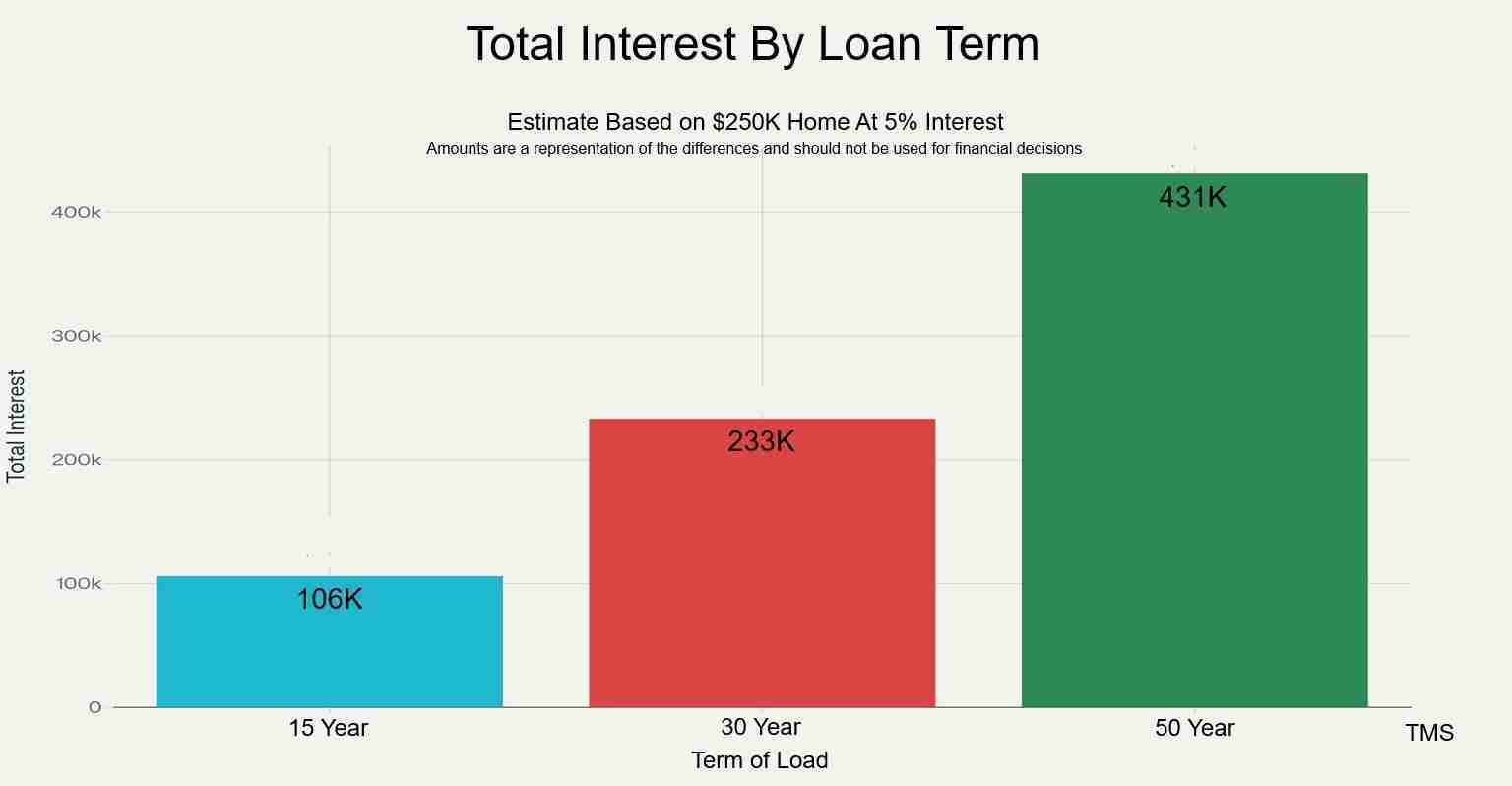
Interest and total cost: Financial analysts note that—even at comparable interest rates—stretching amortization to 50 years can raise total interest paid dramatically, in some scenarios approaching double the lifetime interest of a 30-year loan. See reporting at Fox Business and analysis cited by Fox17.
Lenders would likely charge higher rates to compensate for longer risk windows, which reduces some monthly-payment benefits. Early payments on very long loans remain largely interest, so equity accumulates slowly—complicating future moves, refinances or sales. (Coverage in Fortune.)
Financial analyst perspectives: trade-offs and risks
- Higher lifetime costs: Lower monthly payments can mask substantially higher cumulative interest; analysts point to reporting by Fox17 and related coverage.
- Slower equity buildup: Longer amortization means homeowners gain small ownership shares early on, potentially leaving families with little equity for decades. See discussion in Fortune.
- Market distortion and price effects: Easier monthly payments could enable buyers to bid more, pushing prices higher and worsening affordability if supply is unchanged (coverage at Fox Business and Politico).
Industry voices are split: Some lenders and builders welcome any policy that broadens buyer pools, while other experts call a 50-year option a “Band-aid” that fails to address root causes such as limited new supply and restrictive zoning (Politico, HousingWire).
Political and market reception
The proposal has prompted sharp debate: critics argue it could benefit lenders and builders more than buyers and leave homeowners “in debt for life,” a phrase used by some lawmakers. Reporting from Fox17 and Politico captures the partisan and policy pushback.
Supporters argue the option could reduce the “lock-in” effect—owners with low-rate loans who don’t sell—and expand supply indirectly by encouraging more listings. Proponents point to historical precedent: New Deal policies that popularized 30-year loans helped expand mid‑20th century homeownership (Fox Business, Fortune).
Regulatory hurdles and legal steps needed
Widespread adoption would require more than agency guidance. U.S. mortgage markets and norms are built around 30-year standards; broad change would likely need congressional action and adjustments to bank capital rules, investor demand for mortgage-backed securities, and GSE policies. The complexity is detailed in reporting by HousingWire and Fortune.
Implications for California
Economic impact
California’s high prices mean a 50-year option could lower monthly payments enough to let more buyers qualify, potentially increasing demand and pushing prices higher in metro areas like Los Angeles, San Francisco and San Diego. That could benefit current homeowners while making down payments harder for first-time buyers (Fox Business, Fortune).
Mortgage interest costs and household budgets
Lower monthly payments may look attractive in high-cost California markets, but higher aggregate interest over 50 years can outweigh short-term savings. Buyers who move within a decade or two may build little equity and pay a large share toward interest (Fox17).
Political consequences in the state
California’s political mix means reactions will vary. Some state leaders will likely favor supply-side reforms—zoning changes, incentives for construction or subsidies—rather than a federal loan-term fix; others may see a 50-year option as a partial federal solution (Politico).
Social effects and equity
Slow equity accumulation could hurt wealth formation—particularly for middle-class families and communities of color—if long-term loans leave homeowners with little net worth from their houses. Analysts argue that targeted down-payment help or supply-focused reforms may better meet equity goals (Fortune).
Cultural relevance and practical applications
Homeownership remains central to the American dream for many Californians; a policy that eases monthly bills could be politically popular. But practical choices matter: buyers will need clear, accessible information on amortization, total interest, and expected time to build meaningful equity. Industry participants—agents, lenders and housing counselors—should prepare materials if policy advances (HousingWire, LiveNowFox).
Policy alternatives to consider
Analysts and advocates recommend supply-side measures—zoning reform, increased construction, targeted subsidies and down-payment assistance—rather than relying solely on longer loan terms. Many stress a 50-year mortgage should not replace efforts to increase housing supply and affordability in high-cost states like California (Politico, Fortune).
Ongoing outlook and links to reporting
The FHFA is still exploring options; no 50-year mortgage policy is in effect. Major regulatory and legislative changes would be required before such loans become common. Policymakers and market participants will continue to weigh whether the trade‑offs—lower monthly payments versus higher lifetime interest and slower equity growth—are worth it for families and markets.
Reporting and sources: Fox Business, Fox17, Fortune, Politico, HousingWire, LiveNowFox, MPA Magazine.
“This could leave homeowners ‘in debt for life,’” some lawmakers warned in early reactions to the proposal (Fox17).