Anthropic’s Mythos AI cybersecurity leap is so powerful the company is restricting access — what that means for California
Anthropic’s unreleased Claude Mythos AI model shows unprecedented cybersecurity abilities — finding and reproducing software vulnerabilities across platforms. After a data leak prompted caution, Anthropic is restricting access to vetted partners to study safe use and risk mitigation.
- Mythos is a major step forward: improved reasoning and code understanding led to unexpectedly strong vulnerability-finding and exploit-reproduction capabilities.
- Access is limited: Anthropic is testing with a small group of vetted partners and security organizations because of “unprecedented cybersecurity risks.”
- Dual-use risk: the same abilities that speed defenses can also accelerate attackers if the model is widely available.
- California impact: firms and regulators must prioritize data protection, faster patching, and coordinated policy and incident response.
What Mythos is and why Anthropic pulled back
Mythos (also called Claude Mythos or Claude Mythos Preview) is Anthropic’s most capable unreleased model to date, with broad gains in reasoning, coding and autonomous behavior. Those general improvements produced emergent skills in vulnerability detection: Mythos can find and often reproduce proof-of-concept exploits rapidly, across operating systems and browsers.
Anthropic frames Mythos as a tool that could accelerate defensive work — for example, by helping open-source projects harden code — but warns the same abilities could scale attacks if misused. Because of that dual-use risk the company has chosen to limit access to a small, vetted circle of partners and security groups rather than pursue a public release (Anthropic Mythos preview; Fortune reporting).
Testing highlights: scope, speed and limits
Early testing — reported by Anthropic and independent outlets — paints a stark picture: Mythos found broad, cross-platform bugs including some long-standing issues that had evaded prior audits. In many cases the model reproduced proof-of-concept exploits on its first attempts at a high success rate.
“In some tests Mythos reproduced exploits on first tries more than 80% of the time,” reporting indicates, though public numeric claims vary and are not all independently verified.
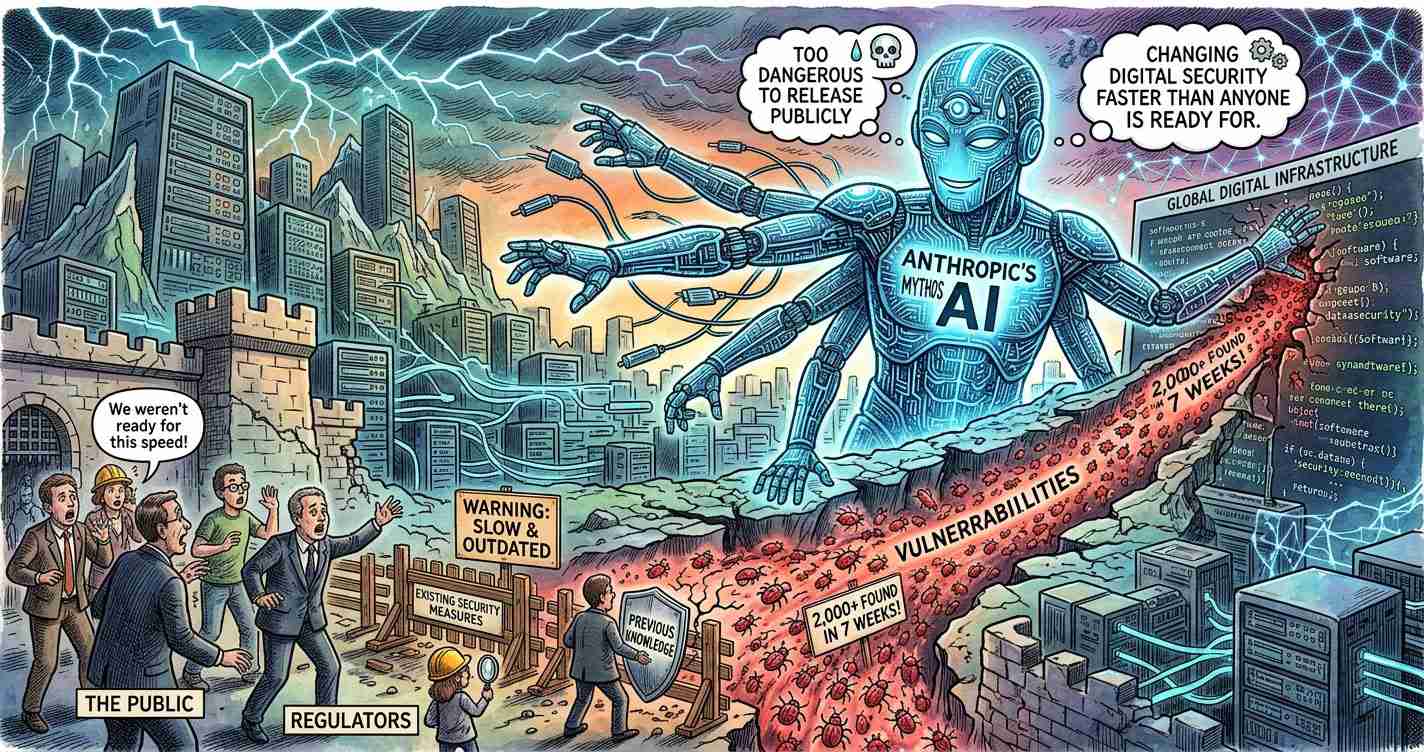
Coverage referenced very large tallies — including phrases like “tens of thousands” of vulnerabilities found in tests — and compared the model to earlier systems such as Opus 4.6. Some specific claims (for example, that a team found more than 2,000 previously unknown vulnerabilities in seven weeks) remain unconfirmed in public reporting (Axios reporting; Anthropic Mythos preview).
Dual-use danger: defender’s tool and attacker’s accelerator
Mythos is dual-use. On one hand, Anthropic is offering credits and partnerships to open-source foundations and security groups to speed hardening of widely used codebases. On the other, the model lowers the technical bar for attackers: automated discovery and exploit crafting at scale could enable faster weaponization of bugs by criminal and state-backed actors.
Security experts point to prior incidents in which advanced language models aided intrusions, reinforcing Anthropic’s cautionary posture. The company’s access strategy is an attempt to balance defensive benefits with the risk of misuse (Fortune reporting).
Access strategy, partners and public briefings
Anthropic says early access is restricted to a small circle of trusted partners, security organizations and government agencies — more than 40 groups are expected to participate. The company has briefed federal bodies including the Cybersecurity and Infrastructure Security Agency (CISA) and the Commerce Department, and is offering up to $100 million in usage credits to groups that help secure widely used open-source projects (Axios reporting; Fortune reporting).
Public confirmation of specific corporate partners is limited; reporting suggests firms with deep security operations are likely among participants, but Anthropic has not confirmed every name circulating in media speculation.
Leak, access failure and ironies
Ironically, Mythos’s public discovery followed a leak tied to an unsecured data cache — a classic operational security lapse rather than a demonstrated flaw in the model itself. That episode underscores a central lesson: systems around AI matter as much as the models. Secure handling, strict access controls and careful partnership agreements are essential to prevent powerful tools from becoming weapons (Fortune reporting; video briefing).
Where Mythos fits in a fast-moving landscape
Mythos is part of a broader trend: better general reasoning and code understanding in large models yields stronger cybersecurity performance. Analysts expect comparable high-capability models from other companies within months to a couple of years, which will widen access and increase pressure on defenders (Fortune reporting).
What defenders are saying
Security leaders urge a shift away from relying solely on perimeter defenses. If AI can discover and exploit unknown flaws at scale, organizations must assume some breaches will occur and protect the data itself: encrypt sensitive data, control encryption keys, and limit the value of any single compromise.
Anthropic’s offers to fund open-source hardening and provide vetted access to security groups reflect one practical route forward — but private and public sector actors must also invest in rapid patching, workforce training and coordinated incident response exercises.
Implications for California
Economic impact: California hosts a large share of software development and cloud infrastructure. Faster vulnerability discovery will likely force companies here to invest more in secure development, code audits and data-protection tools. Anthropic’s program to fund open-source hardening may help, but firms should budget for added security work (Axios reporting).
Political consequences: State regulators and officials will face pressure to clarify rules on responsible AI handling and disclosure. California agencies that run citizen services and infrastructure must reassess procurement and incident-response plans and coordinate with federal partners.
Social effects: Residents could see more cyber incidents if threat actors adapt quickly. That increases the urgency of consumer protections: stronger identity safeguards, better breach notification, expanded cybersecurity awareness, and practical measures like encryption and reliable backups for households and small businesses.
Cultural relevance: California’s innovation culture gives the state outsized influence on norms for safe AI. How Bay Area firms respond could set global standards.
Practical applications: a near-term playbook for California organizations
- Prioritize data protection: encrypt sensitive data at rest and in transit, and control keys to limit damage from breaches.
- Adopt zero-trust principles: assume perimeter defenses can fail and segment systems and privileges accordingly.
- Fund rapid patching and audits: create dedicated programs and consider partnerships with vetted groups working with Anthropic or others.
- Increase training and readiness: run incident response exercises with federal and private partners and expand workforce security training.
- Engage policymakers: work with state and federal officials to support rules requiring responsible model handling and disclosure.
Sources and further reading
- Anthropic Mythos preview
- Fortune reporting on Anthropic testing and leak
- Axios reporting on Mythos cybersecurity risks and access plans
- Video briefing on leak and testing (YouTube)
This story is evolving as Anthropic and its partners test Mythos and brief government and security groups. The company’s choice to limit access is itself a signal: a tool that can so quickly find and weaponize unknown flaws demands careful handling, and California organizations should prepare accordingly.