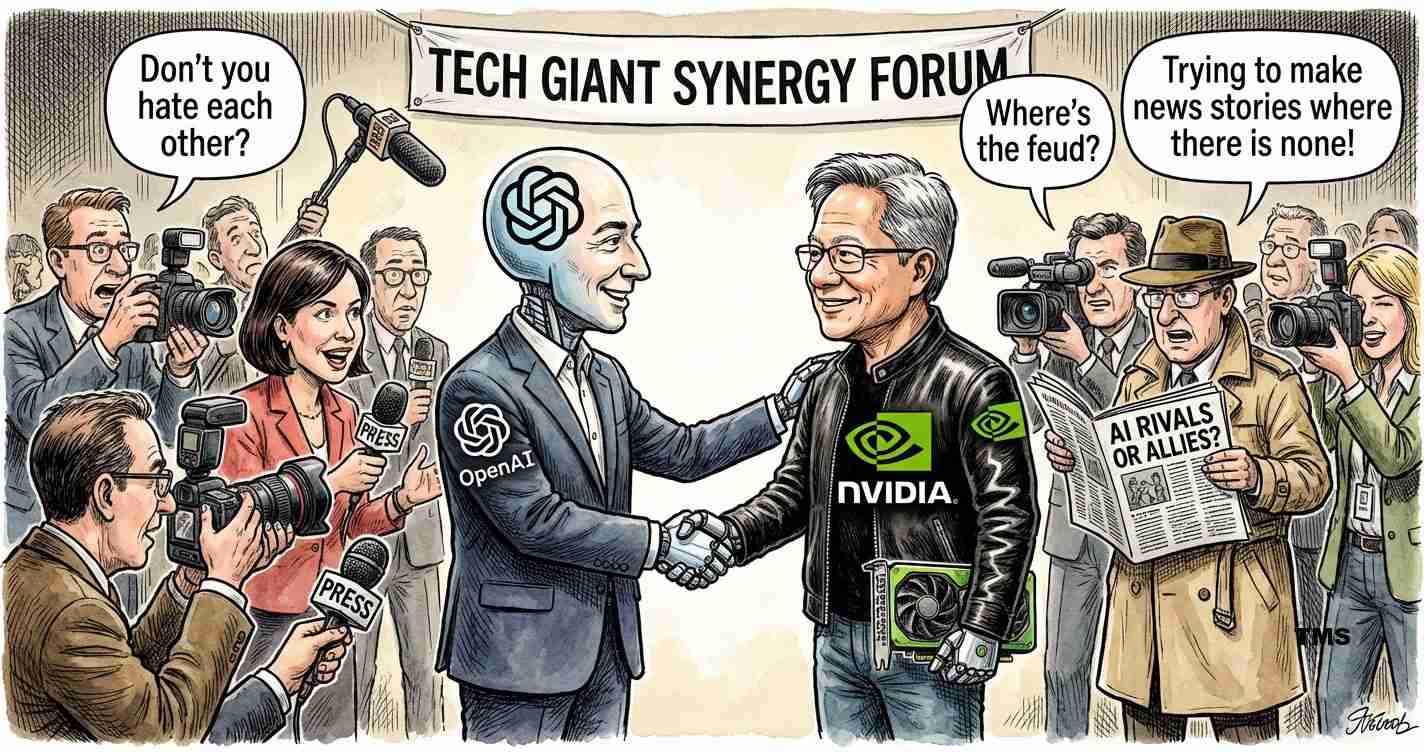
Jensen Huang Denies $100 Billion Deal Has Stalled; Nvidia Says It Will “Definitely Participate” in OpenAI Fundraising
Nvidia CEO Jensen Huang denied reports a planned $100 billion investment in OpenAI had stalled, calling the stories “nonsense.” Speaking in Taipei, he said Nvidia will “definitely participate” in OpenAI’s current fundraising, without naming an amount.
- Huang rejected reports that negotiations over a $100 billion investment had stalled, calling claims of his unhappiness with OpenAI “nonsense” (TechCrunch, Bloomingbit).
- September 2025 framework outlined a non-binding plan for Nvidia to invest up to $100 billion as OpenAI deploys up to 10 gigawatts of Nvidia systems (Nvidia press release).
- Nvidia confirmed participation in the current fundraising but has not disclosed a dollar amount amid reports some executives were reassessing the scale of any equity commitment (MLQ).
Background: the announced partnership and what $100 billion meant
In September 2025, Nvidia and OpenAI unveiled a strategic plan to deploy at least 10 gigawatts of Nvidia systems to scale OpenAI’s infrastructure. The announcement included a non-binding framework under which Nvidia would invest up to $100 billion over time, tied to progressive deployment of each gigawatt and beginning with the Vera Rubin platform in H2 2026. See the original Nvidia press release for details.
Reports of friction, internal doubts and the public pushback
Late January coverage summarized reporting that some Nvidia employees and leaders were reconsidering whether a full $100 billion equity commitment was prudent, suggesting a possible downscale to an investment in the “tens of billions.” Industry pieces referenced Wall Street Journal reporting; TechCrunch summarized those claims and the potential shift in Nvidia’s role (TechCrunch).
On Jan. 31 in Taipei, Jensen Huang publicly disputed that narrative: he called reports of unhappiness “nonsense,” confirmed Nvidia will “definitely participate” in the current OpenAI fundraising round, and suggested Nvidia could make a “huge” investment that might be the company’s largest-ever — while stopping short of reiterating the $100 billion headline figure. He told reporters, “Let Sam Altman announce.” (Sources: Bloomingbit; TechCrunch).
Current status and competing narratives
As of Jan. 31, Nvidia has publicly confirmed participation in OpenAI’s current fundraising round but has not disclosed an amount. That public confirmation coexists with reporting that some Nvidia leaders advocated reassessing the scale of any equity commitment. Two narratives now exist in parallel: one emphasizing internal caution and a potential downscale of the $100 billion figure, the other emphasizing continued strategic alignment and a willingness to invest heavily. Readers should note the original $100 billion framework was non-binding and tied to infrastructure deployment rather than a single guaranteed cash transfer (Nvidia press release).
Why the dispute matters now
A large equity investment from Nvidia into OpenAI would deepen commercial ties between a leading chipmaker and a major AI model developer, with business, policy and market implications. For competition, funding clarity affects rivalries among OpenAI, Google, Anthropic and others. For investors, a multibillion-dollar stake would influence Nvidia’s capital allocation and risk exposure. Huang’s public critique of OpenAI’s business discipline also reframes debates around governance, fiscal responsibility and oversight at rapidly growing AI firms.
Implications for California
Economic impact
- Jobs and investment: Nvidia’s Santa Clara headquarters and California’s broad AI ecosystem could see hiring for engineering, data center operations, and professional services, boosting venture capital and corporate activity (Nvidia press release).
- Real estate and services: Large AI deployments typically increase demand for office and data-center space and local contractors.
Political consequences
- Oversight and scrutiny: A large investment could prompt calls from state lawmakers for transparency on funding, data use, and competition.
- Regulatory focus: Consumer advocates and regulators may press for clearer accountability around model training, privacy, and concentrated corporate power.
Social effects
- Workforce disruption and opportunity: High-skill job creation alongside concerns about automation and displacement; retraining programs may expand.
- Public services and safety: Deployment of AI in health, transport and public safety raises oversight and liability questions.
Cultural relevance
Continued close collaboration would bolster California’s image as an innovation leader while reigniting debates about the concentrated influence of a few dominant firms over AI’s trajectory.
Practical applications for residents
- Consumer products and services: Deeper Nvidia-OpenAI ties could accelerate advanced AI features in consumer apps and cloud services, benefiting small businesses, healthcare tools and public services.
- Energy and infrastructure: Deploying gigawatts of compute has real energy implications; utilities and planners may face pressure on grid reliability and permitting.
- Startups and supply chains: Local firms may find new partnership and supplier opportunities as large AI projects scale.
Sources and reporting
This article draws on Nvidia’s September 2025 press release and contemporaneous industry reporting. Full sources include the Nvidia press release, TechCrunch coverage summarizing Wall Street Journal reporting and OpenAI statements (TechCrunch), Bloomingbit coverage (Bloomingbit) and MLQ reporting on internal concerns (MLQ).