4.9-Magnitude Indio Earthquake Rocks Riverside County — Multiple Aftershocks Felt Across Southern California
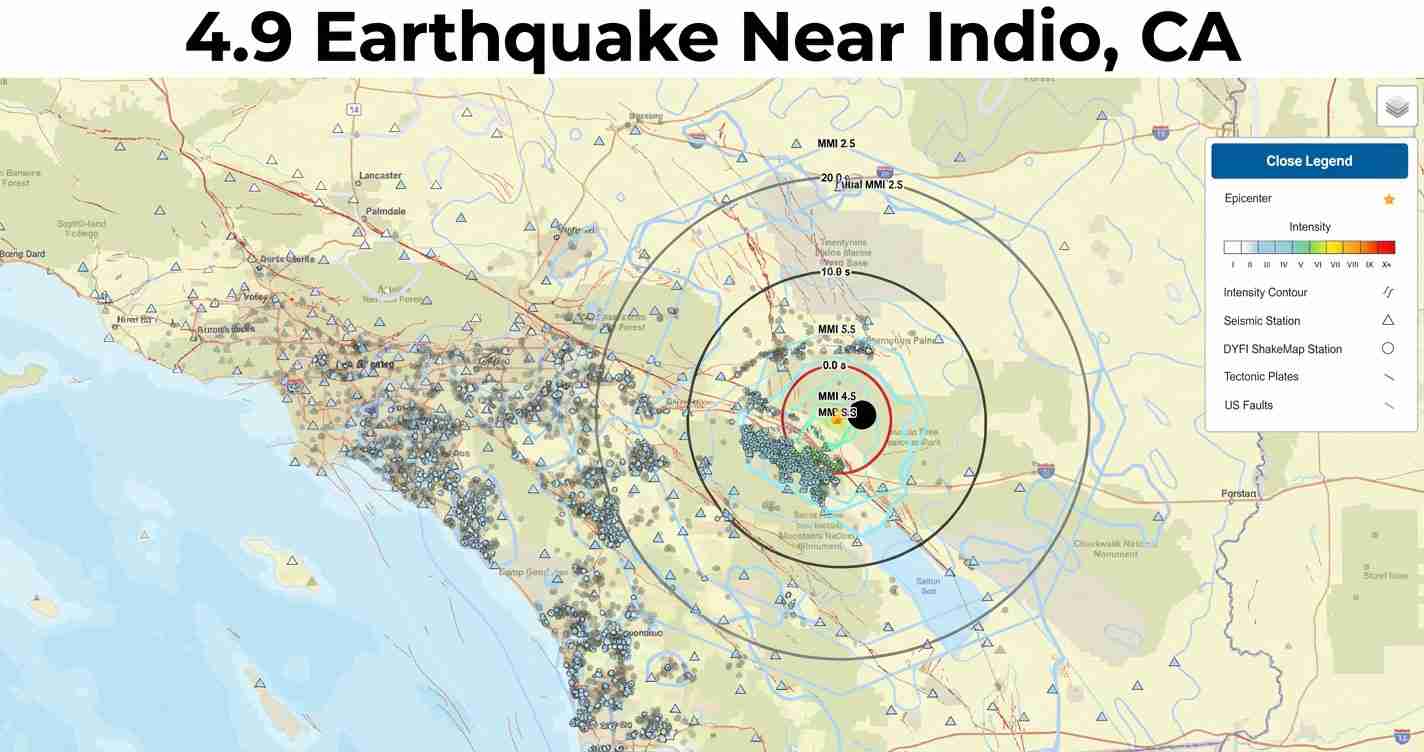
A 4.9‑magnitude earthquake struck near Indio Hills in Riverside County on Jan. 19, 2026, at about 5:57 p.m. PT, followed by multiple aftershocks felt across Southern California; officials reported no injuries or major structural damage.
- Main shock: 4.9 magnitude near Indio Hills at ~5:56–5:57 p.m. PT (USGS preliminary revisions reported).
- Aftershocks: A rapid sequence — four quakes in roughly five minutes; largest aftershock ~3.4 magnitude.
- Wide reach: Felt across Southern California, from the California‑Mexico border to Thousand Oaks; >3,000 “Did You Feel It?” reports.
- Impact: No reported injuries or major structural damage; minor household disruptions (fallen items, shifted frames).
What happened: sequence and early revisions
At about 5:56–5:57 p.m. Pacific Time on Monday, Jan. 19, 2026, a shallow earthquake struck near Indio Hills in Riverside County. Automated early readings varied as seismologists analyzed data — initial automated reports showed near 5.1, later revised to 4.6, and then updated to 4.9 as analysts refined the record.
Seismic details and aftershocks
USGS-tracked reports and regional media recorded a rapid sequence of temblors. Four earthquakes were recorded within roughly five minutes; the largest aftershock measured about 3.4 magnitude, with others near 3.3 and 2.9. Many residents reported feeling multiple jolts in quick succession.
More than 3,000 people submitted “Did You Feel It?” reports to the USGS by about 6:30 p.m. PT, helping map intensity and reach across the region.
Where the shaking was felt
Reports came from a broad swath of Southern California: Palm Springs, Palm Desert, Indio, Murrieta, Temecula, parts of northern San Diego County and Orange County, and as far west as Thousand Oaks. Many respondents in the Coachella Valley and surrounding areas reported shaking lasting 7–15 seconds.
Damage, injuries and immediate response
Local emergency services and county offices reported no injuries and no significant structural damage. Observed effects were mostly minor: items knocked from shelves, picture frames shifted, and momentary power or alarm disturbances in some spots. Authorities conducted routine infrastructure checks in the hardest-hit neighborhoods.
Regional seismic context
The Indio area lies within a complex network of faults linked to the San Andreas Fault system. Seismologists noted an uptick in activity compared with long-term averages over the past year, including several quakes above magnitude 3.0 in the 10 days before Monday’s event. Clusters and elevated swarms are being monitored.
Implications for California
Economic: Short-term economic effects appear minimal given the lack of major damage; however, repeated small quakes can increase maintenance needs and inspection costs for older structures and infrastructure.
Political: The event highlights the need for pragmatic investments in resilient infrastructure and emergency planning. Local officials may be pressured to prioritize targeted inspections and reinforcement programs while balancing budgets.
Social: The temblor underscored the value of preparedness — community interest in emergency programs, drills and supplies may rise.
Practical actions for residents
Officials and emergency experts recommend low-cost preparedness steps: secure tall furniture to walls, store heavy items on lower shelves, maintain a small emergency kit with water and medicines, and review family communication plans. Property owners should consider targeted inspections and retrofitting where feasible.
Reporting and sources
This article draws on seismic data and local reporting, including USGS-based coverage from regional outlets. Key sources include CBS Los Angeles, the Los Angeles Times, and a regional aggregation and briefing.
Key data points preserved: main shock ≈ 4.9 magnitude; shallow depth (~2 miles); epicenter roughly 5–12 miles northeast of Indio; aftershocks ~3.4, 3.3, 2.9; >3,000 USGS “Did You Feel It?” reports; no reported injuries or major structural damage. For original coverage, see the linked sources above.