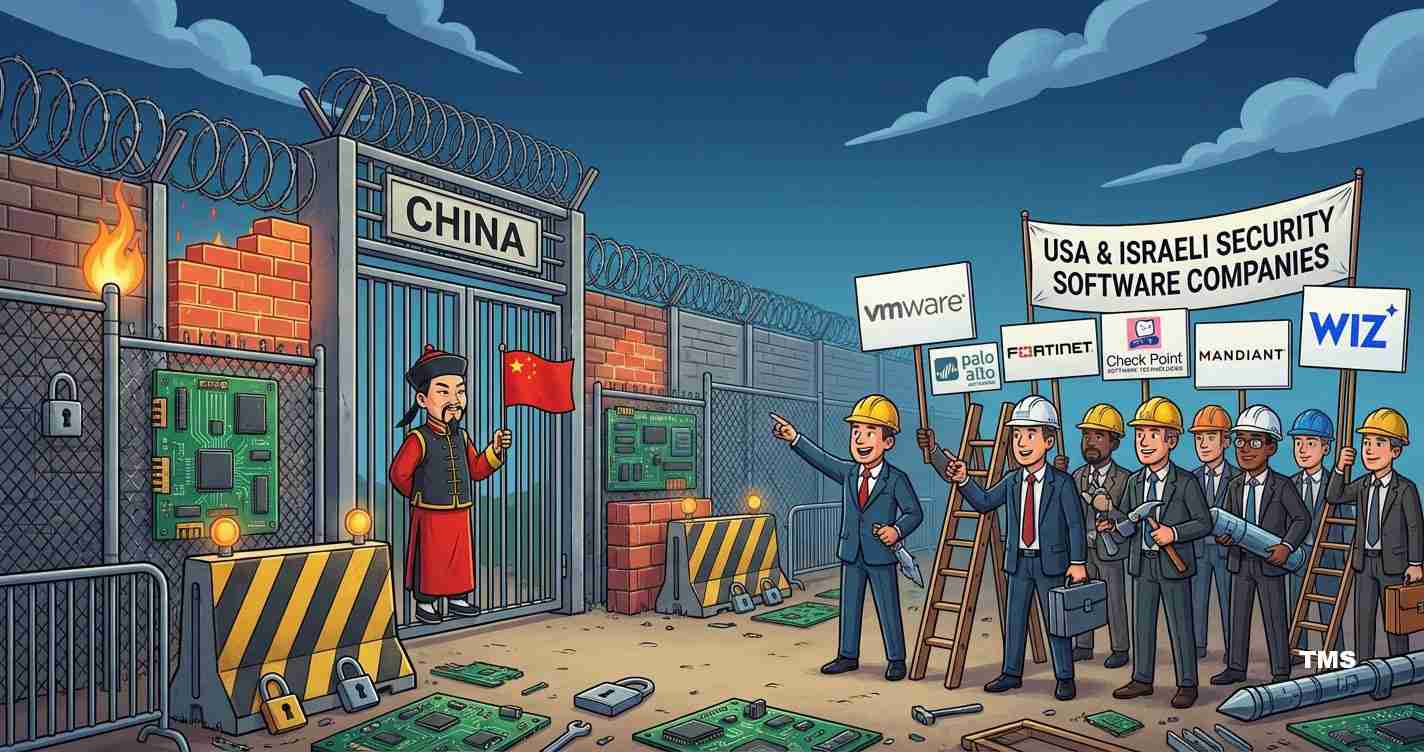
China orders firms to drop cybersecurity tools from more than a dozen U.S. and Israeli vendors, citing national security risks
Chinese authorities told domestic companies to stop using cybersecurity software from more than a dozen U.S. and Israeli vendors, saying the tools could collect and transmit sensitive data abroad — a move tied to Beijing’s push for tech self-reliance.
Key takeaways
- Regulatory notice: Chinese regulators recently asked local firms to phase out or stop renewing products from over a dozen U.S. and Israeli cybersecurity vendors, citing national security concerns.
- Major vendors named: The list reportedly includes firms such as VMware (Broadcom), Palo Alto Networks, Fortinet, CrowdStrike, Check Point and others.
- Strategic aim: Beijing frames the move as protection against data exfiltration and espionage and as part of a broader push to favor domestic suppliers and reduce Western dependencies.
- Reporting limits: Coverage relies on unnamed sources; outlets said they could not independently confirm the full scope or enforcement details at the time of reporting (Fox Business, The Jerusalem Post).
What was ordered and who is affected
Reports say regulators issued a notice in recent days asking Chinese companies to phase out or stop renewing security products from the named foreign vendors because of potential “national security concerns.” The directive targets tools across firewalls, endpoint protection, cloud security and threat intelligence services — systems that often have deep access to customer networks.
Vendors reported on the list include U.S. firms: VMware (Broadcom), Palo Alto Networks, Fortinet, Mandiant, Wiz (Alphabet), CrowdStrike, SentinelOne, Recorded Future, McAfee, Claroty and Rapid7. Israeli firms include Check Point, CyberArk, Orca Security and Cato Networks. Imperva, now part of French defense group Thales, was also reported to appear on the list (Fox Business, The Times of Israel).
Why Beijing says it acted
Chinese officials and domestic analysts say the concern is that foreign security software, given its privileged access, could be used to collect data and transmit it overseas or otherwise create espionage risks. The move is portrayed as both a security measure and an economic strategy to bolster domestic suppliers and reduce dependence on Western semiconductors, cloud gear, AI chips and software (The Jerusalem Post).
“Using foreign cyber tools gives external actors potential visibility into critical infrastructure and business secrets,” said Chinese commentary framing the step as protection against hacking and intelligence threats.
Context in the US–China tech rivalry
Analysts view the directive as another chapter in the broader US–China technology competition, where both sides limit access to strategic technologies and encourage supply-chain diversification. The announcement follows other shifts including recent U.S. adjustments to AI chip export policy and ongoing diplomatic engagements ahead of a planned U.S. presidential visit to Beijing in April 2026 (The Japan Times).
Company footprint in China and reactions
Many named vendors maintain local operations. For example, Fortinet is reported to have multiple mainland offices and a Hong Kong presence; Check Point has support teams in Shanghai and Hong Kong; and Broadcom/VMware has multiple locations across China. At the time of reporting, Chinese regulators such as the Cyberspace Administration of China and the Ministry of Industry and Information Technology had not publicly responded, and several vendors had not provided comment to local media (The Times of Israel).
Domestic alternatives and marketplace impact
Beijing has been promoting Chinese cybersecurity suppliers — for example, 360 Security Technology and Neusoft — as alternatives. A rapid shift toward domestic tools could accelerate demand for local vendors and increase their market share, serving regulators’ goals to build national capacity and insulate networks from foreign influence (Table Media).
Broader security and business implications
Cybersecurity firms typically hire former intelligence and military personnel and are granted deep network access to detect threats — that very access is at the heart of Beijing’s stated concerns. Experts warn that a hurried replacement of mature foreign tools could leave defense gaps if domestic products lack equivalent testing or threat intelligence capabilities. The step also raises the risk of reciprocal measures by other governments, further fragmenting global tech markets (The Times of Israel).
Reporting caveats
Coverage of the directive relied on unnamed sources familiar with the notice. Several outlets, including Reuters in related coverage, said they could not independently confirm the exact scope of the notice or how many firms received it. Officials in China and the named companies had not publicly commented at the time of reporting (The Jerusalem Post).
Implications for California, United States
Economic and business impact
California houses many cybersecurity and cloud companies named in reports. Restrictions on sales into China could reduce revenue for firms such as Palo Alto Networks and CrowdStrike, affect stock prices, and slow fundraising in local venture ecosystems. Startups and VCs may shift focus toward U.S. and allied markets.
Security and supply-chain risks
State agencies and large tech firms in California that rely on global vendors may face changes in product roadmaps, localization efforts, and increased compliance costs. Rapid supplier changes could create security gaps if domestic replacements are less mature in areas like advanced threat intelligence and cloud-native protection.
Policy and practical effects
Policymakers may re-evaluate dependencies on foreign vendors and consider incentives for domestic solutions, while companies may need clearer guidance on cross-border compliance. Workers, sales teams, and engineers who handle China business could see contract disruptions, travel limits, and higher legal costs.
Reporting sources
This article draws on reporting from Fox Business, The Jerusalem Post, The Times of Israel, The Japan Times and Table Media, which cited people familiar with the notice and regional reporting.
Reporting note: Outlets said the directive was issued in the days before Jan. 15, 2026, and that independent confirmation of the full scope and enforcement details remained limited at the time of reporting (The Jerusalem Post, The Times of Israel).