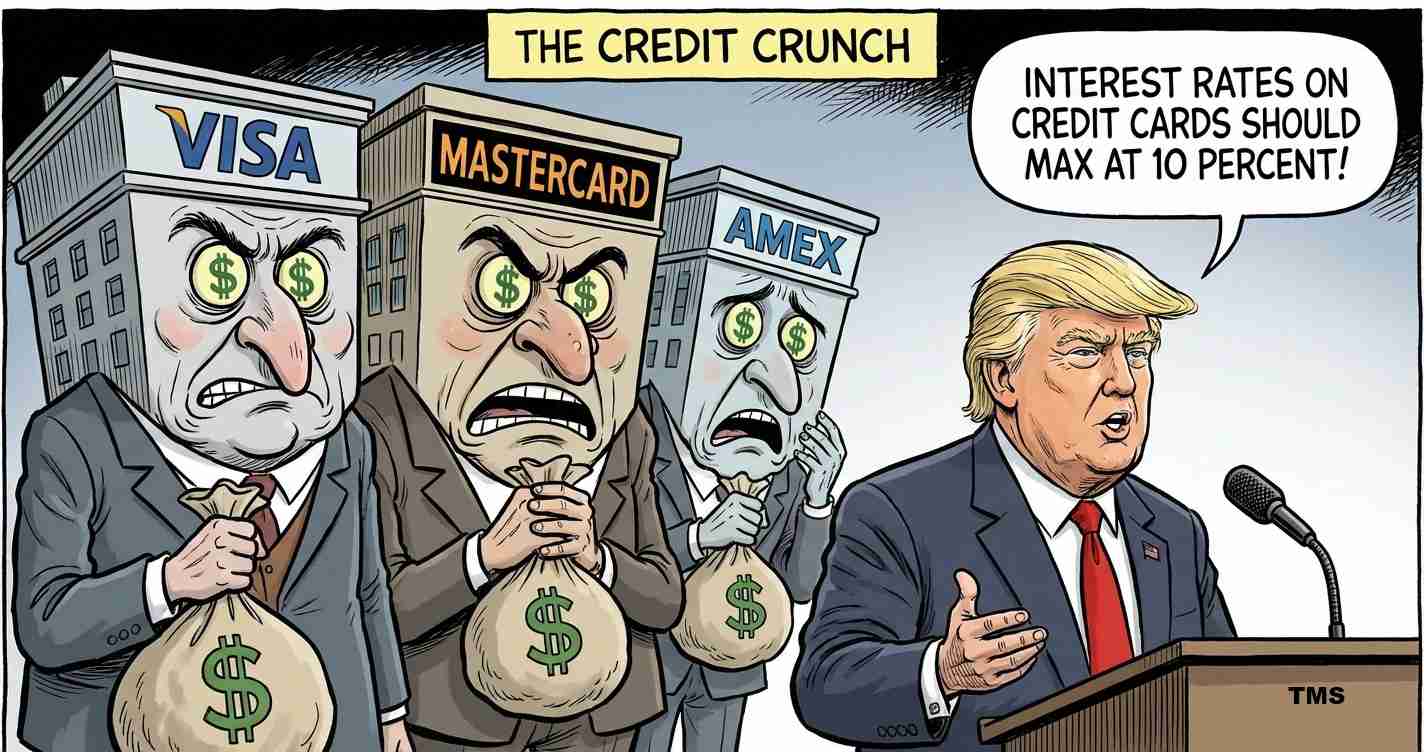
Trump calls for one‑year, 10% cap on credit‑card interest; experts say he lacks unilateral power
Donald Trump called for a one‑year, 10% cap on credit‑card interest starting January 20, 2026, via Truth Social, but experts say a binding nationwide cap would require Congressional action and would face legal and regulatory hurdles.
- Political pledge, not law: Trump’s Truth Social post is a call to action, not an enacted rule — outlets reported the announcement as political messaging (Fox Business, Business Insider, CBS News).
- Legal limits: Experts say a president cannot unilaterally impose a 10% APR cap; Congress or a rule‑making process would be required (Business Insider, Politico).
- Industry warnings: Banks and trade groups say a blunt 10% cap could shrink credit access and push borrowers to riskier alternatives (CBS News).
- Congressional context: Similar bills exist on Capitol Hill but have not become law, leaving implementation uncertain (Business Insider, CBS News).
Key information and original post
Trump posted on Truth Social that credit‑card companies charging 20–30% “festered unimpeded during the Sleepy Joe Biden Administration” and are “ripping off” the American public. He wrote,
“Effective January 20, 2026, I, as President of the United States, am calling for a one year cap on Credit Card Interest Rates of 10%.”
News coverage of the statement appears in Fox Business, Business Insider and CBS News.
What Trump said
In a late‑week Truth Social post, Trump framed the 10% plan as immediate relief tied to his presidency and blamed the Biden administration for allowing high credit‑card interest rates. Reports noted the post presented the pledge as a directive he would pursue as president (Fox Business, Business Insider, CBS News).
Can a president actually impose a 10% cap?
Legal and policy experts say no — not unilaterally. The president can urge action or propose legislation, but a binding nationwide APR ceiling would almost certainly require new law from Congress or a major regulatory rule‑making that would face litigation. Business Insider points out the president “cannot unilaterally impose such a cap; it would require an act of Congress,” and Politico described the authority as unclear without congressional authorization (Business Insider, Politico).
The main federal regulator for credit‑card rules is the Consumer Financial Protection Bureau (CFPB). Any major CFPB rule would require notice-and-comment rule‑making and could be tied up in court. Past actions cutting CFPB funding and questioning its scope raise questions about using the agency to enforce a strict low‑APR rule (Politico, Business Insider).
There is no existing broad federal cap at 10% for the general public; the closest statutory ceiling is the 36% limit under the Military Lending Act for active‑duty service members, not a universal cap (Politico).
Legislative background: similar proposals in Congress
Trump’s demand echoes bills introduced on Capitol Hill. Senators Bernie Sanders (I‑Vt.) and Josh Hawley (R‑Mo.) proposed legislation to cap credit‑card rates at 10% for five years, and in the House Reps. Alexandria Ocasio‑Cortez (D‑N.Y.) and Anna Paulina Luna (R‑Fla.) proposed similar measures. These bipartisan efforts exist but have not become law, per reporting in Business Insider and CBS News.
Current credit‑card rate levels and Biden‑era context
Credit‑card APRs are far higher than earlier in the decade: Federal Reserve data cited by Politico put the average APR at 22.3% as of November, up from about 12.9% in late 2013. CBS News reports average APRs are now over 20% — meaning a 10% cap would represent a large cut for many borrowers.
Economists note that credit‑card APRs generally follow moves in the Federal Reserve’s benchmark rate. Issuers raise variable APRs as funding costs rise and to price borrower risk, complicating direct assignment of blame to administration policy versus broader monetary policy (CBS News).
Reaction from banks and the credit‑card industry
Industry groups warned a blunt 10% cap would shrink credit availability. A coalition including the American Bankers Association and the Bank Policy Institute told CBS News that such a cap “would reduce credit availability and be devastating for millions of American families and small business owners who rely on and value their credit cards.” The Bank Policy Institute estimated more than 14 million households that rarely pay in full could lose or see sharply curtailed access to credit.
Advocacy groups such as America’s Credit Unions and the Electronic Payments Coalition also cautioned that a one‑size‑fits‑all cap could make credit unattainable for many borrowers, pushing some toward less regulated alternatives and reducing consumer choice (CBS News).
Supporters and political response
Supporters say a lower cap would provide relief for families carrying balances and point to trillions in outstanding credit‑card debt. Some progressive and populist politicians noted the message — while others, including Senator Bernie Sanders, criticized Trump for past unfulfilled promises to cap rates. Reporting by Business Insider and CBS News covers the political back‑and‑forth.
How the proposal fits into Trump’s affordability agenda
The credit‑card cap is presented as part of a broader “affordability” push that has included orders to use Fannie Mae and Freddie Mac funds to buy mortgage bonds, limits on large investors buying single‑family homes, and an executive order restricting certain corporate spending. Reporters frame the move as a turn toward populist economic ideas aimed at voters concerned about living costs (Business Insider, CBS News, Politico).
What is not yet clear
Reporters note there is no binding executive order, regulation, or law instituting a 10% nationwide cap at this time. It is unclear whether the administration will pursue a legislative route, seek a regulatory shortcut through the CFPB, or attempt to pressure issuers to voluntarily lower rates. No implementation plan has been released detailing treatment of risk‑based pricing or existing contracts (Fox Business, Business Insider, CBS News, Politico).
Implications for California
Economic impact: Californians carry large shares of household debt and are sensitive to borrowing costs. A 10% cap would cut interest costs for many carrying balances, especially lower‑ and middle‑income households in high‑cost regions such as the Bay Area and Los Angeles. However, if banks reduce credit access, some Californians could lose cards they use for emergencies, cash flow, or small business expenses (CBS News, Politico).
Political consequences: The idea may appeal to moderate conservative voters in California who favor blunt action on “rip‑offs,” but the legal reality that Congress must act — or the plan will face lawsuits — could frustrate voters seeking quick fixes. California leaders and members of Congress may face pressure to favor targeted reforms over a blunt nationwide ceiling (Business Insider, CBS News).
Social effects: Lower APRs could ease budgets for households carrying card debt, but reduced credit access could harm small business owners and gig workers who rely on cards for short‑term cash flow. Vulnerable Californians might benefit more from targeted relief—such as subsidies, debt counseling, or expanded small‑dollar loan programs—than from a blanket cap (CBS News).
Practical applications and next steps
Californians should monitor how any policy effort proceeds. If Congress drafts a bill, state delegations will influence exemptions, time frames, and risk‑pricing rules. If the administration pursues regulatory shortcuts, expect court challenges that could delay relief. In the meantime, consumers should review card terms, shop for lower‑rate products, and consult state or nonprofit credit‑counseling resources while lawmakers debate next steps (Politico, Business Insider, CBS News).
Sources: Fox Business; Business Insider; CBS News; Politico.