
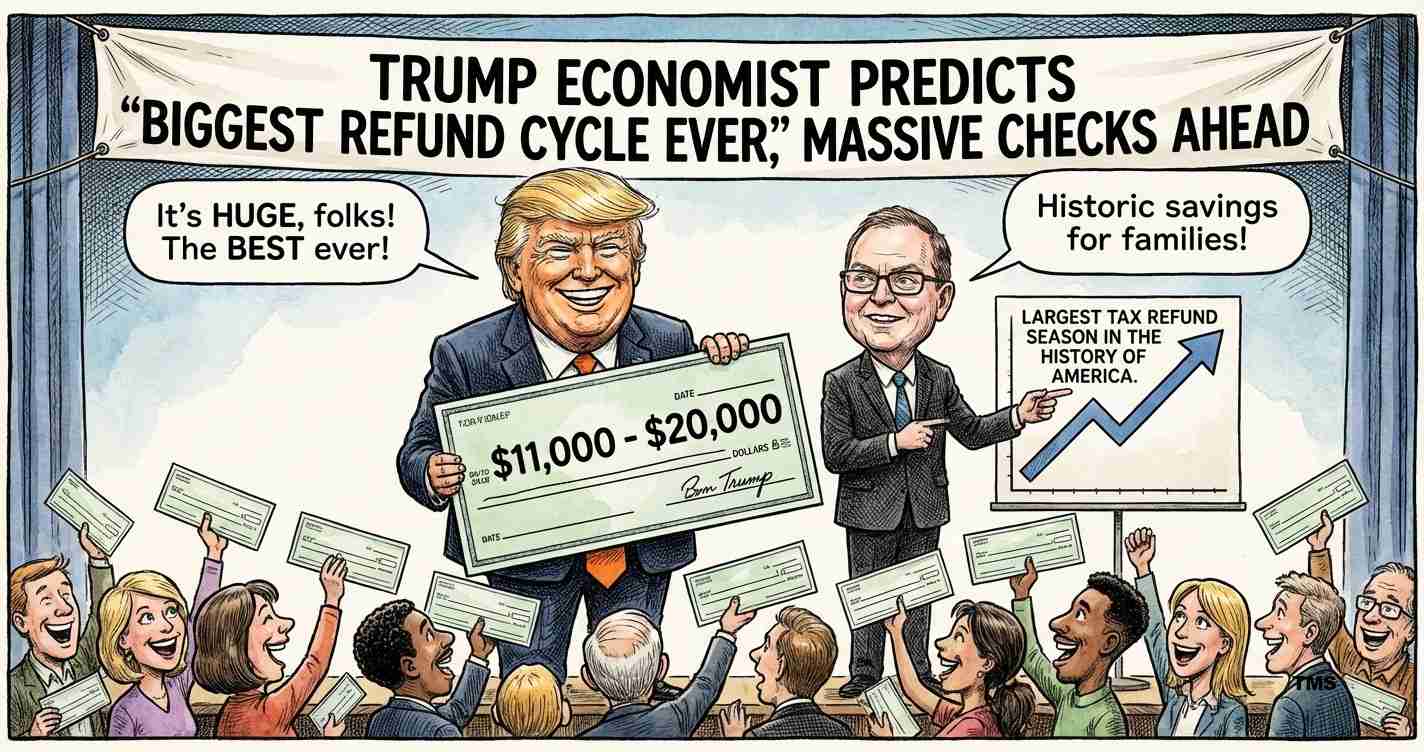
Trump Economist Predicts “Massive 2026 Tax Refunds” After One Big Beautiful Bill Act — Families Could See Big Checks, Experts Say Patchwork of Gains
Kevin Hassett, a top Trump economist, predicts American families will receive “massive refund checks” in spring 2026 — potentially $1,000–$2,000 or more per household — driven by withholding timing and the Working Family Tax Cuts in the One Big Beautiful Bill Act.
- Timing and law changes: The mid‑summer 2025 passage of the One Big Beautiful Bill Act shifted many 2025 tax benefits into refunds when returns are filed in 2026.
- Administration estimates: Officials estimate roughly $1,000–$2,000 per household on average, with some provisions targeting $2,000+ for many families.
- Wide variation: Actual refunds will vary by income, family size, filing status and state taxes — California residents may see lower net gains after state liability.
- Policy implications: Large spring refunds could reshape messaging, household budgets, and short‑term economic activity, though effects may be uneven.
What officials are saying
Kevin Hassett, director of the National Economic Council, told Fox Business that the One Big Beautiful Bill Act (OBBBA) will produce the “biggest refund cycle ever” and “massive refund checks” in spring 2026. Read the Fox Business report: Trump economist predicts biggest refund cycle ever, ‘massive checks’ ahead.
Administration estimates are somewhat narrower than some presidential statements: Treasury officials cited $1,000–$2,000 per household in tax relief, and the White House called 2026 the “largest tax refund season in American history,” citing withholding timing and policy changes. For analysis of the projected refund increases and withholding effects, see the CPA Practice Advisor briefing: Here’s why Americans could see a $1,000 increase in tax refunds next year.
What’s in the One Big Beautiful Bill Act
The OBBBA, passed mid‑summer 2025, changed multiple tax items that affect 2025 tax returns filed in 2026. Because the law passed after many employers had set withholding tables, several benefits are expected to show up first as refunds. Key provisions flagged by tax advisers include:
- Higher standard deductions for 2025: $31,500 (married filing jointly), $15,750 (single), $24,150 (heads of household). Source: Upcoming tax law changes (TurboTax/Intuit).
- Working Family Tax Cuts: Larger Child Tax Credit and other child‑related expansions intended to boost refunds and credits for families. See: CPA Practice Advisor analysis.
- No tax on tips or overtime and reduced Social Security taxation: Provisions that exempt many tips/overtime from federal tax and limit taxable Social Security for many recipients. See: CPA Practice Advisor analysis.
- New deductions and credits: A vehicle interest deduction up to $10,000 (phased out at higher incomes), a higher SALT cap of $40,000 for 2026–2029, and a $1,000 government deposit to Trump savings accounts for eligible children born 2025–2028. Source: Upcoming tax law changes.
- Other changes: End of the Electric Vehicle Credit after Sept. 30, 2025, and inflation‑indexing adjustments to brackets, the Alternative Minimum Tax, and IRA phaseouts. See TurboTax guidance: Upcoming tax law changes. The IRS also posted a summary of OBBBA provisions and timelines: One Big Beautiful Bill provisions.
Why refunds could spike in spring 2026
Tax experts emphasize timing. Because OBBBA passed after many employers set 2025 withholding tables, workers likely paid taxes through the year under old rules and will file under the new rules in spring 2026 — generating larger refunds rather than smaller paychecks during 2025. Analysts including Piper Sandler estimated roughly a $91 billion increase in refunds plus about $30 billion from reduced 2026 withholdings, figures used in White House briefings and public statements. For discussion of withholding timing and estimates, see the CPA Practice Advisor analysis.
Putting the numbers in perspective
There is a range of claims. President Trump has cited much larger household savings in some statements — as much as $11,000–$20,000 annually — while Hassett and other administration officials describe narrower, provision‑specific impacts: an average of $1,000–$2,000 per household and targeted $2,000+ benefits from key changes. Analysts warn that averages mask wide variation; refunds will depend on income, family size, filing status and state tax rules. Sources: Fox Business report and CPA Practice Advisor.
Economic backdrop and political pushback
Hassett framed the refund forecasts as part of a broader economic improvement — citing stronger wage growth, cooler inflation readings and a “blockbuster” November inflation report as evidence of real wage gains. He disputed poll findings showing economic pessimism; a recent Fox News Poll found 44% saying they were falling behind financially and 74% describing the economy as “not so good” or “bad.” See the Fox Business coverage: Trump economist predicts biggest refund cycle ever, ‘massive checks’ ahead.
Quote: “This will be the biggest refund cycle ever,” Hassett said — a claim tied to both policy changes and timing of withholding adjustments.
Tax experts caution that one‑time refunds may be used to pay down debt or cover expenses rather than spur sustained discretionary spending, limiting their macroeconomic impact.
How California taxpayers may see the change
State considerations: California’s separate, progressive tax system means federal refund increases do not automatically translate into equal net gains for residents. High state liability, housing costs and local levies can reduce the practical benefit of a federal refund.
Implications for California
Economic impact
Many California households could see larger federal refunds in spring 2026. For middle‑ and lower‑income families in high‑cost metros like Los Angeles or the Bay Area, a $1,000–$2,000 federal boost could help with rent, childcare or paying down credit‑card debt — though higher state taxes and living costs may blunt the net effect. See CPA Practice Advisor for the refund and withholding estimates: CPA Practice Advisor.
Political consequences
If refunds arrive as projected, Republican messaging about tax relief could gain traction with moderate conservatives in suburban and exurban counties. Conversely, uneven or smaller refunds would allow Democrats to emphasize limits and highlight state supports.
Social effects
Refunds could be used to reduce debt, build emergency savings, or cover one‑time needs. For working families in sectors like hospitality and retail, provisions such as no tax on tips or overtime could provide meaningful relief. Source: Upcoming tax law changes.
Cultural relevance
Framing refunds as support for working families may resonate with Californians who value family support and fiscal responsibility — particularly moderate voters who prioritize both economic stability and targeted relief.
Practical applications for residents
- Timing: Expect the surge when 2025 returns are filed in spring 2026; consult tax preparers if you itemize or have complex withholding.
- State filings: Federal refunds don’t automatically reduce state taxes; ask preparers how to reflect federal changes on California returns. The IRS summary of OBBBA provisions is available at One Big Beautiful Bill provisions.
- Planning: Consider using refunds to pay down debt, build emergency savings, or make one‑time investments rather than treating them as permanent income.
Sources and further reading
- Trump economist predicts biggest refund cycle ever, ‘massive checks’ ahead — Fox Business.
- Here’s why Americans could see a $1,000 increase in tax refunds next year — CPA Practice Advisor.
- Upcoming tax law changes — TurboTax/Intuit tax tips.
- One Big Beautiful Bill provisions — IRS newsroom.
All facts, figures and source links above are preserved from reporting and official briefings.



