Chicago officers say patrol chief ordered them to stand down as federal agents were rammed, surrounded at Broadview ICE facility protest
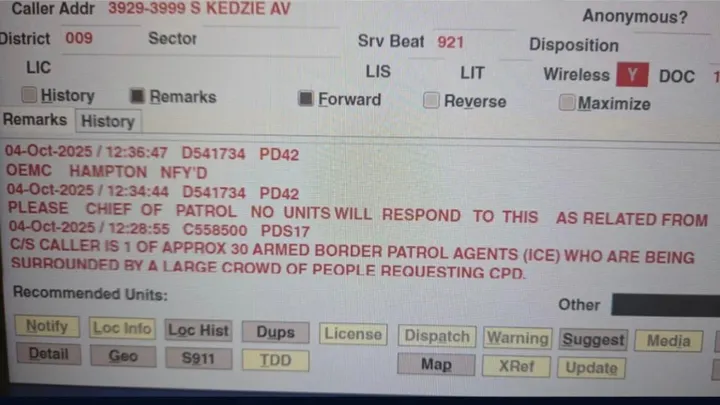
Internal dispatches from Oct. 4, 2025, show a Chicago patrol chief ordered officers not to aid federal agents who were surrounded and attacked near the Broadview ICE Processing Center, prompting outrage and questions about inter-agency response.
- Dispatches allege officers were told to “cover their [expletive]” and not intervene as federal agents were boxed in and struck by a vehicle.
- Federal agents used pepper spray and rubber bullets while at least five demonstrators were arrested amid chaotic scenes.
- Broadview officials have sued DHS/ICE over fencing and launched probes into federal tactics; state-federal tensions have intensified.
- Implications reach beyond Illinois — California jurisdictions and officials are weighing inter-agency policy, legal risk, and community trust.
What the internal records show
Reporters reviewed internal dispatch logs from Oct. 4 that allegedly contain a directive from a Chicago patrol chief instructing officers not to render aid to federal agents operating near the Broadview facility. Sources say the logs include the phrase “cover their [expletive]”, and that officers were explicitly told not to engage as federal vehicles were boxed in.
Video and accounts cited by reporters support that federal vehicles and agents were obstructed by crowds; see the Video footage and internal sources for raw coverage of the clashes.
Violence and crowd dynamics at Broadview
Protesters converged on the Broadview ICE Processing Center after national and local campaigns targeting immigration enforcement. Eyewitness video and reporting show large, heated crowds and at least one incident in which demonstrators rammed an ICE vehicle, temporarily trapping agents.
Federal personnel used crowd-control measures — pepper spray and rubber bullets — in attempts to regain mobility and protect staff. Local press coverage and multiple clips document chaotic scenes of agents pushing through crowds; interpretations differ on whether tactics were necessary or excessive. See the ABC7 Chicago account and additional Video report.
Police presence and the standing order
Chicago police were present, but multiple sources say department leadership imposed strict limits on engagement. Those accounts indicate a patrol chief ordered officers not to step in during confrontations between federal agents and protesters — a move some officers said ran counter to standard inter-agency assistance protocols.
“We had agents surrounded and being assaulted. Then we’re told to cover our [expletive] and stand down. That’s dangerous for everyone on the street.”
Officers speaking on background described fear and outrage; federal officials criticized the lack of local assistance, noting moments when agents appeared isolated while nearby police units held back. See related footage: video.
Legal action and local probes
The Village of Broadview has pursued litigation against federal agencies connected to the processing center, alleging that security fencing and federal operations endangered residents and first responders. Officials have also opened criminal inquiries into protest incidents, including alleged excessive force and reckless endangerment.
At least five demonstrators were arrested during the Oct. 4 protests, while journalists on scene reported being detained or pushed back during federal maneuvers. Local and federal agencies said they will review use-of-force claims as investigators gather evidence; reporting from ABC7 Chicago outlines arrests and legal steps.
Political fallout and competing narratives
The Broadview clash has become a national flashpoint. President Trump publicly urged National Guard deployments to certain cities, while Illinois Gov. J.B. Pritzker criticized some federal tactics as “inhumane” and defended trained local teams aiming to protect First Amendment rights. These competing statements underscore broader tensions over federal intervention and local autonomy.
The incident has renewed debate about cooperation with federal immigration enforcement and the boundaries of local policy, adding strain to inter-agency trust at a politically charged moment. See related video reporting.
Voices inside the Chicago Police Department
Multiple officers and dispatch personnel described the order as unprecedented. Some said it prioritized political or liability concerns over immediate safety, while others defended the decision as adherence to legal boundaries around federal operations.
Supporters of closer coordination warned the refusal to assist endangered both agents and the public; critics argued local police must avoid participation perceived as violating civil rights. The split reflects deeper fractures over how local forces should interact with federal partners.
Documentation and public evidence
Key facts about the Oct. 4 clash are corroborated by video and local reporting. Clips show federal agents confronted by hostile crowds and using less-lethal tools to create space. The Video footage and internal sources and the ABC7 Chicago report form the basis of the internal dispatch review alleging limited CPD intervention.
Implications for California
Economic impact: Federal-local standoffs can disrupt commerce and public services; California communities near ICE sites could face closures, security costs, and litigation expenses.
Political consequences: The Broadview episode may influence California debates over cooperation with federal immigration enforcement and inform state or local policies limiting participation in federal operations.
Social effects & cultural relevance: Community trust and relationships between residents, local departments, and federal authorities may shift — energizing both advocates for immigrant protections and proponents of stricter enforcement.
Practical applications for residents and officials
- Municipal leaders should review mutual-aid and inter-agency protocols to remove ambiguity about assistance during protests.
- Police chiefs and municipal lawyers may need to update training, policies, and public communications to avoid operational confusion in volatile events.
- Community groups and residents should plan peaceful demonstrations with clear safety protocols and stay informed about legal boundaries.