Fire on cargo ship One Henry Hudson at Port of Los Angeles forces full crew evacuation, hazmat teams monitor air quality
An electrical fire aboard the Panama-flagged container ship One Henry Hudson at the Port of Los Angeles Friday evening prompted the safe evacuation of all 23 crew members, while hazmat teams and firefighters worked overnight to contain the blaze and monitor air quality.
- All 23 crew members safely evacuatedPort of Los Angeles news release.
- Fire began as an electrical blaze on a lower deck and spread to multiple decks; explosion reported mid-deck (KESQ coverage).
- Hazmat teams identified hazardous materials in cargo bays; crews used full protective suits and self-contained breathing apparatus while air quality monitoring continued (Inkl).
Key information
Vessel: One Henry Hudson — Panama-flagged container ship built in 2008; arrived from Tokyo with prior calls in Kobe and Nagoya. Source: KESQ.
Time: Fire began about 6:38 p.m.Inkl and KESQ).
Crew: All 23 crew members were evacuated and accounted for by about 8:27 p.m.; no injuries reported (Inkl, KESQ).
Location: Berth at the Yusen Container Terminal, Port of Los Angeles — confirmed by the Port of Los Angeles.
Hazardous materials: Hazmat teams identified hazardous substances in involved bays; crews used full protective suits and SCBAs while continuous air monitoring proceeded (KESQ, Inkl).
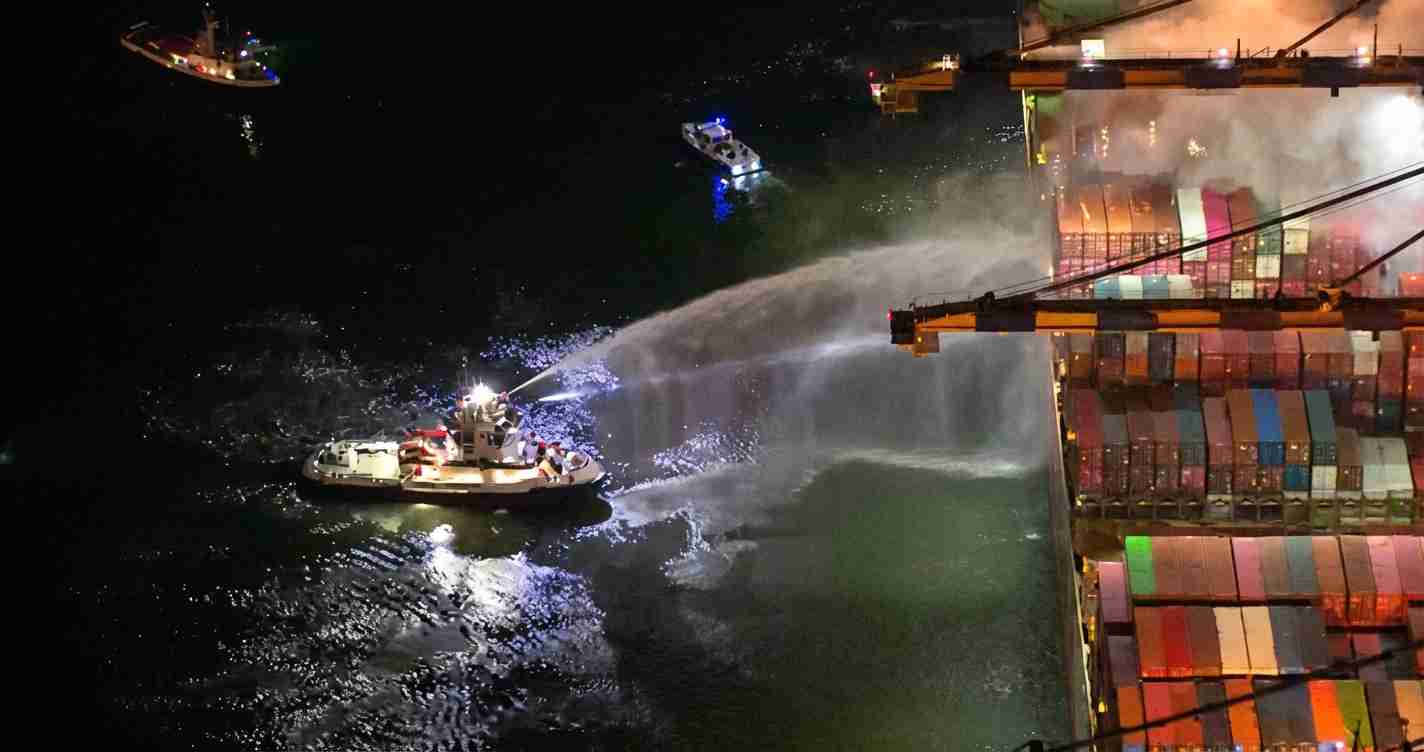
Response: More than 100 firefighters responded; marine units and fireboats cooled the exterior while personnel remained off lower decks (KESQ).
Investigation and operators: Incident under investigation. Ship manager Fukujin Kisen and operator One Ocean Express have not issued detailed statements as of this report (KESQ).
What happened: timeline and immediate response
According to fire officials and port statements, the incident began as an electrical fire on a lower deck at about 6:38 p.m. Local fire crews were dispatched immediately after the ship’s alarms and port emergency teams secured the area. By roughly 7 p.m., flames had moved to multiple levels (Inkl, KESQ).
Shortly before 8 p.m., crews reported an explosion in a mid-deck area. Witness video showed power interruptions and thick black smoke as cranes and nearby operations paused; live footage captured support vessels spraying water on the hull (KESQ, video).
Port and city response
The Port of Los Angeles issued an official statement confirming the fire at the Yusen Container Terminal, noting that fireboats and marine units were cooling the ship’s exterior while crews worked from safe perimeters. Mayor Karen Bass acknowledged city coordination; Governor Gavin Newsom was briefed. Local fire authorities reported dispatching more than 100 firefighters (KESQ).
Hazardous materials and air monitoring
One of the most urgent concerns was hazardous materials in several cargo bays. Hazmat teams identified dangerous substances and required firefighters working near or below deck to wear full protective suits and self-contained breathing apparatus. Authorities initiated continuous air-quality monitoring to detect any harmful emissions (KESQ, Inkl).
Fire officials said the active flames were largely contained to lower decks and hazardous bays; for safety no personnel were allowed below those decks while suppression and cooling continued overnight.
Crew safety and conflicting reports
Early reports suggested some crew members might have been unaccounted for, but port and fire officials later confirmed that by about 8:27 p.m. all 23 crew members were safely evacuated and no injuries were reported. Officials conducted roll-call verification as part of the emergency response (KESQ, Inkl).
Ship details and ownership
The One Henry Hudson is a Panama-flagged container ship built in 2008 that had recently arrived from Tokyo, with previous port calls in Kobe and Nagoya. The vessel is managed by Fukujin Kisen and operated by One Ocean Express. Neither company had released detailed public statements at the time of reporting (KESQ).
Ongoing investigation and unanswered questions
Authorities say the cause is under investigation. Initial findings point to an electrical fire that began on a lower deck, but investigators will review wiring, cargo manifests, maintenance logs and crew statements to determine how it started and why it spread to multiple decks. The mid-deck explosion requires forensic analysis to determine whether it was related to cargo or equipment failure (Inkl, KESQ).
Environmental and operational impacts
Because hazardous materials were involved and air quality monitoring was underway, officials stressed caution. The port reported no public evacuations at the time, but nearby terminal activity and crane operations were disrupted. Cooling and monitoring efforts will continue until authorities deem the vessel secure (Port of Los Angeles, KESQ).
Implications for California
Economic and supply-chain effects
The Port of Los Angeles is a major gateway for goods to California and the western U.S.; hazardous-material incidents that limit terminal operations can create delays, backlogs and higher costs for importers and exporters. Investigations will determine how long the Yusen Container Terminal may operate below capacity (Port release).
Public safety and health
Air-quality monitoring is central to protecting nearby communities. Officials are watching for toxic releases and will notify residents if thresholds are exceeded. Vulnerable populations—children, the elderly, and those with lung conditions—may face higher risk. No public evacuations were ordered as of this report (KESQ).
Local government and emergency preparedness
The incident tested coordination between port authorities, city agencies, state officials and federal regulators. Mayor Karen Bass and Governor Gavin Newsom were briefed; the event underscores the need to review emergency plans for industrial and port incidents (KESQ).
Regulatory and industry scrutiny
Cargo ship fires that involve hazardous materials prompt scrutiny of safety rules, cargo declarations and enforcement. Investigators will review cargo manifests and procedures to determine whether hazardous items were properly declared, stowed and labeled; regulators may push for stricter checks and updated safety systems (Inkl, KESQ).
Practical effects for residents
Nearby residents should expect continued air monitoring updates and possible temporary traffic or terminal restrictions while investigators secure the vessel. Commuters and businesses that rely on port activity may see adjusted schedules. Follow official guidance from the City, the Port of Los Angeles and local air-quality agencies (Port release).
Sources and media
This report is based on coverage and official statements from the following sources:
“Hazmat teams identified hazardous materials in involved bays; crews use full protective suits and SCBAs while air-quality monitoring continues.”
Authorities will release additional information as the investigation proceeds and as ship management and the operator provide statements. Hazmat teams and firefighters remain on scene to manage the fire and environmental risk through the night and into the following days (KESQ, Port release).