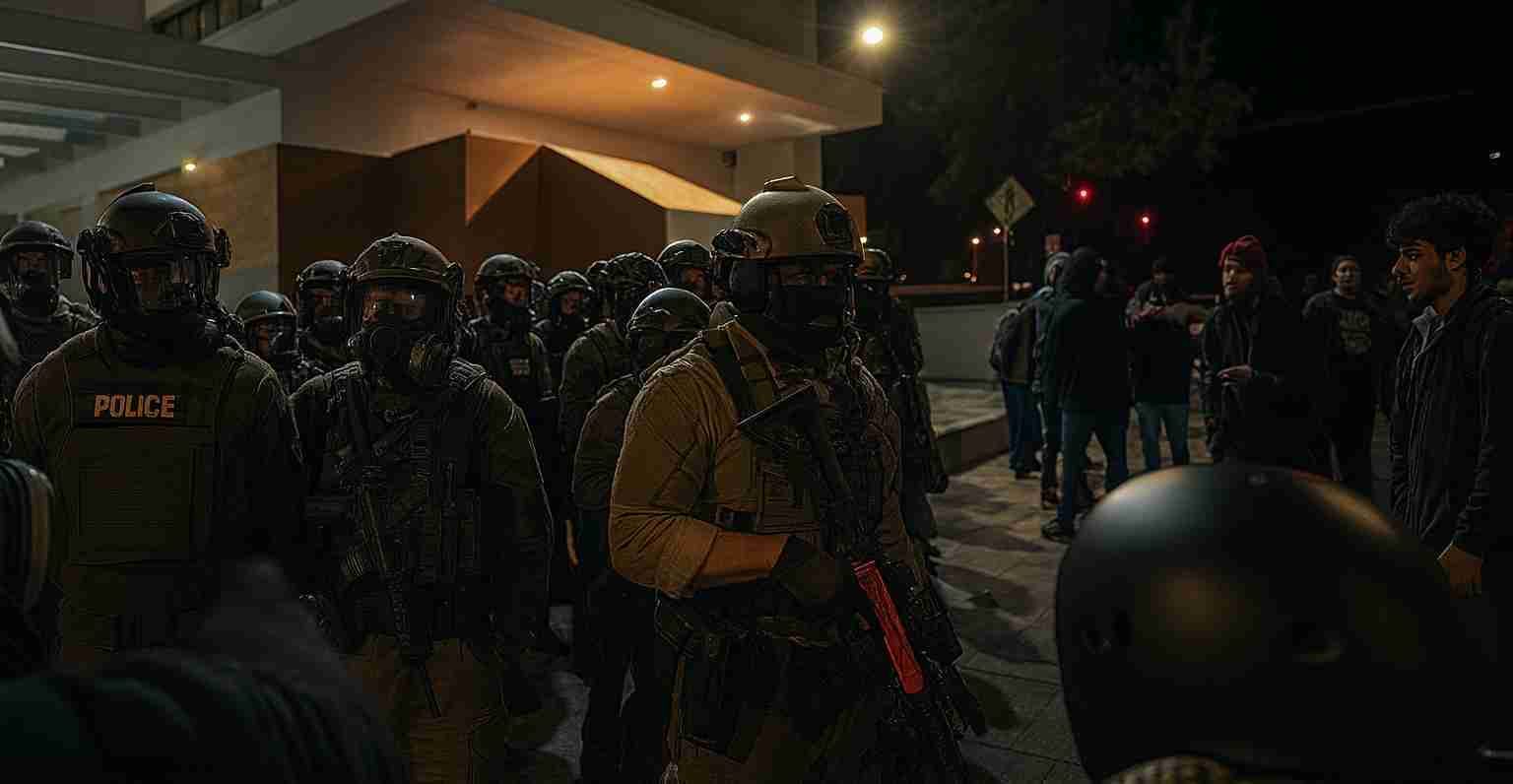
Ninth Circuit Clears Way for Trump Administration to Federalize Oregon National Guard for Portland Deployment
The Ninth Circuit granted a stay allowing the Trump administration to federalize about 200 Oregon National Guard troops for deployment to protect an ICE facility in Portland, reversing a district court temporary restraining order while appeals continue.
- Stay allows deployment: The Ninth Circuit granted a stay enabling federalization and deployment of roughly 200 Guard members to protect the Lindquist Building — Opinion: 25-6268, Oct. 20, 2025.
- Panel composition: A three-judge panel (Ryan D. Nelson, Bridget Bade, Susan Graber) concluded the President likely acted within statutory authority under 10 U.S.C. § 12406(3).
- District court blocked deployment: U.S. District Judge Karin Immergut issued a temporary restraining order earlier, finding the administration had not clearly met the conditions for federal intervention — reporting by OPB reporting.
Background
President Trump ordered federalization of about 200 Oregon National Guard members for a 60-day period to protect the Lindquist Building, an Immigration and Customs Enforcement facility in Portland, amid repeated protests and clashes. Oregon officials and the City of Portland challenged the move, arguing conditions required for federalization — such as insurrection or the inability of state forces to enforce federal law — were not present (Ninth Circuit opinion).
District court action
U.S. District Judge Karin Immergut issued a temporary restraining order blocking the deployment, reasoning the administration had not demonstrated that federalization was justified. The TRO aimed to keep federal troops out of Portland until courts resolved the legal questions (OPB reporting).
Ninth Circuit ruling and legal reasoning
The Ninth Circuit reversed the district court’s TRO and granted a stay pending appeal. The panel applied the “range of honest judgment” standard, concluding the President likely acted lawfully under 10 U.S.C. § 12406(3), which permits federalization of a state National Guard when regular forces are insufficient to enforce federal law (Opinion: 25-6268, Oct. 20, 2025).
“The court pointed to record evidence of ongoing threats to the federal facility and emphasized judicial caution in second-guessing executive judgments on national security and law enforcement.”
Administrative stay and timing
Before the Oct. 20 opinion, the Ninth Circuit issued an administrative stay preserving the status quo: Guard members remained federalized but were not deployed until the panel decided the matter (administrative opinion, Oct. 8, 2025). After reviewing briefs and records, the panel issued a full stay pending appeal that permits deployment while litigation proceeds (Oct. 20 opinion).
Panel makeup and significance
The three-judge panel consisted of two Trump appointees — Ryan D. Nelson and Bridget Bade — and one Clinton appointee, Susan Graber. The mixed appointments highlight that the panel applied precedent on executive deference across appointee lines, stressing judiciary restraint in national security and federal law enforcement contexts (OPB reporting).
Legal standards and statute cited
At the core is 10 U.S.C. § 12406(3), which permits the President to order the National Guard into federal service to enforce federal law when regular forces are unavailable. The Ninth Circuit applied the standard that if the President’s determination falls within a reasonable range and is supported by evidence, courts should not lightly overturn it.
Public safety and federal authority in Portland
The administration argued federal action was necessary to protect federal property and personnel. Portland and Oregon leaders countered local law enforcement remained capable and that federalization risked inflaming tensions. The Ninth Circuit weighed these views and deferred to the executive branch’s assessment in this instance (OPB reporting).
Reactions and stakes
Oregon officials emphasized state sovereignty and local control of the National Guard. Supporters of the federal move contended protecting federal facilities is a basic federal responsibility, particularly when protests target federal property. The ruling raises broader questions about the balance of federal authority and state rights during civil disturbances and is expected to proceed through further appeals.
Implications for California
- Public safety and federal response: California officials will watch closely; the ruling signals the federal government can, under certain conditions, federalize a state Guard to protect federal facilities (Oct. 20 opinion).
- State-federal relations: Governors typically control their Guard unless federalized; this decision narrows unilateral state control in federal matters.
- Political consequences: The precedent may appeal to voters focused on public order while raising concerns among advocates of state sovereignty.
- Operational readiness: California Guard leadership may reassess training and coordination with federal agencies to clarify procedures for potential federalization.
- Practical effects: Residents near federal facilities could see increased federal presence, altered traffic, or changed protest dynamics if similar circumstances arise.
Source documents and reporting
- Ninth Circuit opinion (Oct. 20, 2025), Case No. 25-6268
- Ninth Circuit administrative opinion (Oct. 8, 2025)
- OPB reporting on the case and appeals
Ongoing coverage
Ongoing coverage will track legal filings, any changes in deployment status, and responses from federal and state officials as appeals proceed (Oct. 20 opinion; OPB reporting).