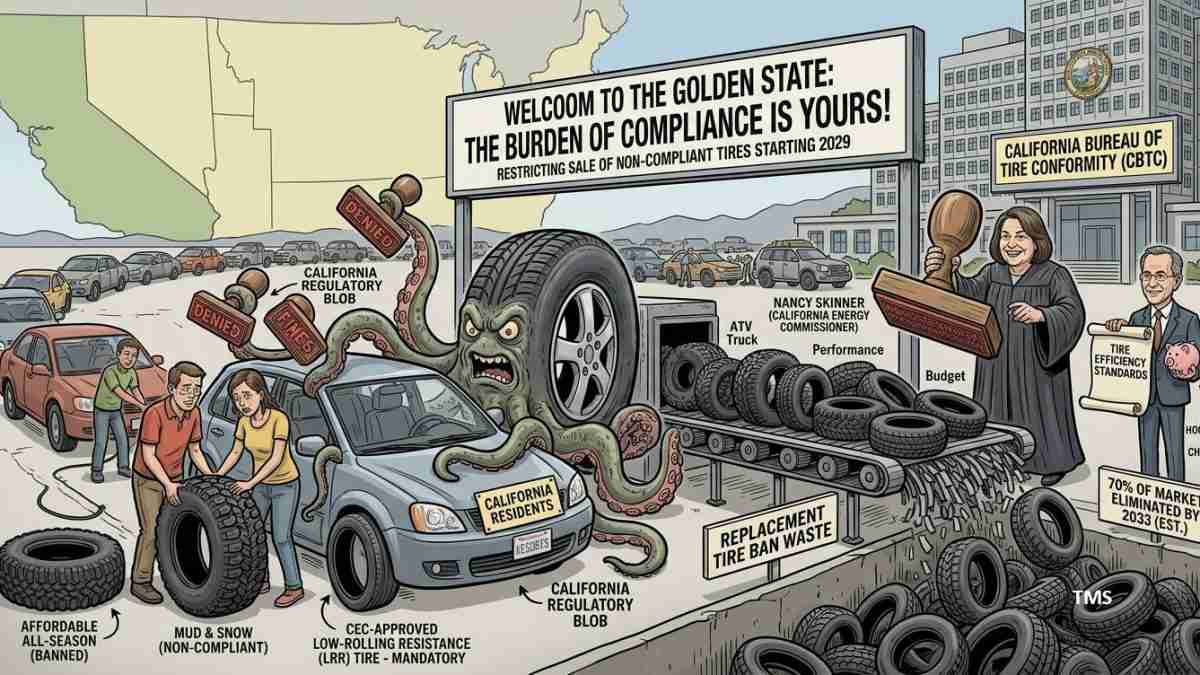
SACRAMENTO, Calif., Aug. 19 (Our California Times) — California drivers will face new limits on some replacement tires beginning in 2029, after the California Energy Commission unanimously approved statewide efficiency rules in August 2026.
The rules are designed to reduce the energy vehicles use to move on the road. They apply to covered replacement tires offered for sale, not the tires originally installed on new cars and light-duty trucks.
What is changing?
The standards measure a tire’s rolling resistance — the energy needed to keep it moving along the road. Tires with lower rolling resistance generally require less energy, which can reduce gasoline or electricity use.
The rules will be introduced in two phases:
- In 2029, covered tires must have a rolling resistance of no more than 9.1 newtons per kilonewton, or N/kN.
- In 2033, the limit will fall to 7.2 N/kN.
The commission says the goal is for replacement tires to be, on average, at least as energy-efficient as the original tires supplied with passenger cars and light-duty trucks.
The commission’s staff tested 537 types of tires while developing the standards. The CEC has projected energy-cost savings of $79 over four months under the first phase and about $153 over seven months under the second phase. Those figures are estimates, not guaranteed savings for every driver, and the available material does not provide the full calculation method.
The rules also include wet-grip requirements intended to preserve traction and safety. The specific wet-grip thresholds were not included in the available information.
Which tires are excluded?
The rules do not cover every type of tire. Reported exemptions include competition tires; winter and some all-season winter-performance tires; used and retreaded tires; deep-tread tires; certain off-road and all-terrain vehicle tires; motorcycle tires; temporary-use and space-saver spare tires; and small tires with nominal rim diameters of 13 inches or less.
Other exclusions include limited-production tires, emergency-vehicle tires, high-load-index tires and tires that cannot sustain speeds above 50 mph.
That means the effect will depend on the vehicle, tire size and type of replacement tire being purchased. The rules do not ban drivers from replacing tires, nor do they apply to tires already installed on vehicles.
Why did California adopt the rules?
The action follows Assembly Bill 844, a 2003 California law directing the Energy Commission to establish or explore tire-efficiency standards.
The CEC adopted the rules under state authority. No separate funding source was identified for the standards in the available material. The commission, tire manufacturers, retailers and vehicle owners will be the main groups involved in putting the rules into practice.
CEC Chairman David Hochschild described the policy as a way to protect consumers and reduce higher costs over time. Commissioner Nancy Skinner said the commission intended the tires available in 2029 to be comparable in quality to the tires installed on new vehicles.
What happens before 2029?
The rules have been approved, but the restrictions do not begin immediately. The first phase is scheduled for 2029, followed by the stricter standard in 2033.
The available material does not specify all enforcement procedures, retailer obligations or how existing inventory will be treated. It also does not establish the source of an estimate that about 70% of tires now sold in California could be excluded by 2033. That figure has been attributed differently in published accounts and should be confirmed against the commission’s adopted rule or staff record.
For now, California’s change is a planned, phased sales standard rather than an immediate restriction on the tires currently on the road. Drivers will still need to choose tires that fit their vehicles and meet safety requirements, while retailers and manufacturers will have to adjust the covered products they offer as the deadlines approach.