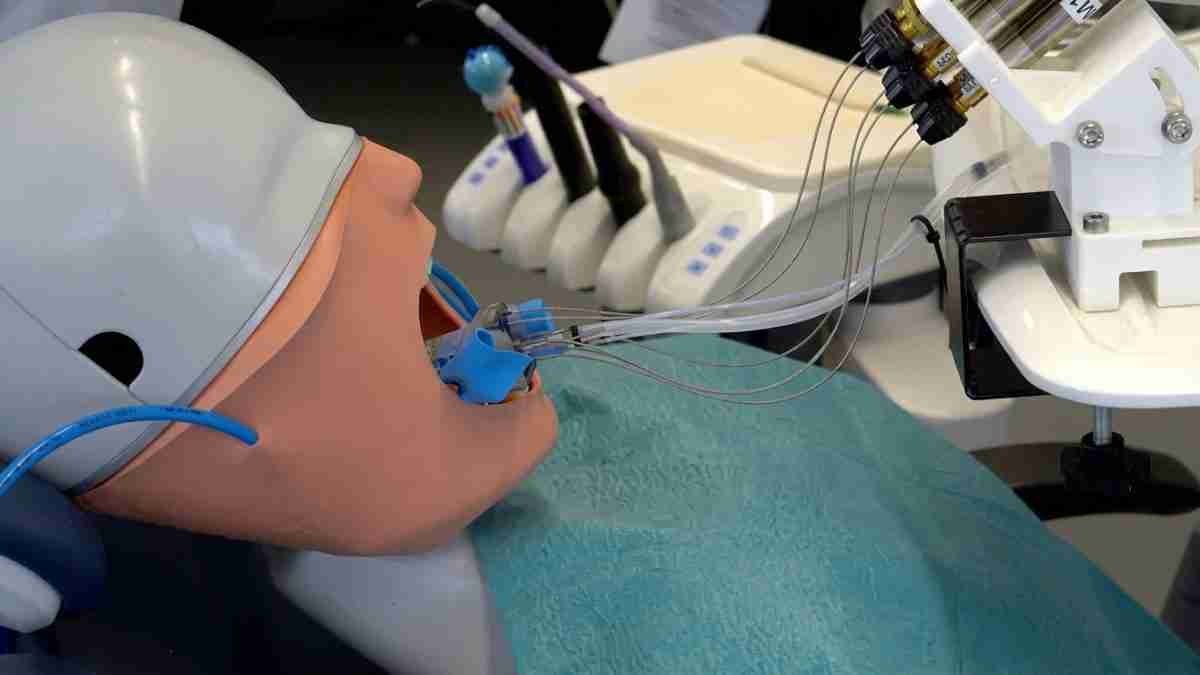
BASEL, Switzerland, July 19 (World Daily Times) — Imagine a crown appointment that takes less time and may need fewer visits. That is the promise behind MIR, a miniature dental robot built by researchers at the University of Basel. For now, though, the device has only been tested in the lab, not in patients, so it is not ready for routine dentistry.
What problem is it trying to solve?
A crown is a cap that covers and protects a damaged tooth. Before a crown can be placed, the tooth usually has to be shaped first. The Basel researchers say MIR could help do that preparation step more quickly and could one day reduce the number of appointments needed.
What is MIR?
MIR stands for Miniature Intraoral Robot. The team describes it as about the size of a wine cork, measuring 43 by 26 by 28 millimeters. It is designed to clip onto a custom dental splint made from a patient’s scan. The motors and controls stay outside the mouth, connected to the robot by flexible shafts, cables, and tubes.
How well did it work?
In the paper published in IEEE Transactions on Medical Robotics and Bionics, the researchers reported tests on synthetic resin tooth models and on a ceramic material with hardness similar to tooth enamel. They reported positional error of less than 0.2 millimeters and drilling forces below 5 newtons. The current version still does not have sensors to directly measure or correct its position, so these results came from a prototype under controlled lab conditions.
Why are researchers interested?
The appeal is not just size. University of Basel research group leader Georg Rauter said the next step is to add sensors and a camera so the robot can track where it is and how the procedure is going, even after a power outage, without making the robot larger. That could make the system more practical for a real dental office if later testing shows it is safe and reliable.
Is it ready for patients?
No. The sources describing MIR consistently call it a prototype, and none report patient trials or regulatory clearance. That matters because a tool can look accurate in a lab and still need much more testing before it is used on people.
What should a reader make of this?
For now, MIR is best seen as an early sign of where dental technology may be headed. If future studies in people go well, a robot like this could help dentists prepare teeth for crowns in less time. But today it remains a research project, not something a patient would encounter in a regular appointment.