Oceanside installs sand fences and native seeds in pilot Oceanside dune restoration to fight coastal erosion
Oceanside launched a pilot dune restoration at Harbor Beach and the San Luis Rey River mouth in late 2025, installing wired wooden sand fences and seeding native plants to rebuild dunes, reduce windblown sand, and create shorebird habitat.
Key takeaways
- Pilot scope: ~10 plots totaling ~1 to 1.36 acres at Harbor Beach, North Strand and the San Luis Rey River mouth.
- Techniques: Wired wooden-slat sand fences and 12-inch cedar shims, followed by seeding with Pink Sand Verbena and native grasses.
- Timeline & monitoring: Work began fall 2025, installations continued into January 2026, monitoring planned through 2028.
Main story
What was installed and why
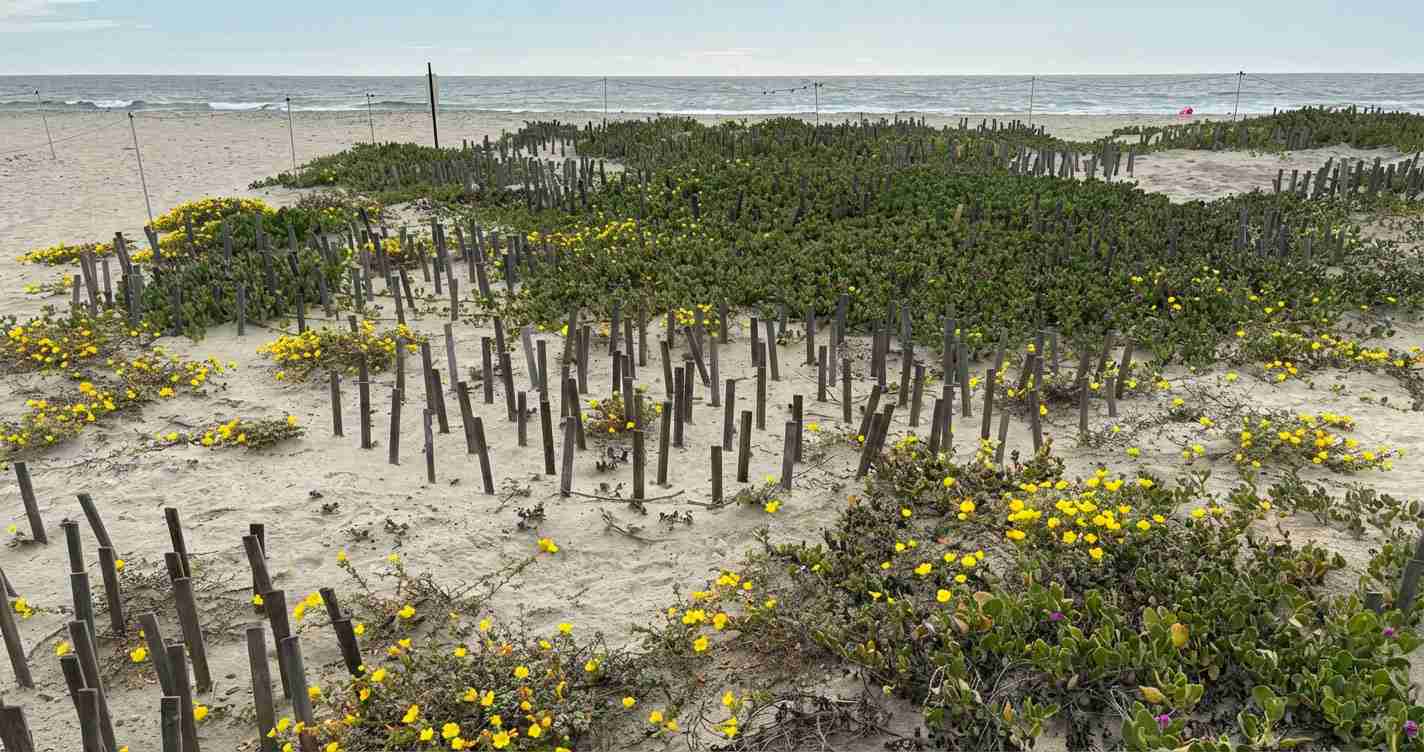
Crews this winter erected short stretches of 4-foot sand fencing made of wired wooden slats and hammered 12-inch cedar shims (small wooden stakes) into the sand at several northern Oceanside beaches. The fences were placed landward of the high-tide line in planned plots to slow wind and trap sand that otherwise blows across sidewalks, streets and parking lots. Over time, trapped sand is expected to form low dunes that can be stabilized with native plants. See the City of Oceanside press release and the CEQA filing.
Officials describe the approach as low-cost, low-tech biomimicry: wired wooden slats on posts to slow wind and cedar shims to help sand settle. Planting native, low-growing species such as Pink Sand Verbena will follow to naturally anchor sand and create habitat for shorebirds and insects. Industry coverage explains the method and local context; see DredgeWire and the City of Oceanside announcement.
Where the work is happening
Four plots were set near the foot of Surfrider Way, north of the Oceanside Municipal Pier, with several more at the mouth of the San Luis Rey River. The overall plan calls for 10 plots covering about one acre, although the environmental filing lists 1.36 acres when all sites are included: Harbor Beach (0.53 acre), North Strand/The Strand (0.07 acre) and the San Luis Rey River mouth (0.76 acre). See the CEQA filing for site-level area figures.
Sites are visible from I-5 and State Route 76 and are near public walkways, parking lots and residences. City crews have placed symbolic fencing and signage at some locations to discourage foot traffic while dune formation takes hold (City of Oceanside).
Plants and sourcing
The pilot will be seeded with Pink Sand Verbena, a native creeping plant that helps hold sand in place. Project documents note seed for the pilot is sourced from Camp Pendleton to ensure genetic suitability to the region. The planting mix will include native grasses and other low-growing species chosen to tolerate salt spray, wind and occasional wave overwash (DredgeWire; CEQA filing).
Timing and monitoring
The pilot began in fall 2025, with installations continuing into January 2026 to take advantage of seasonal winds and wetter months for seed germination. Officials expect visible changes in dune size and vegetation within about a year, and the city will monitor beach topography and plant survival through at least 2028 to evaluate sand-trapping effectiveness and make adjustments as needed (DredgeWire; CEQA filing).
Regulatory and community context
The City of Oceanside is managing the pilot through its Coastal Zone program. The project was filed as a Notice of Exemption under the California Environmental Quality Act (CEQA), Class 33 (Small Habitat Restoration Projects, Section 15333), a classification for hand-based habitat restoration projects not expected to have significant environmental impacts (CEQA filing).
City communications list Jayme Timberlake, Coastal Zone Administrator, as a project contact. Local conservation groups and volunteers participated in planning and outreach. Community advocate Robert Ashton of Save Oceanside Sand summarized the local goal: keep sand on the beach to allow dunes to rebuild naturally and protect the shore
(City of Oceanside; video interview).
Potential benefits and expected outcomes
- Sand retention and dune rebuilding: Fences should trap windblown sand and help form a landward dune ridge that acts as a buffer against storms and high waves.
- Natural stabilization: Native plants’ roots and groundcover will help hold sand in place without hard infrastructure.
- Habitat restoration: Dunes and native plants can provide forage and nesting habitat for shorebirds and coastal insects.
- Cost-effectiveness: Materials and installation are relatively inexpensive compared with seawalls or large-scale beach nourishment.
Questions and points under investigation
While the technique is widely used, practical questions remain as the pilot proceeds:
- Effect on public access: Sand fencing and planted plots can limit beach access in small areas; signage is installed but managing public use without heavy enforcement may be challenging.
- Longevity and maintenance: Dunes can be damaged by storms, foot traffic, dogs, and vehicles. The city plans monitoring through 2028; longer-term maintenance plans are not yet detailed publicly (CEQA filing; City release).
- Measured benefits: Officials will measure sand trapped and whether plots reduce sand encroachment on streets and parking; data collection during monitoring will inform scaling decisions.
- Coastal hazards: Low dunes can be overtopped or eroded in extreme storms; performance under severe weather will inform future planning.
Sources and documentation
Primary sources include the City of Oceanside project announcement, technical and environmental filings on the California CEQAnet, industry reporting at DredgeWire, and video documentation of early site work (video).
Implications for California
Economic and maintenance impacts: For coastal cities facing rising costs to maintain infrastructure near beaches, Oceanside’s pilot offers a lower-cost tool to reduce sand blow onto roads, sidewalks and parking. If plots reduce daily clean-up and mechanical sand removal, local governments could see maintenance savings (City of Oceanside; CEQA filing).
Coastal resilience and policy: Sand fencing and native planting are part of soft-engineering strategies used across California to adapt to erosion without hard armoring. Successful monitoring could encourage other municipalities to adopt similar approaches that balance habitat, access and fiscal restraint (DredgeWire).
Local politics and land use: The pilot’s reliance on proven, hands-on methods and local seed sourcing from Camp Pendleton may build bipartisan support among officials focused on fiscal responsibility and property protection (DredgeWire; City of Oceanside).
Next steps for citizens and officials
Residents are encouraged to watch monitoring reports and attend public meetings to learn about plot performance. Local leaders should track maintenance costs, sand-trapping results and vegetation survival over the three-year monitoring window before scaling up. Contact details for the Coastal Zone Administrator are provided in the project filing.
Reporting note
This article was compiled from City of Oceanside documents, CEQA filings, industry reporting and on-site video coverage: City of Oceanside; CEQA filing; DredgeWire; video.