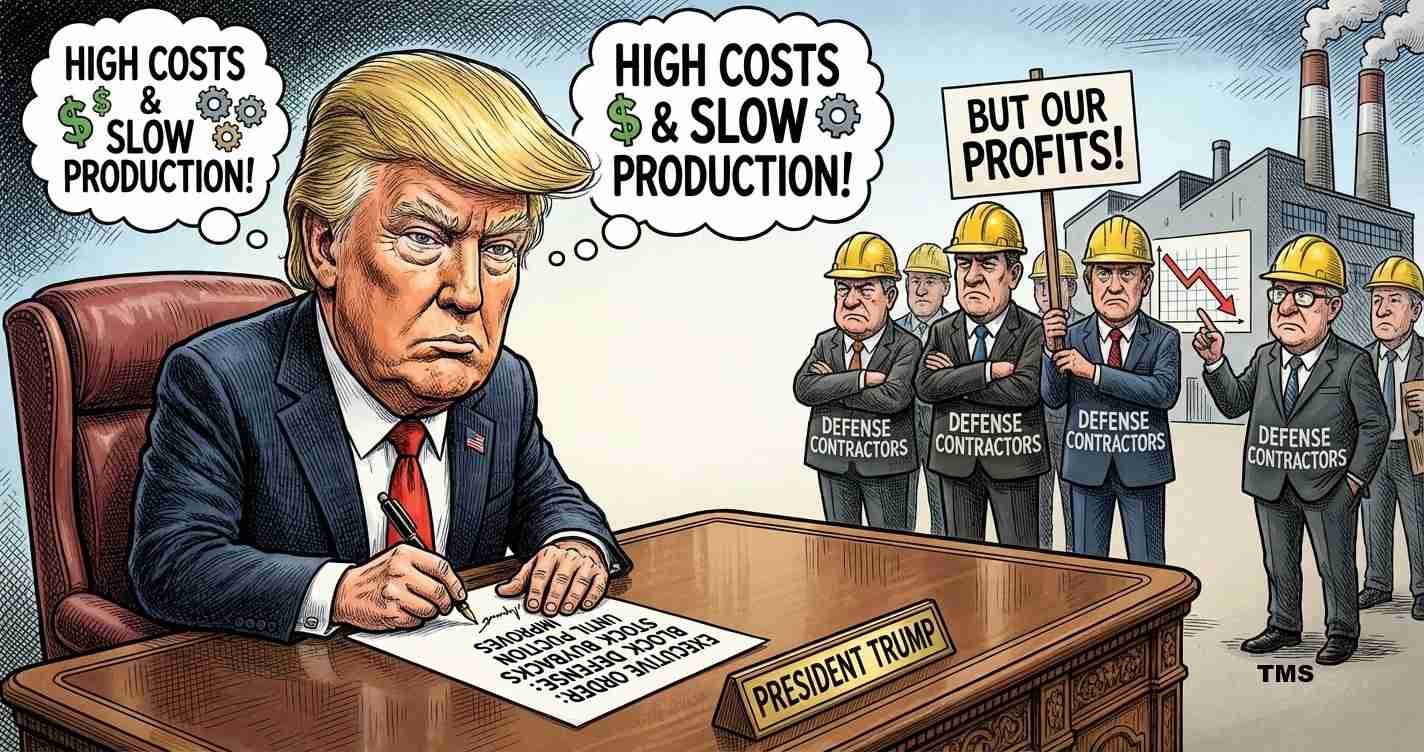
Trump executive order targets defense contractors’ stock buybacks and dividends to force faster production
President Donald Trump on January 7, 2026, signed an executive order restricting dividends and stock buybacks by defense contractors deemed underperforming, tying capital allocation and executive pay to production, delivery performance, and investment in manufacturing capacity.
Key takeaways
- The White House issued an EO that can block dividends and buybacks for firms the Pentagon deems “underperforming” (Breaking Defense; Fox Business).
- Executive pay and contract language will be linked to on‑time delivery, higher production rates and investment in manufacturing (White House; Defense One).
- Market reaction showed sector declines after the announcement, with major contractors trading down in early reports (POLITICO; Breaking Defense).
Main content
How the executive order works
The order directs the Pentagon to identify contractors who are “underperforming” within 30 days. Criteria include failure to invest capital in production capacity, poor prioritization of U.S. government contracts, and slow or late deliveries. For firms labeled underperforming, the administration says they will be blocked from paying dividends or conducting stock buybacks until they meet production and delivery standards. The Pentagon will be required to include no‑buyback/no‑dividend clauses and performance‑linked pay in future contracts (Fox Business; Breaking Defense; White House fact sheet).
Trump’s stated aims and public criticism
In remarks and posts accompanying the order, Trump accused large defense firms of returning cash to shareholders through “massive dividends” and “massive stock buybacks” while neglecting factories and maintenance. He demanded companies build modern plants for production and sustainment. The White House framed the move as part of a broader push to strengthen the industrial base and support a larger Pentagon budget and faster buildup of stockpiles (POLITICO; Defense One).
Which companies are affected
The order targets the defense sector broadly, emphasizing large prime contractors that returned substantial capital to shareholders in recent years. Reporting highlights Lockheed Martin, RTX, General Dynamics and Northrop Grumman as examples of firms with large buybacks and dividends during 2021–2024. The administration says any firm judged underperforming could face restrictions (POLITICO; Breaking Defense).
Market reaction and verification of claims
Market coverage showed defense stocks fell on the news. POLITICO reported the biggest contractors were trading down and noted Northrop Grumman fell about 4% that day. Some precise intraday figures and certain quotes circulating online (for example, naming Raytheon as “the least responsive”) were not found in major outlets or the official fact sheet; the broader criticism of pay and buybacks is well documented (POLITICO; Breaking Defense; Fox Business).
Legal and practical questions
Normally, boards and shareholders decide dividends, buybacks and executive pay. Legal experts say the White House lacks direct authority to dictate corporate boardroom decisions. Administration officials appear to rely on contracting leverage: the Pentagon can require terms in contracts and condition future sales or advocacy on corporate behavior. Analysts warn pressuring a few big firms may not solve deeper supply‑chain and capacity problems; industry leaders caution they may be reluctant to invest without long‑term government commitments (POLITICO; Breaking Defense).
Contrast with Pentagon’s existing strategy
The EO arrives as the Pentagon already uses longer deals and higher volumes to grow capacity. For example, a seven‑year agreement announced before the order aims to more than triple annual Patriot missile interceptor production with Lockheed Martin, showing multi‑year contracts can spur investment. The EO and fact sheet aim to reset incentives by combining carrots (bigger contracts) with sticks (contract conditions) to speed production (POLITICO; Defense One).
Clarifying disputed elements
White House materials and major coverage back the broad thrust of the order: limits on dividends and stock buybacks tied to underperformance and a push to tie executive pay to delivery and investment. However, some specific claims circulating online are not supported in reputable reporting — for example, the attributed line that “Raytheon has been the least responsive” does not appear in major outlets or the official fact sheet. Likewise, exact intraday stock‑move percentages quoted in some versions were not corroborated by the outlets or the White House release (POLITICO; Breaking Defense; Fox Business; White House fact sheet).
Implications for California
Economic impact: California houses major defense suppliers, hardware producers and specialized suppliers across aerospace and electronics supply chains. If the Pentagon enforces no‑buyback/no‑dividend clauses and demands new capital investment, some California plants and subcontractors could see increased work and hiring — benefiting Southern California, the Central Valley and Bay Area suppliers. Firms may delay hiring until long‑term contracts are secured, leaving short‑term uncertainty for workers (POLITICO).
Budget and contracting: California’s defense ecosystem depends on predictable, multi‑year contracts. If the Pentagon pairs tougher contracting terms with multi‑year awards — as with Patriot interceptors — California firms could gain clearer revenue streams. But if the EO triggers legal fights or contract delays, local suppliers could face short‑term drops in orders (Defense One; White House fact sheet).
Political consequences: California leaders must balance support for defense jobs with concerns about government reach into corporate governance. Moderately conservative voters may welcome the push to prioritize production; others may see it as overreach. The issue will shape federal contracting and job growth conversations in the state (POLITICO).
Social and workforce effects: Faster production and manufacturing investment could revive blue‑collar job growth in regions hit by declining manufacturing. Training programs, community colleges and apprenticeships will be critical to fill technician and machinist roles. If companies resist investment without guaranteed contracts, hiring gains may be limited (POLITICO).
Cultural relevance and practical applications: Californians value both innovation and strong national defense. The EO’s emphasis on domestic production aligns with state interests in tech leadership and supply‑chain resilience. Local business leaders should watch Pentagon guidance closely and pursue partnerships to secure multi‑year deals and training funds to make new plants viable (White House fact sheet).
Reporting sources
“The administration says it is prioritizing the warfighter and correcting a pattern of favoring investor returns over production capacity.” — White House materials and reporting