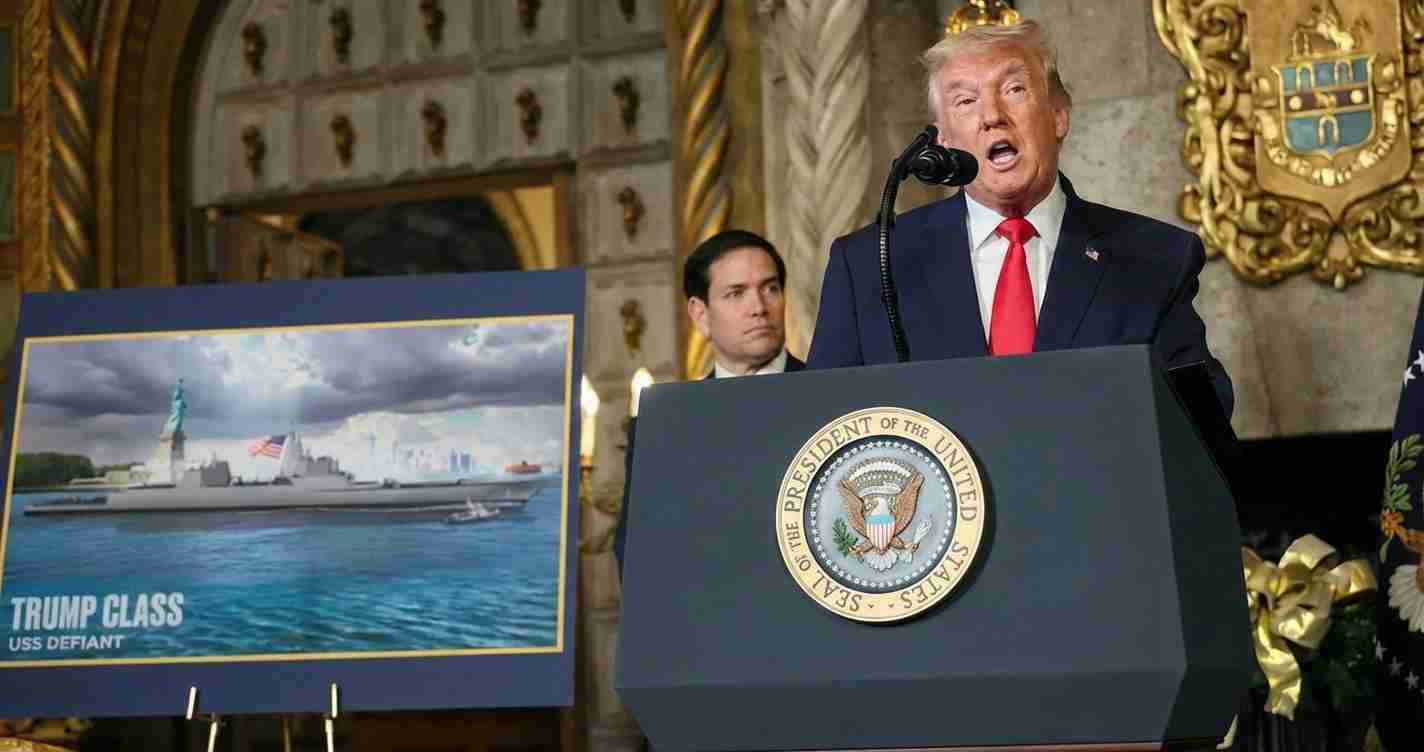
Trump unveils “Golden Fleet,” names USS Defiant battleship as lead ship in sweeping US naval expansion
President Donald Trump on December 22, 2025, announced the “Golden Fleet,” unveiling the USS Defiant (BBG 1) as the lead vessel of a proposed “Trump‑class” of advanced battleships to rapidly expand U.S. naval power and accelerate shipbuilding.
Key takeaways
- Immediate orders: Two ships to be ordered immediately, with plans to scale to 10 and ultimately 20–25 ships total.
- Lead ship: USS Defiant (BBG 1) named as the first of the proposed “Trump‑class” battleships.
- Timeline: Administration target — first two ships within 2.5 years; analysts warn timelines and costs are uncertain.
- Force architecture: Plan includes up to 50 support vessels to sustain and extend fleet operations.
The Golden Fleet initiative
On December 22, 2025, the White House presented the Golden Fleet as a rapid response to perceived shortfalls in ship numbers and naval readiness. The administration framed the program as a way to expand U.S. maritime power and accelerate defense production across the shipbuilding sector. Sources at the announcement included press coverage from Hindustan Times and the official Navy statement linked below as the U.S. Navy press release.
Senior officials and messaging
The announcement featured senior defense and foreign-policy officials, including Defense Secretary Pete Hegseth, Navy Secretary John Phelan and Secretary of State Marco Rubio — underscoring an all-of-government pitch for the program. Administration rhetoric emphasized urgency:
“We’re desperately in need of ships. Our ships are some of them have gotten old and tired and obsolete,”
a remark quoted by media at the event.
The New Battleship Class: USS Defiant (BBG 1)
The centerpiece is a new class of large surface combatants repeatedly described by the administration as “battleships.” The lead ship will be christened USS Defiant (BBG 1), designated the first of the so-called Trump‑class vessels. Officials characterize these platforms as among the most lethal surface-warfare ships outside the submarine force, featuring advanced weapons, sensors and defensive systems — language echoed in the U.S. Navy press release.
Fleet composition and scope
The Golden Fleet plan extends beyond the capital ships. The administration proposes an integrated force that would include up to 50 support vessels tasked with logistics, resupply, maintenance and specialized mission support to increase reach and persistence at sea. Officials describe the architecture as capable across mission sets from sea control and power projection to escort and maritime security.
Procurement schedule and timeline questions
The White House outlined an aggressive acquisition tempo: immediate procurement of two ships, an initial surge toward 10, and a long‑range goal of 20–25 ships. The administration set a target of delivering the first two vessels within 2.5 years. Analysts and industry observers cautioned that new large‑surface combatant programs typically involve lengthy design, testing and production phases, with shipyard capacity and cost estimates central to feasibility concerns (see reporting on schedule scrutiny by Military.com).
Strategic context and policy drivers
The announcement occurs amid long-running debates over how to modernize the surface fleet in a competitive era. Supporters argue that large surface platforms with modern missile and sensor suites can deliver sustained presence and distinct power-projection capabilities. Critics question mission fit and cost-effectiveness given trends toward missile systems, cyber and undersea forces. The administration presented the Golden Fleet as a deterrent-centered response to near‑peer competition.
Prior efforts and program history
Officials noted the pivot follows an earlier plan to build a smaller battleship design that was shelved amid delays and cost overruns; that program had shifted to a modified Coast Guard cutter as a stopgap. Lessons from the prior effort, they say, informed the new emphasis on broader fleet architecture, integrated support vessels and an accelerated procurement posture.
Budget and industrial‑base considerations
The administration did not provide a full cost estimate at the announcement. Building a new class of large surface combatants plus up to 50 support ships will require major appropriations from Congress and a significant industrial ramp-up. Shipyards will need workforce expansion, steel capacity, outfitting docks and testing ranges; availability of trained shipbuilders and specialty suppliers will shape program pacing. Industry and budget documents to come will be closely watched.
Implications for California
Economic impact: California could gain shipbuilding, maintenance and modernization work at major bases and yards, particularly around San Diego. Firms such as General Dynamics NASSCO may compete for program supply‑chain roles, potentially creating thousands of manufacturing and engineering jobs.
Political consequences
Federal contracting and work allocation will involve coordination with California’s congressional delegation and local leaders. Shipyard contract awards could become a partisan and regional battleground as lawmakers seek to steer investment to home‑state industries and labor.
Social and workforce effects
A construction ramp-up would increase demand for skilled trades — welders, pipefitters, electricians — and engineers. Community colleges and apprenticeship programs could benefit from training partnerships; conversely, awards concentrated on the East Coast could limit California gains.
Environmental and coastal considerations
Expanded construction and port activity could raise concerns about emissions, coastal traffic and shoreline impacts. California regulators and environmental groups may influence permitting and mitigation, which could affect timelines for dock expansions tied to the Golden Fleet.
Operational and base impact
San Diego and other Pacific Fleet homeports could see increased use for testing, pre-deployment work and maintenance if Defiant‑class ships are Pacific‑assigned. That would affect dry‑dock demand, deployment cycles and community activity around bases.
Sources and further reading
- Hindustan Times: “USS Defiant to lead Trump’s ‘Golden Fleet’ as new class of battleships announced”
- Military.com: “Trump expected to announce plans for new Navy battleship”
- U.S. Navy press release: “President Trump announces new battleship”