SAVE plan ended: Federal appeals court terminates Biden-era repayment plan, forcing more than 7 million borrowers to shift student loan repayment options
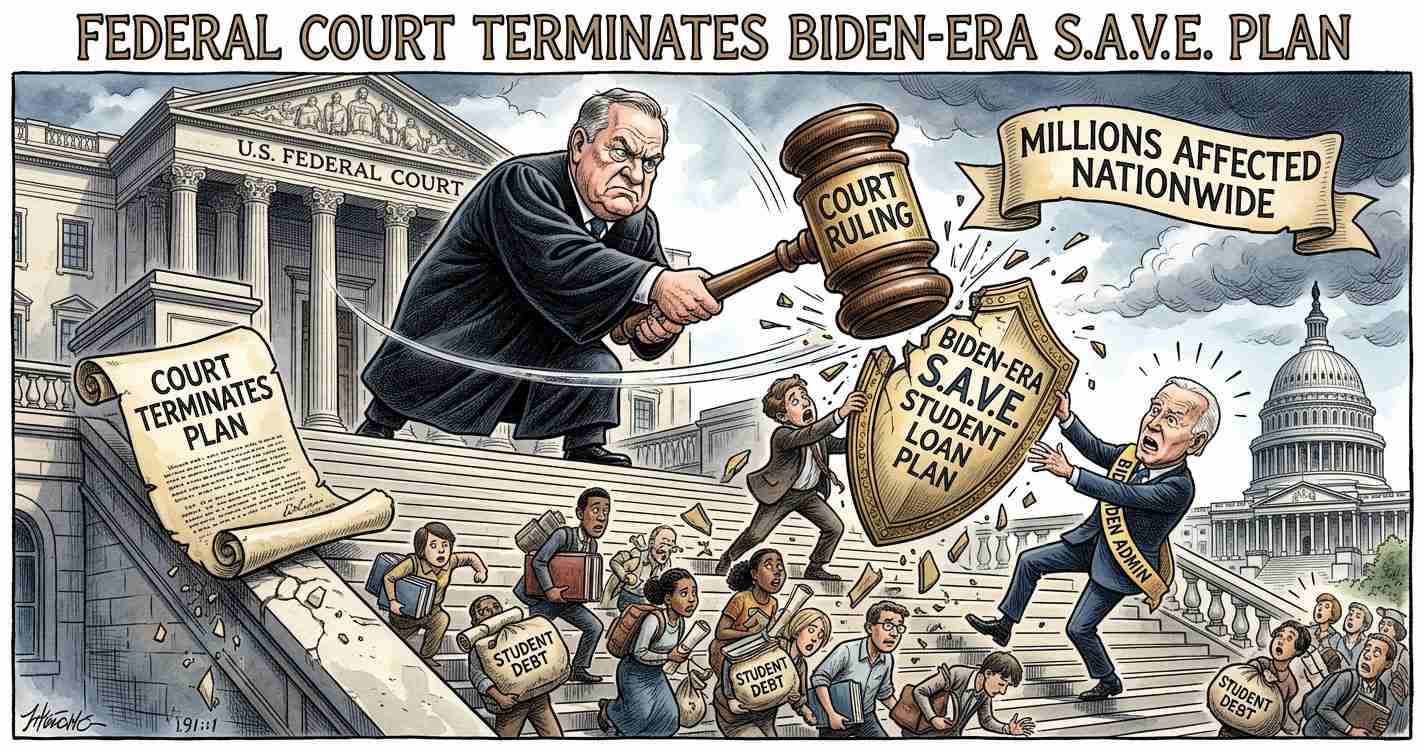
A federal appeals court has terminated the Biden-era SAVE student loan plan, forcing more than seven million borrowers to seek alternative repayment options sooner than expected and accelerating changes to federal loan rules under the One Big Beautiful Bill Act.
- Court action: The 8th U.S. Circuit Court of Appeals reversed a district-court dismissal and ended the SAVE plan, a move documented by TICAS and The College Investor.
- Who’s affected: More than 7 million current SAVE enrollees will be moved to other plans; ED will stop new SAVE enrollments and deny pending applications (TICAS).
- Policy shift: Under OBBBA, a new Repayment Assistance Plan (RAP) begins July 1, 2026, with 1%–10% of AGI payments and 30 years to forgiveness (The College of New Jersey Financial Aid Office).
Background: what SAVE did and how the court action unfolded
SAVE was launched in 2023 and billed as the most affordable federal repayment program ever created. Its signature feature: the Department of Education subsidized unpaid monthly interest so borrowers’ loan balances could not grow—an exception among income-driven plans (TICAS).
Republican-led states, including Missouri, sued. In February a U.S. district judge, John Ross (Eastern District of Missouri), dismissed the challenge, briefly allowing SAVE provisions to remain. On March 9, 2026, the 8th Circuit reversed that dismissal and effectively ended SAVE under a proposed settlement that still requires further court approval (TICAS; background on the district-court action is summarized by the Center for Responsible Lending).
What the Department of Education will do next
The Department of Education (ED) has said it will:
- Stop new enrollments in SAVE and deny pending SAVE applications.
- Transfer current enrollees into other repayment plans; ED plans outreach but has not provided firm timelines.
- Rescind some SAVE-era administrative fixes, which broadened access to income-driven plans and simplified applications—removing them could raise monthly payments or erase progress toward forgiveness for some borrowers (TICAS).
Advocates warn that servicer backlogs and limited ED timelines could delay transfers and account updates for months, leaving borrowers uncertain about payments and eligibility.
Alternative student loan repayment options now in focus
With SAVE ended, borrowers need to compare remaining options carefully. Key plans include:
Income-Based Repayment (IBR)
IBR is available to more borrowers and generally sets payments at 10% to 15% of discretionary income over 20 to 25 years. ED systems were updating to expand access with expected system changes completed in late 2025 (TICAS; TCNJ).
Repayment Assistance Plan (RAP)
RAP, created under the One Big Beautiful Bill Act, takes effect July 1, 2026. It uses a sliding scale from 1% to 10% of AGI, includes a $10 monthly floor for AGI under $10,000, and requires 30 years of payments for full forgiveness. Systems and servicer rules for RAP are still being implemented (TCNJ).
Standard, Graduated and Extended plans
Fixed-payment options remain for borrowers with loans disbursed before July 2026, with terms from 10 to 25 years depending on plan and loan type (TCNJ).
ED recommends borrowers use the Federal Student Aid Loan Simulator to compare scenarios and estimate monthly payments under each option.
Public Service Loan Forgiveness (PSLF) and frozen progress
PSLF remains a pathway to cancel remaining federal loan balances after 10 years of qualifying payments and public-service employment. Borrowers pursuing PSLF should:
- Verify eligibility and submit employment certification forms promptly.
- Document any months when SAVE protections were in effect to reclaim credit where possible.
- Work with servicers and keep records of communications and employment documentation.
Regulatory and fiscal changes tied to OBBBA
The One Big Beautiful Bill Act (OBBBA) introduced major changes that take effect across 2026–2028. Key provisions include:
- New borrowers after July 1, 2026, will generally be limited to the Standard plan or RAP (TCNJ).
- ICR and PAYE will be phased out by July 2028; borrowers who do not switch will be auto-enrolled in alternatives (TICAS).
- Forbearance caps: Forbearance is capped at nine months per two-year period (down from 12) (TCNJ).
- The temporary tax exclusion for forgiven federal student loan debt (American Rescue Plan) could end after 2025, potentially making non-PSLF forgiveness taxable (TCNJ).
Administrative gaps and legal conditions
ED’s transition plans remain incomplete. Negotiated rulemaking has been announced, but precise timelines and system fixes are not yet public. A draft settlement tied to the court action includes a clause requiring 30 days’ notice to Missouri’s attorney general for any monthly forgiveness amount exceeding $10 billion; that notice requirement lapses after 10 years (TICAS).
Experts warn servicer backlogs, unclear enrollment timelines, and sudden payment increases could leave many households scrambling. Surveys show borrowers already reducing essential spending to make payments; losing SAVE’s interest subsidies may intensify financial strain (TICAS).
What borrowers should do now
Immediate steps for borrowers:
- Check your servicer account and messages for official notices; document everything.
- Use the Federal Student Aid Loan Simulator to compare repayment scenarios.
- PSLF candidates: confirm and file employment certification forms now to preserve credit.
- Contact your servicer early, but expect delays; keep copies of payment records and communications.
- Consider professional advice: a financial counselor or tax advisor can help if payments rise or forgiveness may be taxable.
Implications for California
Economic impact: California—home to a large share of U.S. student borrowers—may see reduced household discretionary income and softer consumer spending as monthly payments rise in high cost-of-living metro areas.
Political consequences: State leaders and California’s congressional delegation may face constituent pressure to press ED for clearer timelines. For moderate conservative readers, the ruling raises questions about administrative rulemaking and judicial oversight.
Social effects: Lower- and middle-income Californians could face trade-offs between loan payments and essentials such as rent, healthcare, or children’s education. Nonprofits and local governments may see higher demand for counseling and relief.
Practical steps for Californians: Log in to your federal loan account, use the Loan Simulator, submit PSLF employment certification if eligible, and contact local legal aid or counseling services for help.
Sources and further reading
- The Institute for College Access & Success (TICAS), “Department of Education announces end of SAVE plan; offers little clarity for borrowers.”
- The College Investor, “SAVE student loan plan officially ended by court order.”
- The College of New Jersey Financial Aid Office, “Update on federal loan changes beginning in 2026.”
- Center for Responsible Lending, “Court dismisses case against SAVE plan, restoring affordable provisions.”