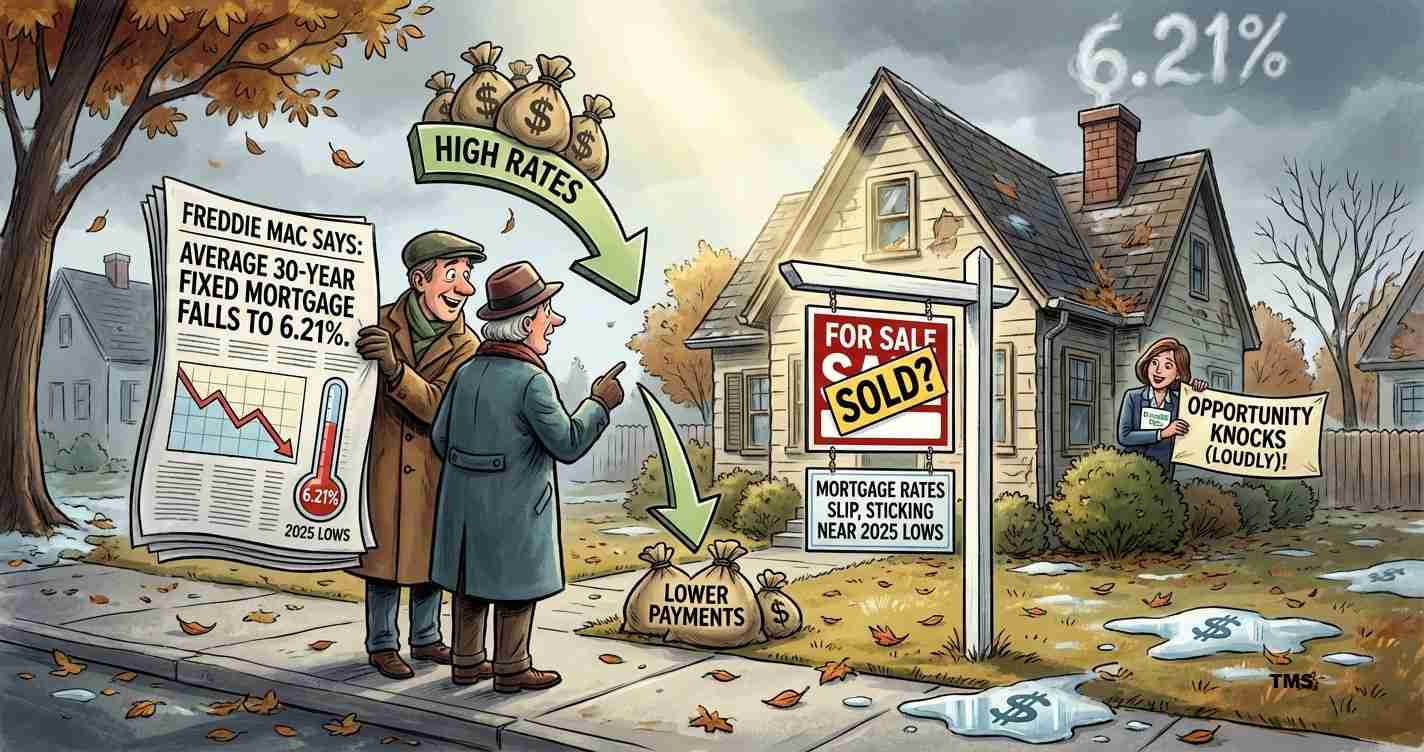
Mortgage rates slip, sticking near 2025 lows as 30‑year rate falls to 6.21%, Freddie Mac says
The average 30‑year fixed mortgage rate fell to 6.21% on Dec. 18, 2025, near 2025 lows, Freddie Mac reported, offering potential relief for homebuyers and refinancers amid a recent Fed cut and moves in the 10‑year Treasury yield.
Key takeaways
- 30‑year average: Freddie Mac’s weekly reading showed a 30‑year fixed average of 6.21% for the week ending Dec. 18, 2025, near the year’s lows — Mortgage News Daily.
- Fed and Treasuries: The Dec. 11 Fed cut of 25 basis points influenced sentiment, but mortgage pricing tracks the 10‑year Treasury, which was about 4.12% in mid‑December — Federal Reserve H.15 and Fox Business.
- Small weekly swings: Daily trackers such as Mortgage News Daily, Bankrate and The Mortgage Reports show similar mid‑December readings below 2025 peaks.
Main content
Key information
Freddie Mac’s weekly primary mortgage market survey showed the 30‑year fixed mortgage rate averaged 6.21% for the week ending Dec. 18, 2025, a 0.01 percentage‑point decline from the prior week’s 6.22% and roughly 0.39 percentage points lower than one year earlier. (Source: Mortgage News Daily.)
Why the shift matters
A move to 6.21% on the benchmark 30‑year fixed mortgage can materially change monthly payment math. For example, on a $500,000 loan, a one‑tenth percentage‑point shift typically alters the monthly principal‑and‑interest payment by about $50–$60, depending on loan structure and escrow items. In high‑cost regions such as much of California, even modest rate improvements can affect affordability and buyer behavior.
Where the numbers come from
Freddie Mac publishes a weekly survey aggregating contract rates reported by lenders. The Dec. 18 reading of 6.21% is drawn from that weekly primary mortgage market survey and is cited in reporting by Mortgage News Daily. Historical context for U.S. 30‑year mortgage rates is available via the Federal Reserve Bank of St. Louis — FRED mortgage series.
“The Dec. 18 reading of 6.21% represents a 0.01 percentage‑point decline from the previous week’s 6.22%,” per the weekly survey reporting.
What’s driving home loan rates now
- The Fed cut and market psychology: The Federal Reserve cut the federal funds rate by 25 basis points to a 3.50%–3.75% range on Dec. 11, 2025, which signaled easing and helped sentiment for lower short‑term borrowing costs — reporting summary at Fox Business.
- Treasury yields dominate: Mortgage rates more closely follow the 10‑year Treasury yield than the fed funds rate. The 10‑year was about 4.12% in mid‑December; movements there strongly correlate with mortgage pricing (see Federal Reserve H.15).
- Bond market volatility & inflation expectations: Traders’ inflation and growth forecasts, plus global demand for U.S. Treasuries, affect long‑term yields. Lower inflation expectations or heavier Treasuries demand can pull yields and mortgage rates down (rate commentary: Mortgage News Daily).
- Product and borrower differences: Government‑backed loans (FHA, VA) and shorter‑term fixed products have shown larger declines and typically remain below conventional 30‑year pricing. Individual offers depend on credit score, LTV, points, and local costs (The Mortgage Reports).
How lenders and borrowers are responding
Lenders constantly monitor Treasury markets. When yields fall and hold, many trim advertised rates and lower the cost of rate locks, but banks factor in profit margins, hedging and pipeline risk. That makes national averages helpful as indicators, yet individual borrower offers will vary.
Refinancers will evaluate time‑to‑break‑even, closing costs, and how long they plan to stay in a home. In California, high listing prices and limited inventory mean that small rate improvements can expand the qualified buyer pool, though supply constraints often limit immediate price relief.
Comparing short‑term readings
- Freddie Mac weekly average: 6.21% (week ending Dec. 18) — Mortgage News Daily
- Mortgage News Daily daily: roughly 6.22%–6.27% across Dec. 17–19 — Mortgage News Daily
- Bankrate daily average: 6.25% as of Dec. 19 — Bankrate
- The Mortgage Reports: partner network showed a conventional 30‑year at about 6.251% on Dec. 19, with FHA and VA averages lower — The Mortgage Reports
- Federal series for comparison: historical mortgage and Treasury yield series are available at FRED and Federal Reserve H.15.
What this means for housing activity
Lower averages near 2025 lows can nudge marginal buyers into the market and make some refinances financially sensible. Real estate agents and lenders may see increased locks or applications if rates remain stable or decline further. Impacts will vary by region, price tier and inventory.
Implications for California
- Economic & housing impact: California’s high prices mean even small rate declines can modestly improve affordability, especially in inland and Central Valley markets. In constrained inventory areas, lower rates can increase buyer demand and potentially lift prices (Mortgage News Daily; The Mortgage Reports).
- Refinancing & budgets: Homeowners with higher‑rate loans may find refinancing attractive; Californians should weigh closing costs and break‑even time given local taxes and insurance expenses (guidance from The Mortgage Reports and Bankrate).
- Policy and construction: Short‑term rate relief may reduce immediate political pressure for affordability programs, but supply constraints (zoning, permitting) remain the structural barrier. Increased demand could support construction and related jobs if supply allows.
- Practical advice: Shop local quotes, compare FHA/VA options if eligible, and evaluate total refinance costs — not just the headline rate.
Sources and further reading
- Freddie Mac weekly primary mortgage market survey data and commentary via Mortgage News Daily
- Fox Business coverage of December mortgage‑market moves: Fox Business
- Federal Reserve H.15 release (Treasury yields, market rates): Federal Reserve H.15
- Historical U.S. 30‑year mortgage rate series (St. Louis Fed / FRED): FRED mortgage series
- The Mortgage Reports rate snapshots (partner network): The Mortgage Reports
- Bankrate daily mortgage rate tracker: Bankrate